The popular version of Mansa Musa's story is designed to travel fast: a medieval African ruler was so rich that he handed out gold on pilgrimage and crashed the economy. It is memorable because it makes wealth visible in one gesture. It is also too blunt. The evidence does not show a man casually breaking the global economy. It shows a ruler of Mali whose 1324-1325 hajj passed through Cairo, impressed Mamluk observers, strained local gold prices in a reported way, and then became a durable image of West African power in Arabic writing and European cartography.[1][2][4]
Correcting the myth should not make the story smaller. It makes it more historical. Mansa Musa's journey mattered because it moved between several systems at once: Islamic pilgrimage, royal diplomacy, trans-Saharan commerce, Mamluk court etiquette, Cairo's bullion market, and Majorcan mapmaking. The crash tale isolates the gold. The evidence asks what the gold did when it met institutions, witnesses, and memory.
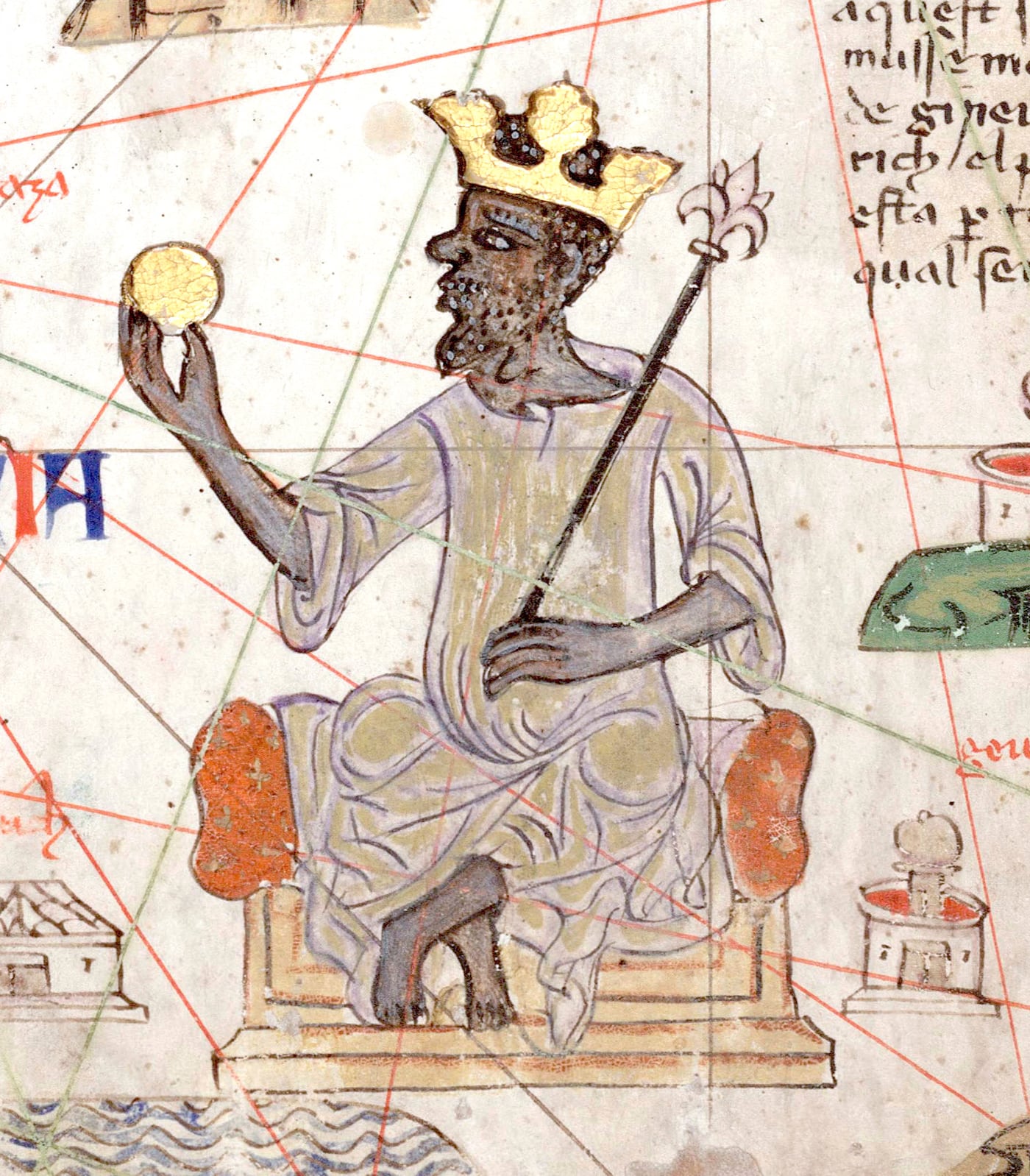
Image context: the cover is a real archival reproduction of the Catalan Atlas detail of Mansa Musa, not a modern diagram, chart, or generated illustration. Its historical value is in the artifact itself: a 1375 Mediterranean map turns a Sahelian ruler into the emblem of gold-bearing West Africa.[2][3]
Myth: Mansa Musa Broke The Economy
The hard core of the myth comes from a real Arabic account. Boston University's African Studies Center reproduces an al-Umari passage, based on testimony collected in Cairo after Mansa Musa's visit, describing lavish spending, gifts to officials, and a fall in the gold price. In that account, Musa's party is said to have brought so much gold into Egypt that the mithqal's value fell from around 25 dirhams to 22 dirhams or less, with the cheapness remembered as lasting for about twelve years.[1]
That is strong evidence for a local shock in Cairo's gold market. It is not the same thing as proof that Musa wrecked Egypt, the Mediterranean, or the "global economy." The account is retrospective, mediated through Cairo informants, and framed by wonder at a foreign ruler's magnificence. Al-Umari's informant wanted readers to understand two things at once: Musa was devout and politically proud, and Cairo profited from the visitors' spending before complaining about the price effect.[1]
The distinction matters. A price movement in a bullion market is historical evidence. A viral claim that one person broke the world economy is a modern exaggeration. The source does not need that exaggeration to be dramatic. It already contains a sharper scene: a West African Muslim ruler arriving in the capital of a great Islamic power and making his wealth impossible for local observers to ignore.
The anecdote has also been important enough to receive a specific monetary-history reappraisal by Warren C. Schultz, whose article title frames the episode as a "world civilizations anecdote" rather than as a settled global measurement.[5] That is a useful warning about genre. A teaching story can preserve a real event while encouraging a scale of certainty the source base cannot bear.
Evidence: The Cairo Story Is About Performance And Protocol
The same al-Umari excerpt complicates the idea of Musa as only a walking treasury. Before it reaches the gold-price claim, the account lingers over court protocol. Musa resisted appearing before Sultan al-Nasir Muhammad because the ceremony would require gestures of submission. When he finally entered, the account says he prostrated himself only by reframing the act as obeisance to God.[1]
That scene is not a footnote. It shows that the hajj was also a diplomatic performance. Musa was a pilgrim, but he was not trying to appear as a subordinate provincial visitor. He was moving through Cairo as a sovereign whose piety and rank had to be negotiated in another ruler's court. His gold worked inside that negotiation. Gifts to treasury, officials, courtiers, and merchants were not random generosity; they translated Mali's distant power into forms Cairo could recognize: honor, protocol, exchange, and spectacle.[1]
This is where the myth loses useful information. If the only question is how much Musa was "worth," the answer collapses into impossible arithmetic. If the question is what the hajj did, the evidence becomes more concrete. It advertised Mali's access to goldfields and trade routes. It created relationships with the wider Islamic world. It made Musa's court legible to people who would repeat the story after he left. It turned West African wealth into a reportable political fact.[1][4]
Myth: The Catalan Atlas Proves A Modern Richest-Man Ranking
The famous 1375 Catalan Atlas detail often gets pulled into the same myth. The image is irresistible: Mansa Musa sits crowned, holding a gold orb, with map lines crossing the parchment around him. Northwestern University's Caravans of Gold project identifies the object as an illuminated parchment atlas made in Majorca, probably associated with Abraham Cresques, and notes that it presents Mansa Musa as lord of Guinea and the richest and most distinguished ruler of the region because of the gold found in his lands.[2]
That is a powerful testimony to reputation. It is not a modern balance sheet. The atlas does not calculate Musa's net worth, compare him with every ruler in world history, or measure Mali's treasury. It translates a known story into a visual grammar familiar to Mediterranean map readers: a crowned monarch, a throne, a scepter, and gold in hand.[2]
The image therefore proves something more interesting than a ranking. By 1375, roughly half a century after the hajj, Mali's gold reputation had traveled far enough to become part of European geographic imagination. The mapmaker did not need to know Mali from inside. The point was that West Africa mattered to long-distance commerce, and Mansa Musa's image made that importance visible at a glance.[2][4]
Evidence: The Map Tells Us How Reputation Traveled
The Catalan Atlas turns economic knowledge into iconography. Gold is not shown as an abstract commodity flow; it is held by a person. Mali is not represented through mining labor, market taxation, or caravan logistics; it is represented through a ruler's body. That compression is exactly why the image remains useful and dangerous. It preserves a European awareness of Sahelian wealth, but it also filters that awareness through foreign conventions of kingship and exotic abundance.[2][3]
The Caravans of Gold exhibition context helps restore some of what the image compresses. The Northwestern Magazine account of the exhibition describes Musa's hajj as one of the great Saharan caravans and places it within a broader medieval system of gold, pilgrimage, scholarship, architecture, and exchange.[4] The article's value is not that it gives a final number for Musa's fortune. It repositions him inside networks: courtiers, servants, camels, Cairo, Mecca, Timbuktu, and the art-historical afterlife of Saharan exchange.[4]
That networked reading is the antidote to the "richest man ever" meme. The meme makes Musa singular to the point of isolation. The evidence makes him powerful because he was connected: to gold-producing regions, to trans-Saharan routes, to Islamic learning, to Mamluk witnesses, and to later mapmakers who made Mali's reputation portable.[1][2][4]
What The Crash Myth Hides
The crash myth hides the labor and governance behind the gold. Mali's wealth did not appear because one ruler carried treasure across the desert. It rested on control over territory, taxation, trade corridors, political authority, and the long-distance demand for West African gold. Musa's hajj dramatized that system, but it did not create it from nothing.[4]
It also hides the source problem. The most vivid written account is not Musa's diary. It is al-Umari writing from information gathered in Cairo after the event, preserved through later scholarly editions and teaching excerpts.[1] The most famous image is not a Malian self-portrait. It is a Majorcan atlas made for Mediterranean audiences decades later.[2][3] Both are invaluable. Neither is neutral. Good history does not discard them; it asks what each source was positioned to see.
Al-Umari could see Cairo's astonishment, court etiquette, commercial windfall, and market complaint. The Catalan Atlas could see reputation as geography: a wealthy ruler placed in the western Sahel so readers would remember where gold came from. Neither source can tell us exactly how to price Musa's total wealth in modern dollars. They tell us how his wealth became news.
A Better Version Of The Story
The better version is this: in 1324, Mansa Musa's hajj made Mali's wealth visible in Cairo at a scale that witnesses remembered through gifts, diplomacy, and a reported fall in gold's local value.[1] In the decades after, that reputation traveled into maps and Mediterranean imagination. By 1375, the Catalan Atlas could make Mansa Musa recognizable as a gold-bearing sovereign even to viewers who had never crossed the Sahara.[2][3]
That version keeps the wonder without letting it flatten the evidence. Musa did not need to break the global economy to matter. He made a West African empire legible to outsiders through the languages they understood: pilgrimage, gold, court ceremony, and maps. The famous gold story is therefore less a tale of accidental economic destruction than a lesson in how power becomes portable. A ruler moves through Cairo, observers tell and retell the scene, a map gives the story a body, and centuries later the image still teaches us that medieval world history did not run only through Europe or the eastern Mediterranean.[1][2][4]
The myth is useful only as a doorway. Once inside, the evidence is richer: not one impossible fortune, but a chain of markets, witnesses, manuscripts, maps, and memories that turned Mansa Musa into one of the most visible rulers of the medieval world.
Sources
- Boston University African Studies Center, "Kingdom of Mali" - classroom source page reproducing al-Umari's account of Mansa Musa's 1324 Cairo visit and the reported gold-price effect.
- Northwestern University Library, Caravans of Gold, "Abraham Cresques (?). Atlas of Maritime Charts (The Catalan Atlas)" - object page for the 1375 Catalan Atlas and its Mansa Musa description.
- Wikimedia Commons, "File:Catalan Atlas BNF Sheet 6 Mansa Musa (cropped).jpg" - archival reproduction from the Gallica Digital Library used as the article image.
- Northwestern Magazine, "A Golden Age: King Mansa Musa's Reign" - exhibition-linked account of Musa's hajj, entourage, gold, and cultural afterlife in the Caravans of Gold project.
- University of Chicago, Mamluk Bibliography Online record for Warren C. Schultz, "Mansa Musa's Gold in Mamluk Cairo: A Reappraisal of a World Civilizations Anecdote" - bibliographic anchor for the scholarly reappraisal of the Cairo gold anecdote.