The Omaha Platform is easy to flatten into a checklist: free silver, income tax, railroad ownership, postal savings, direct election of senators, land reform, and labor demands. That list is accurate, but it misses the document's real historical logic. Read as a primary source from July 4, 1892, the platform is less a grab bag than a theory of circulation. The Populists argued that money, transport, land, information, and votes had been captured at the points where ordinary people needed them to move.[1]
That is why the document begins with crisis language before it begins with policy. It says the republic is at the edge of moral, political, and material ruin; then it names the channels through which ruin travels: ballot boxes, legislatures, courts, newspapers, banks, mortgages, railroads, landholding, and wage labor.[1] The indictment is sweeping, sometimes overheated, and unmistakably partisan. But its structure is disciplined. The platform does not merely say that farmers were poor or that corporations were powerful. It says that institutions built to connect a continental republic had become tollgates.
The date matters. The People's Party met in Omaha in early July 1892, after Farmers' Alliance organizing and Greenback-style monetary politics had already given many western and southern reformers a shared vocabulary of debt, freight rates, credit, and monopoly.[3] In the November election, James B. Weaver and James G. Field won 22 electoral votes and more than one million popular votes, 8.5 percent of the national total.[4] Those numbers did not make the Populists a governing party. They did make them impossible to dismiss as a local protest. The platform reads like a national argument from people who believed the two major parties had learned to stage conflict while leaving the main machinery untouched.[1][4]
The preamble turns moral outrage into a systems claim
The platform's preamble is famous for its verbal force. It contrasts "tramps and millionaires," invokes the "plain people," and describes both major parties as guardians of a false fight over tariffs.[1] Those phrases can sound like pure denunciation. The closer reading is that the Populists were trying to make different complaints look like one mechanism.
Start with the ballot. The platform says corruption touches elections, legislatures, Congress, and even the bench.[1] It then moves quickly to newspapers, mortgages, labor organization, hired armed force, public debt, national banks, silver, currency scarcity, and railroad power.[1] The sequence is not random. It is a map of blocked representation. If the ballot is intimidated, the newspaper subsidized or silenced, the court captured, the bank empowered, and the railroad unaccountable, then popular sovereignty exists formally but not operationally.
That is the document's central move. The Populists did not reject the republic's constitutional language. They tried to claim it. The platform invokes the Constitution's purposes: union, justice, domestic tranquility, common defense, general welfare, and liberty.[1] In other words, its radicalism comes wrapped in restoration. The party's argument is not that American republicanism should be abandoned. It is that republican language has become hollow when the channels of credit, transport, information, and law are controlled elsewhere.
This makes the platform different from a simple anti-elite pamphlet. It is not only angry at wealth. It is angry at intermediation. The same pattern appears again and again: someone between producer and market, voter and policy, worker and protection, borrower and currency, settler and land has acquired the ability to set terms. Populism here is not just a style of naming enemies. It is a diagnosis of where power sits in a modern economy.
Money is described as a public utility
The finance plank is the most revealing section because it treats money as infrastructure. The platform calls for a national currency issued by the general government only, legal tender for debts, distributed without banking corporations, and connected to the Farmers' Alliance subtreasury idea or a better system.[1] It then demands free and unlimited coinage of silver and gold at 16 to 1, more circulating medium, a graduated income tax, limited public revenues, and postal savings banks.[1]
It is tempting to isolate the silver demand because later memory of the 1890s often narrows Populism to free silver and William Jennings Bryan. But in the Omaha text, silver is part of a broader currency architecture. The Populists wanted more money in circulation because they understood falling prices and tight credit as political problems, not as neutral market weather.[1][3] A farmer selling crops after harvest, paying railroad freight, servicing a mortgage, and buying supplies did not experience money as an abstraction. Money was the medium that determined whether work could be converted into solvency.
The subtreasury idea clarifies the point. The platform imagines a federal mechanism that would put credit closer to producers rather than routing it through private banks and local middlemen.[1] Whether that proposal was administratively plausible is a separate question. Historically, what matters is the premise: the republic could not be democratic if the currency supply and credit system worked as private choke points.
The graduated income tax fits the same logic. It is not presented as a moral add-on after the money plank. It is part of the party's attempt to change how public finance moved through society: less dependence on tariffs and regressive burdens, more pressure on accumulated wealth.[1][3] That helps explain why later Progressive Era reforms could absorb pieces of Populist language even after the People's Party itself declined.[3]
Railroads made monopoly visible because they made distance priced
The platform's transportation section gives the document its bluntest sentence: the railroad corporations will either "own the people" or be owned by the people.[1] That line is memorable because it takes an economic dependency and turns it into a sovereignty problem. Railroads were not just another business in the Populist imagination. They were the system through which distance became price.
For farmers in grain, cotton, livestock, and other commodity markets, the railroad could decide whether a harvest reached market on tolerable terms. Freight rates, rebates, elevator arrangements, and regional discrimination were not abstract antitrust concerns. They touched whether producing more meant earning more or simply feeding a larger machine. That is why the platform groups railroads with telegraph and telephone systems as public necessities for exchange and news.[1]
The inclusion of telegraph and telephone is easy to overlook, but it matters. The Populists understood information as part of market access. Prices, orders, contracts, credit, and political news all moved through communication networks. If those networks were private monopolies, then even knowledge could become unevenly distributed. The platform's public-ownership demand therefore has a larger structure than railroad anger alone. It is an argument that certain networks are too central to citizenship and exchange to be run as private choke points.[1][3]
The document also anticipates a danger inside its own remedy. It says that if government takes over railroads, civil service regulation should prevent the national administration from converting new employees into partisan power.[1] That clause is easy to miss because it sits inside the ownership demand. But it shows the Populists were not naive about state power. They feared corporate domination, but they also feared patronage. Their solution was public control plus rules against turning public control into a party machine.
Land reform ties settlement to anti-monopoly politics
The land plank compresses a long American argument into one paragraph. It calls land and natural wealth the heritage of the people, rejects speculative monopoly, opposes alien ownership, and demands reclamation of excess railroad and corporate holdings for actual settlers.[1] This is not Jeffersonian nostalgia alone. It is a claim about who should benefit from the public domain after railroads, land grants, speculation, and debt had already transformed the meaning of western settlement.
The key phrase is "actual settlers."[1] The platform is not defending open land as empty romance. It is drawing a line between use and enclosure. Land held beyond actual corporate need, or held for speculation, is treated as another blockage in circulation. It prevents people from turning labor into independent livelihood. In that sense, the land plank belongs beside the money and railroad planks. Credit, freight, and land all determine whether production can become independence.
That does not make the platform innocent. Populist language about "the people" often left hard questions unresolved: Black political rights in the South, Indigenous dispossession, immigrant labor, gender, and the racial boundaries of who counted as a full member of the producing public. The Omaha text gestures toward union of labor forces and equal rights, but it does not fully solve those exclusions.[1] A close reading should not polish that away. The platform's power and its limits come from the same habit of speaking in a grand collective voice.
The document's afterlife is not the same as victory
The Populists did not win the presidency in 1892. Four years later, fusion with the Democrats and the free-silver campaign narrowed much of the movement's independent identity.[3] But the Omaha Platform matters because it made a durable grammar for American reform. Its specific demands did not all become law, and some, like national railroad ownership, remained outside the mainstream. Others, including a graduated income tax, direct election of senators, postal savings, and stronger regulation of monopoly power, would echo through later reform politics.[3]
The reason is not simply that the Populists were "ahead of their time." That phrase is too clean. The stronger point is that they named a problem modern politics kept rediscovering: formal rights do not fully describe power when the working channels of economic life are privately controlled. Money supply, credit access, freight, communications, land, and electoral procedure were separate policy areas. The Omaha Platform's historical achievement was to insist that they were connected.[1]
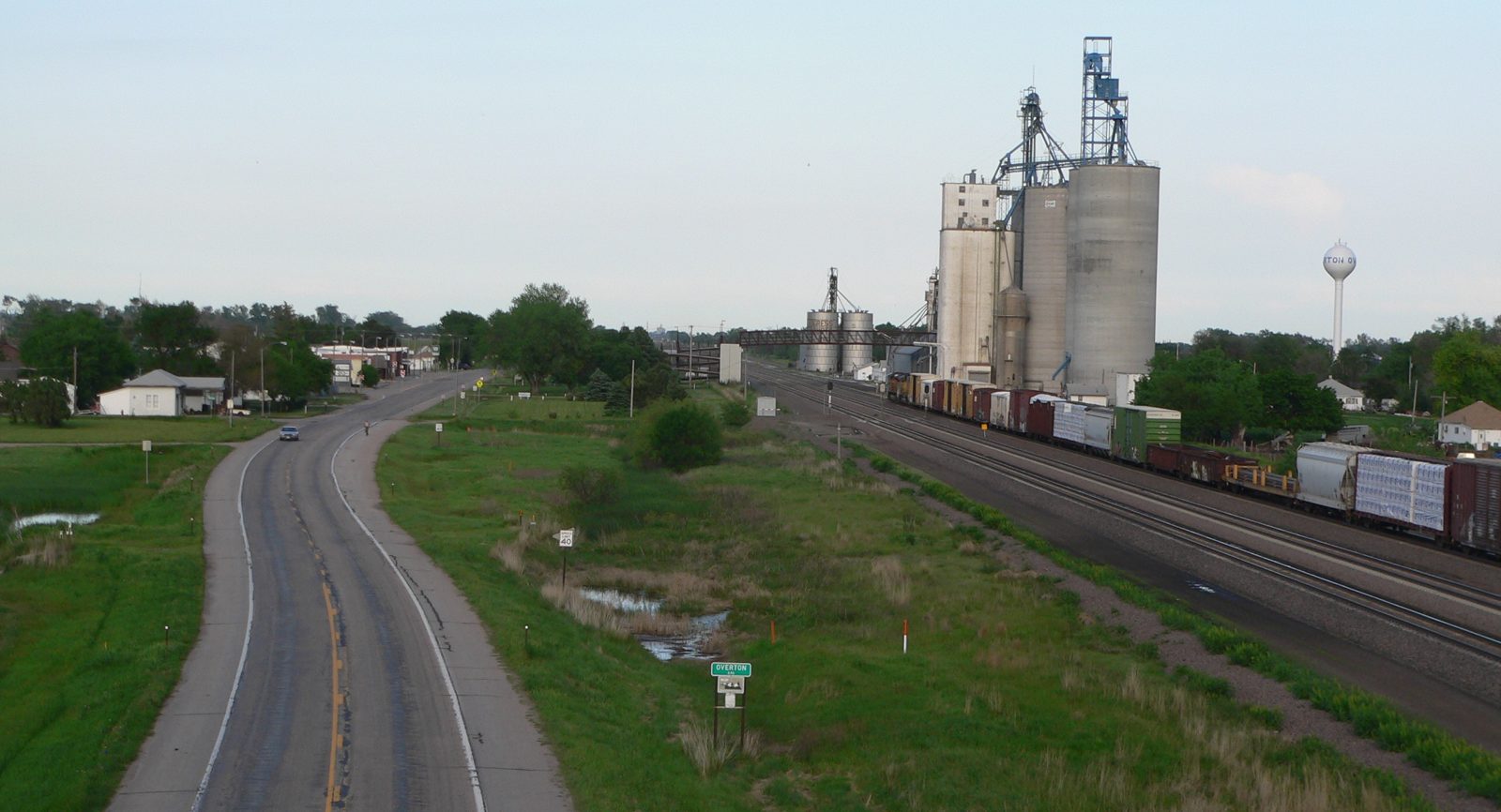
That is why the view across Overton, Nebraska—grain elevator, freight cars, road, tracks, and open land—is more than period atmosphere.[2] It returns the platform's abstractions to the places where they were felt: freight rates at the edge of a crop, credit before a harvest moved, land converted into collateral, and distance priced by companies powerful enough to look like public institutions. More than a century later, that remains the best way to approach the platform itself: not as a list of exotic 1890s demands, but as a primary-source map of where a mass reform movement believed the republic's circulation had been captured.
Sources
- The American Presidency Project, "Populist Party Platform of 1892" (full text of the July 4, 1892 Omaha Platform).
- Wikimedia Commons, "Overton, Nebraska from W" (cover image; railroad, grain elevator, road, and field landscape used as contextual visual evidence).
- Encyclopaedia Britannica, "Populist Movement" (overview of the agrarian reform coalition, demands, and later political afterlife).
- The American Presidency Project, "1892 Presidential Election" (electoral and popular vote results for Cleveland, Harrison, Weaver, and others).