The 1925 serum run to Nome is usually remembered as a race through weather. That is true, but incomplete. The deeper mechanism was a race among three clocks: the clinical clock of diphtheria toxin, the transport clock of a winter supply chain, and the publicity clock that turned one final team into the public face of a much larger system.
That distinction matters because the famous version can make the episode look like one heroic sprint. In practice, the antitoxin reached Nome because territorial officials, rail workers, roadhouse keepers, Indigenous and non-Indigenous mushers, and dog teams converted a blocked port and unusable aircraft into a relay. The system worked by breaking one impossible trip into handoffs small enough to survive the weather.[1][3] The later legend, centered on Kaasen and Balto, preserved the emotional truth of urgency while compressing the operational truth almost beyond recognition.[5][6]
The medical clock came first
Diphtheria made delay dangerous because the disease is toxin-mediated. CDC's clinical summary explains the key mechanism: antitoxin can neutralize circulating toxin, but it cannot reverse toxin already fixed to tissue.[2] In other words, the medicine is most valuable before the disease has advanced too far. That is why the Nome problem was not simply "get medicine eventually." It was "get viable antitoxin there while it can still change outcomes."
The Alaska State Archives summarize the emergency as a 674-mile trail from Nenana to Nome, with antitoxin moved by dog teams through gale winds, whiteouts, and extreme cold, arriving in 127.5 hours without a broken vial.[1] Those numbers are not decorative. They define the transport problem. Nome was isolated by winter sea ice, and the available medicine had to move across interior Alaska faster than a normal freight rhythm would allow.
The clinical clock also explains why the cargo mattered more than the drama around it. The package was not symbolic aid. It was diphtheria antitoxin, a treatment whose value depended on timing, preservation, and prompt administration.[2][3] Once the serum reached Nome and thawed, Dr. Curtis Welch found it usable and treated much of the town; quarantine was lifted later in February.[3] The run's success therefore sits at the junction of medicine and logistics. The right biological tool existed, but it still had to cross a landscape that seemed designed to punish delay.
The transport clock was solved by splitting the route
The fastest answer was not a single champion. It was decomposition. A doctor in Anchorage had antitoxin available, territorial Governor Scott C. Bone approved moving it by train to Nenana, and from there it passed into a dog-team relay.[3] That rail-to-trail transfer is the hinge of the whole event. Rail could solve the first part of the distance. Dog teams could solve the part that machines and ships could not.
On January 27, 1925, the first musher, "Wild Bill" Shannon, took the canvas-wrapped package from the railroad and began the trail portion toward Tolovana.[3] Other teams then carried it onward through the interior and toward the Seward Peninsula. The Alaska State Archives point readers to Governor Bone's correspondence files from January and February 1925, which is exactly the kind of administrative trail a heroic retelling tends to hide: emergency transport required messages, authorization, local knowledge, and coordination before it became a sled line.[1]
The relay format reduced exposure in two ways. First, it limited how far any one exhausted team had to carry the package before another took over. Second, it used people who knew their sections of trail, roadhouses, weather traps, and dog teams. That was not incidental color. It was the operating system. In subarctic winter, route knowledge is infrastructure.
UAF's Geophysical Institute account names the breadth of that system: 20 mushers moved the serum, including Leonhard Seppala and a Native musher known as Jackscrew, who carried a 40-mile section between Kaltag and Old Woman cabin.[3] The point is not to replace one hero with a longer list of heroes. It is to restore the mechanism. Nome was reached because the trip became a chain, and a chain works only if each link is positioned before the previous one fails.
Weather made expertise, not speed, the scarce resource
The popular vocabulary of "race" can mislead. Speed mattered, but so did restraint. A winter trail is not a racecourse in the modern sports sense. Visibility, frostbite risk, dog fatigue, river ice, coastal wind, and the need to protect the serum all mattered at once.[1][3] Going fast in the wrong way could lose the cargo, freeze a team, or break the relay's next handoff.
That is why the 127.5-hour arrival time is best read as a systems achievement rather than a stopwatch trophy.[1] The relay had to keep moving without becoming reckless. It had to use cold as both enemy and preservation context. It had to keep the package intact while moving through conditions that made ordinary transport fail.
This also clarifies why the final leg became more famous than the longest or hardest work. The last arrival is narratively clean: a team enters Nome, the medicine is there, and the crisis has a visible threshold. The middle of a relay is messier. It contains transfers in dark weather, local trail decisions, fatigue management, and the invisible discipline of not losing the package. History often remembers thresholds better than maintenance.
The publicity clock selected Balto
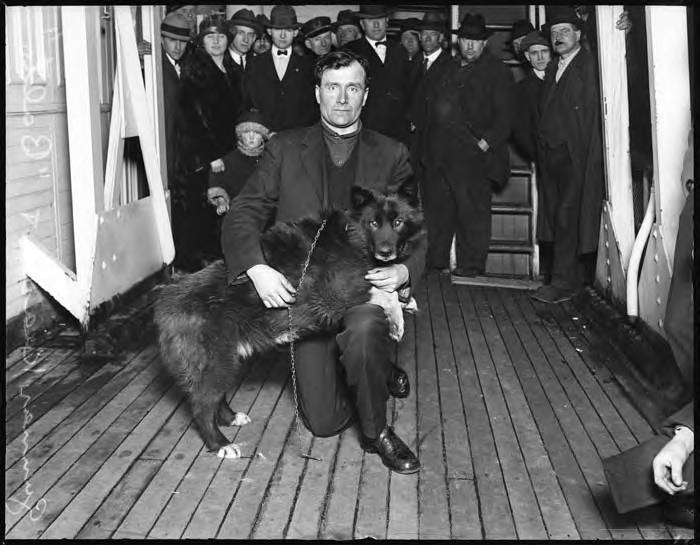
The archival photograph used here shows Gunnar Kaasen with Balto in Seattle on March 21, 1925, weeks after the delivery.[6] It is not an image of the serum moving through Alaska. It is an image of fame moving through the United States. According to the Commons file description, the photograph was made after Kaasen and Balto arrived by steamship and were on their way to Mount Rainier National Park to film Balto's Race to Nome.[6]
That timing is the article's memory problem. By March 1925, the emergency network had already been compressed into a portable public icon. Kaasen and Balto were real participants, and the final leg mattered. But the photo belongs to the afterlife of the event, where a complex relay became easier to market as a musher-and-dog pair.
Centennial reporting has sharpened this imbalance. AP's 2025 account notes that official records listed five deaths and 29 illnesses, while also warning that the toll was likely higher because Alaska Native communities were not accurately tracked.[4] The same report describes how Balto and Kaasen gained extraordinary attention, while Seppala and Togo, associated with more difficult and longer work, missed much of the limelight.[4] The National Park Service's Togo biography makes the correction in institutional form: Balto often receives the broad credit, but Togo led Seppala's team across the most dangerous leg.[5]
The correction should not become a new simplification. Togo's role matters. So do Kaasen and Balto. So do the less famous mushers, rail workers, officials, medical staff, and communities along the route. The useful historical question is not "which dog was the real hero?" It is "why did public memory need a single face for a distributed emergency system?"
Why the mechanism still reads modern
The Nome run is modern because it shows emergency response as choreography across incompatible systems. A drug developed for a toxin-mediated disease had to be matched to a transport network that stopped at Nenana. A rail line had to become a sled relay. Territorial correspondence had to become local action. Local expertise had to become a timed chain. Then newspapers and commemorations had to turn that chain into a story people could keep.
The relay's success also depended on a boundary condition often left out of the legend: existing infrastructure was thin but not absent. There was a rail endpoint. There were trail communities and roadhouses. There were experienced mushers and trained teams. There were officials who could authorize movement and physicians who could define the medical emergency. The run was extraordinary, but it did not come from nowhere.[1][3]
That is the difference between a heroic anecdote and a causal mechanism. Heroism describes courage under pressure. Mechanism explains why courage had a path to travel. Nome's antitoxin arrived because the emergency was translated into segments: Anchorage to Nenana by rail, Nenana to Nome by relay, serum to patients by medical judgment, and lived crisis to public memory by newspapers, photographs, statues, and centennial retellings.[1][3][4][5][6]
The photograph of Kaasen and Balto therefore deserves both appreciation and skepticism. It preserves one authentic participant in the run's final public image. It also reminds us how easily a system becomes a mascot. Nome was helped by a relay, not a myth. The relay beat the disease clock because many people and teams made the route work before memory narrowed the frame.
Editor's Pick Review
This piece earns the editor's pick because it turns a familiar rescue legend into a precise operating model without draining the story of force. The "three clocks" frame gives the article a clean causal spine: medicine, transport, and memory each impose a different deadline, and the serum run becomes legible as emergency infrastructure rather than a single heroic dash.
It also clears today's stricter visual and translation bar. The archival Balto/Kaasen image is immersive and topic-grounded rather than analytical; its caption actively advances the article's memory-politics argument. The Chinese version keeps the same mechanism visible in natural, paced prose, preserving the article's distinction between courage, logistics, and later public myth.
Sources
- Alaska State Archives, "Serum Run of 1925" - overview, distance, weather, delivery time, and links to Governor Scott C. Bone's correspondence files.
- Centers for Disease Control and Prevention, Pink Book, Chapter 7: "Diphtheria" - toxin mechanism, clinical urgency, antitoxin limits, and treatment sequence.
- Ned Rozell, "Sled Dogs Were Lifesavers in the Serum Run," University of Alaska Fairbanks Geophysical Institute, Alaska Science Forum (2001) - rail transfer, relay structure, named mushers, and quarantine aftermath.
- Mark Thiessen, "Mushers and dogs braved a horrific Alaska winter to deliver lifesaving serum 100 years ago," Associated Press (2025) - centennial reporting, official illness/death count, memory politics, and Iditarod commemoration.
- National Park Service, "Togo" - short biography of Leonhard Seppala's lead dog, Balto/Togo credit imbalance, dangerous-leg framing, and later commemoration.
- Wikimedia Commons, "File:Gunnar Kaasen and dog Balto, Seattle, March 21, 1925 (MOHAI 4619).jpg" - source page for the archival Seattle Post-Intelligencer photograph used as the article image.