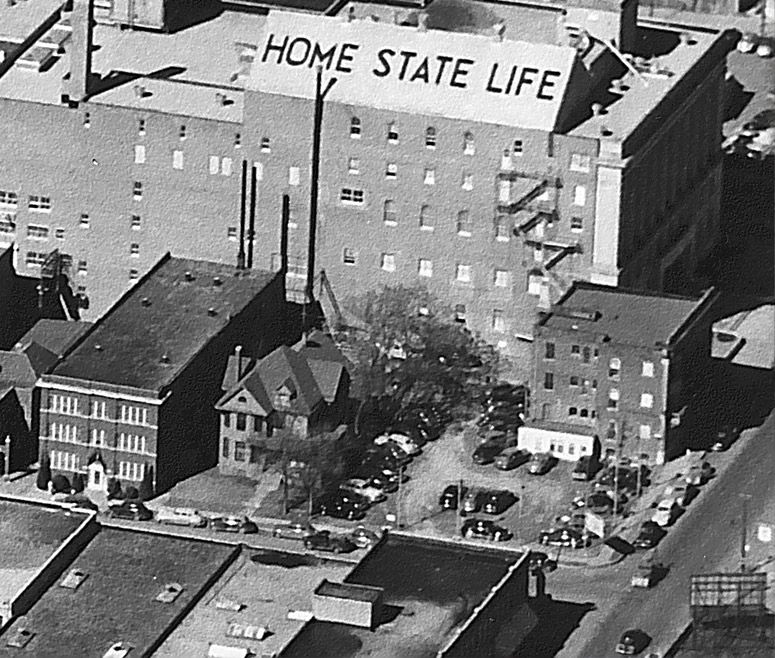
Someone who wanted a shady parking space in downtown Oklahoma City used to have a reason to get to work early. One American elm shaded the lot across Northwest Fifth Street from the Alfred P. Murrah Federal Building. An older photograph in the Oklahoma City National Memorial & Museum shows how the tree got there. Look just behind the peaked roof near the center of the 1947 aerial photograph. The elm stands in a family's backyard, its branches picked out against the tall business block behind it. The house went, the other trees went, and drivers inherited the shade. The museum dates the planting to around 1920, an estimate by foresters. The photograph tells us something a planting date alone could scarcely convey. An entire yard once fitted into what a visitor now experiences as a national memorial. [1][2]
On April 19, 1995, the bombing of the federal building killed 168 people. Across the street, fragments lodged in the elm's trunk and branches. Investigators considered cutting it down to retrieve evidence. They recovered material and the tree stayed. For a time, its importance lay precisely in what it had caught. Within a year people were gathering beside it to remember what had happened. A photograph from 1996 shows President Bill Clinton addressing a crowd with the damaged elm behind him. Long before there was a finished place for commemorations, people had found a place to stand. [1][2][3]
A condition of the competition
Families of people who died, survivors, rescue workers and other residents helped write the mission statement for the permanent memorial. They specified that the design had to include the Survivor Tree and identified its position on the Journal Record Building block. An architect could choose the paving, the approach and the view. The community had already chosen this one component, down to its address. For people who remembered the parking lot, the distance from the trunk to the federal building was still the distance across a familiar street. [2][3]
In the finished memorial, you can sit on a curved sandstone bench facing the elm. Turn around and the ground falls away in terraces toward the reflecting pool along the former Fifth Street. Beyond it, empty chairs occupy the site of the federal building. There is one for each person killed. The chairs give grief an individual scale. The tree on the other side has room beneath it for a gathering. Water occupies the interval that drivers and pedestrians once crossed between the two. Keeping the elm where it grew lets a visitor trace the old walk from a parked car to the federal building. [4][5]
What a visitor can scarcely see is the work under the bench. Ordinary paving around a tree could close off the ground its roots depended on. Urban forester Mark Bays and the construction crew dug by hand for the piers that would carry the circular plaza. Below the paving, they provided for air and water to reach the roots. The bench thus puts two kinds of care in the same place. Someone coming to remember a person who died can sit down for as long as they need. Underfoot, the space that makes that visit possible has been built to keep the elm alive. [2][4]
What a seedling can carry
The grounds crew also collected seeds. Nursery workers raised them and returned saplings for distribution on the anniversary of the bombing. In 2006 the memorial partnered with American Forests to extend that work. It added an unusual task to an anniversary observance. Someone who went home with a young elm had to choose a spot for it and see it through its first seasons. A child encountering that tree years later might need someone to explain why it grew outside this particular house or school. Its connection to Oklahoma City could be handed on in the telling. [2][3]
The backyard photograph records the other end of that exchange. Nobody looking at the elm in 1947 could have supplied the story attached to one of its seedlings. What they could have recognized, and what a person on the sandstone bench can recognize too, is the pleasure of sitting beneath a mature shade tree. Preserving that ordinary use may be the most generous part of the design. A visitor can spend time there before finding words for the reason they came. [1][4]
Sources
- Oklahoma City National Memorial & Museum, “The Survivor Tree – Then,” with the 1947 backyard photograph
- Oklahoma City National Memorial & Museum, “Survivor Tree,” on the mission statement, construction and seed collection
- Oklahoma City National Memorial & Museum, “The Survivor Tree – Today,” with photographs of the first anniversary and memorial construction
- National Register of Historic Places, Oklahoma City National Memorial registration form, section 7, page 12
- National Park Service, self-guided tour of the Oklahoma City National Memorial