The first car into Boston’s subway had come from Allston. At 6:02 on the morning of September 1, 1897, car 1752 rolled down the incline at the Public Garden. Three minutes later it reached the platform at Park Street. A passenger who had boarded out in Allston could stay on the same open streetcar for the whole trip. Someone waiting near the Garden to ride underground would have seen the car go by already full. Harper’s Weekly put the crowd aboard at more than 150, some hanging on wherever they could find a foothold. [1][2]
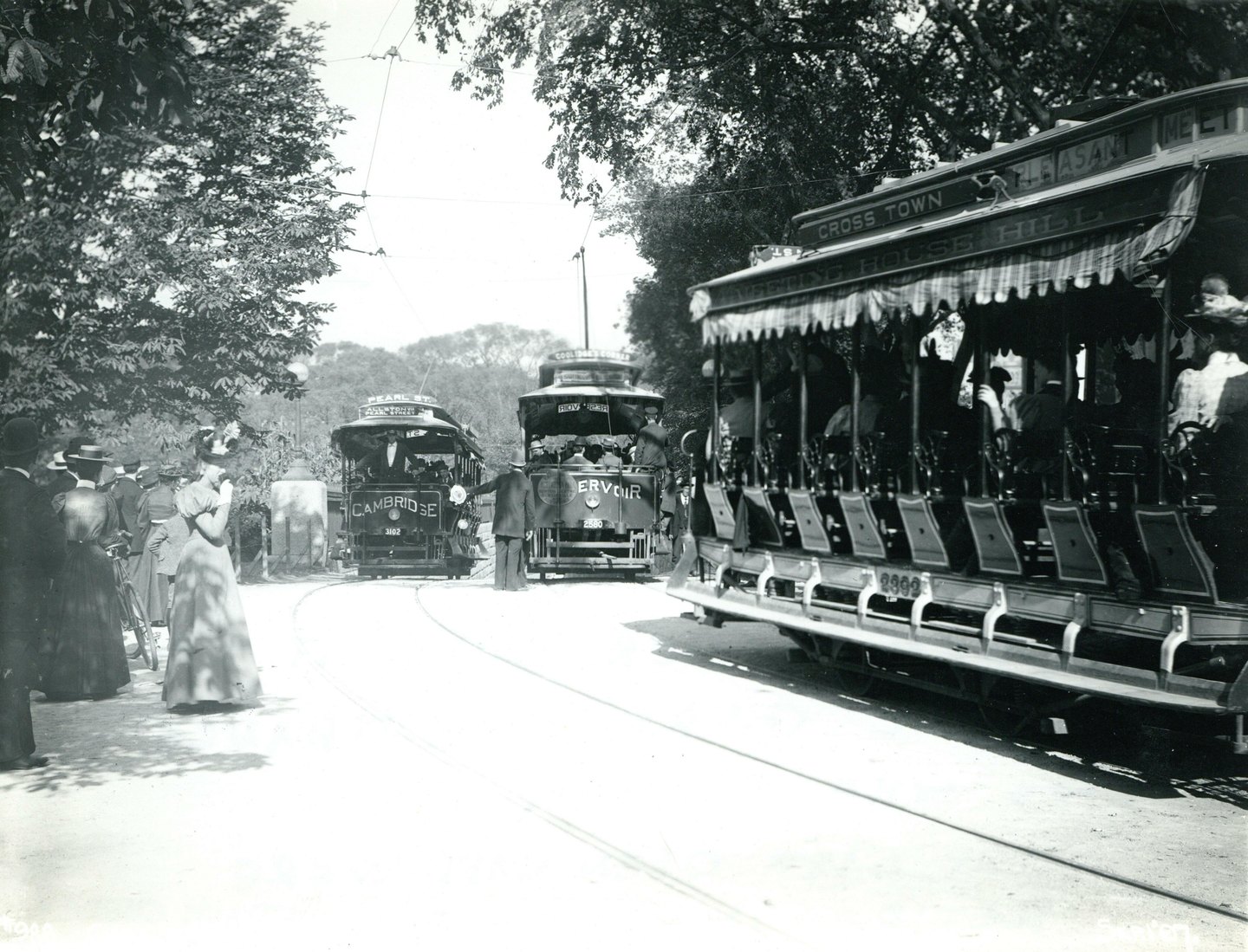
The destination board on that outbound car helps explain what Boston had bought. Allston was well beyond the end of the tunnel. Boston could give a neighborhood its own service into the business district by laying new tracks only where its car had the most trouble getting through. And a passenger whose car stayed on the surface could still get home sooner because somebody else’s car had gone below. [2][3]
Where the queue formed
In a construction photograph taken in 1895–96, Park Street Church stands behind a row of steel frames sunk along the edge of Boston Common. Across Tremont Street, the commercial buildings are still in place. The photograph catches a choice while it was briefly visible. Here was ground that could have been given over to tracks at street level, at the expense of the Common. The builders were fitting a second route underneath its walks instead. Once the roof went on, a pedestrian and a carload of passengers could use the same strip of Boston at the same time. [2][4]
Think of two trolleys coming in from different neighborhoods. They can make good time miles apart, then lose it together as soon as their routes converge. A streetcar caught behind another at a crowded stop cannot pull out and pass. Sending more cars down that track may give waiting passengers more places to sit while doing little to advance the head of the queue. Boston’s incline let western routes leave the street before they reached the worst of the interference. At Park Street a loop turned the cars for the trip home. A delay crossing downtown no longer had to travel all the way back out to the neighborhood on the returning car. [1][2]
The rider who stayed upstairs
In its September 18 issue, Harper’s estimated that the first section had taken ninety cars an hour off the surface. Its most telling comparison concerned the lines still running in daylight. A stretch that had often taken fifteen minutes now took about seven above ground, the correspondent reported. These were observations from the opening weeks. They give a sense of what a rider might have noticed, though they tell us little about the average trip over a whole winter. [2]
Within a week, Labor Day crowds had also exposed a limit underground. Cars could get to the station promptly and still bring in more people than its platforms could comfortably handle. The holiday and the faster surface journey belong in the same account. At street level the scarce space had been the track ahead of the car. On a busy platform it was the few feet where the next passenger needed to stand to board. Boston had made room in one place, and riders quickly found the next narrow spot. [2]
A second southern approach opened on October 1, 1897. On September 3 the following year, service extended from Park Street to North Station. Rails came up on Tremont Street between Boylston Street and Scollay Square, and along Boylston as far as Charles Street. The missing rails were as consequential as the new ones below. On those blocks the room freed for people walking, driving or making deliveries would still be there the following morning, even if the railway wanted to run more cars. [1]
There was a price to designing the tunnel for the cars Boston already had. In 1901, trains from the new elevated railway began using it to get across downtown. Their passengers needed raised platforms. The tight curves and clearances that a streetcar could negotiate made poor quarters for the larger equipment. In 1908 the elevated trains gained a tunnel of their own under Washington Street. The open car from Allston had fitted the Tremont Street subway so well because the route had been built around precisely that kind of trip. Seven years of trying to fit a different railway through the same space showed how specific that achievement was. [1]
Sources
- National Park Service, Tremont Street Subway landmark nomination, section 8 — opening dates, removal of tracks and elevated operation
- “Opening of the Boston Subway,” Harper’s Weekly, September 18, 1897 — contemporary reporting on surface travel times, the loop and holiday crowds
- City of Boston Archives, streetcars at the Public Garden portal on September 1, 1897 — opening-day photograph and route identifications, Wikimedia Commons
- Historic New England, construction at Park and Tremont streets, 1895–96 — photograph GUSN-195289