Read the last article of the Northwest Ordinance aloud and there is a natural place to take a breath. Congress has just prohibited slavery and involuntary servitude in the territory northwest of the Ohio River, with an exception for punishment after a criminal conviction. An account of the ordinance could end there and leave a reader picturing an enslaved Virginian reaching freedom on the far bank. Congress kept writing. The next two words in the text it adopted on July 13, 1787, are “Provided, always.” [1]
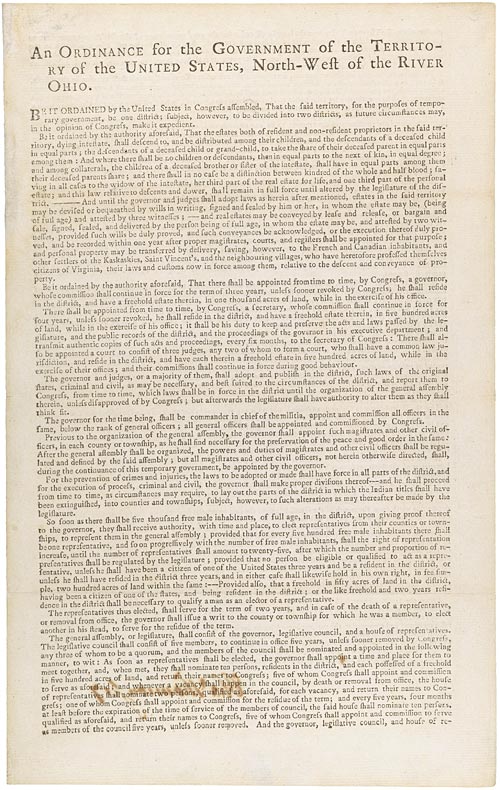
The sentence changes its subject at that hinge. Its opening words govern a place. The proviso follows a person escaping into that place and asks where someone has a lawful claim to that person’s labor. If the answer is one of the original states, Congress authorizes the claimant to recover the person and have them carried back. A Virginian who crossed the Ohio had put a river between herself and her enslaver. The ordinance preserved his claim on both banks. [1]
What the claimant had to show
Virginia matters in that example. Article Six specifies “any one of the original States,” a phrase easy to pass over now that the territory itself has long since been divided into states. In 1787 the distinction ran through the whole document. Congress laid out how the territory would acquire a legislature and how its inhabitants could form states that would enter the Union as equals. During that transition, a claim to labor recognized in Virginia could reach into a territory whose own founding compact prohibited slavery. [1]
What would happen if a claimant identified the wrong person? Article Six leaves the reader at precisely that point. It supplies a destination for the captive and a legal basis for the journey. It names no officer to hear evidence, specifies no document the claimant must produce and gives the captive no occasion in that sentence to dispute the identification. Those omissions mattered wherever one jurisdiction agreed to honor another’s law. Someone on the receiving side of the border still had to decide whose account to believe. [1]
The Constitution drafted later in 1787 addressed flight from one state into another. Its Article IV makes a small but consequential change of verb. Under the ordinance a person “may be lawfully reclaimed.” Under the Constitution the person “shall be delivered up” on a claim. Read the neighboring clause and a second distinction appears. For the return of someone accused of a crime, a demand comes from the executive authority of the state the accused has left. For someone claimed as owing labor, the party claiming that labor can set the process in motion. An enslaver had standing here in his own right. [1][2]
The paper that could take someone back
On February 12, 1793, a federal statute gave that claimant a procedure. Section Three allowed him or his agent to seize the person and bring them before a federal judge or a local magistrate. He could offer oral testimony or a certified affidavit. If the official accepted the proof, the official issued a certificate authorizing removal. Consider what that sequence meant to the person identified in an affidavit. By the time an official weighed the evidence, the claimant could already have taken her into custody. The paper that came out of the hearing went to the claimant. [3]
One family's experience shows how much could happen even when a hearing stalled. In 1837 Edward Prigg, acting for Maryland enslaver Margaret Ashmore, obtained a warrant in York County, Pennsylvania, for Margaret Morgan, who had come from Maryland five years earlier. When Morgan was brought before the magistrate, he declined to proceed. Prigg took Morgan and her children to Maryland anyway. Pennsylvania convicted him under its kidnapping law. In 1842 the U.S. Supreme Court reversed his conviction, holding that the state law interfered with the constitutional right of recapture. This was a state-to-state case under Article IV. It gives a concrete measure of the power that the earlier territorial proviso had expressed in a few lines. [2][4]
There is a detail in the court record worth carrying back to the ordinance. At least one of Morgan’s children had been born in Pennsylvania more than a year after she arrived. For that child, the journey to Maryland in Prigg’s custody could hardly be described as a return. Congress in 1787 had pictured a person escaping across a boundary and a claimant entitled to follow. The Pennsylvania record lets us see someone else on the road, a child who had never made the crossing on which the claim depended. [1][4]
Sources
- National Archives, Northwest Ordinance, July 13, 1787. Archival image and transcript, especially Articles Five and Six.
- Cornell Legal Information Institute, U.S. Constitution, Article IV, Section 2.
- United States Statutes at Large, Act of February 12, 1793, chapter VII, Section 3, pages 302–305.
- United States Reports, Prigg v. Pennsylvania, 41 U.S. 539 (1842). Special verdict and opinion of the Court.