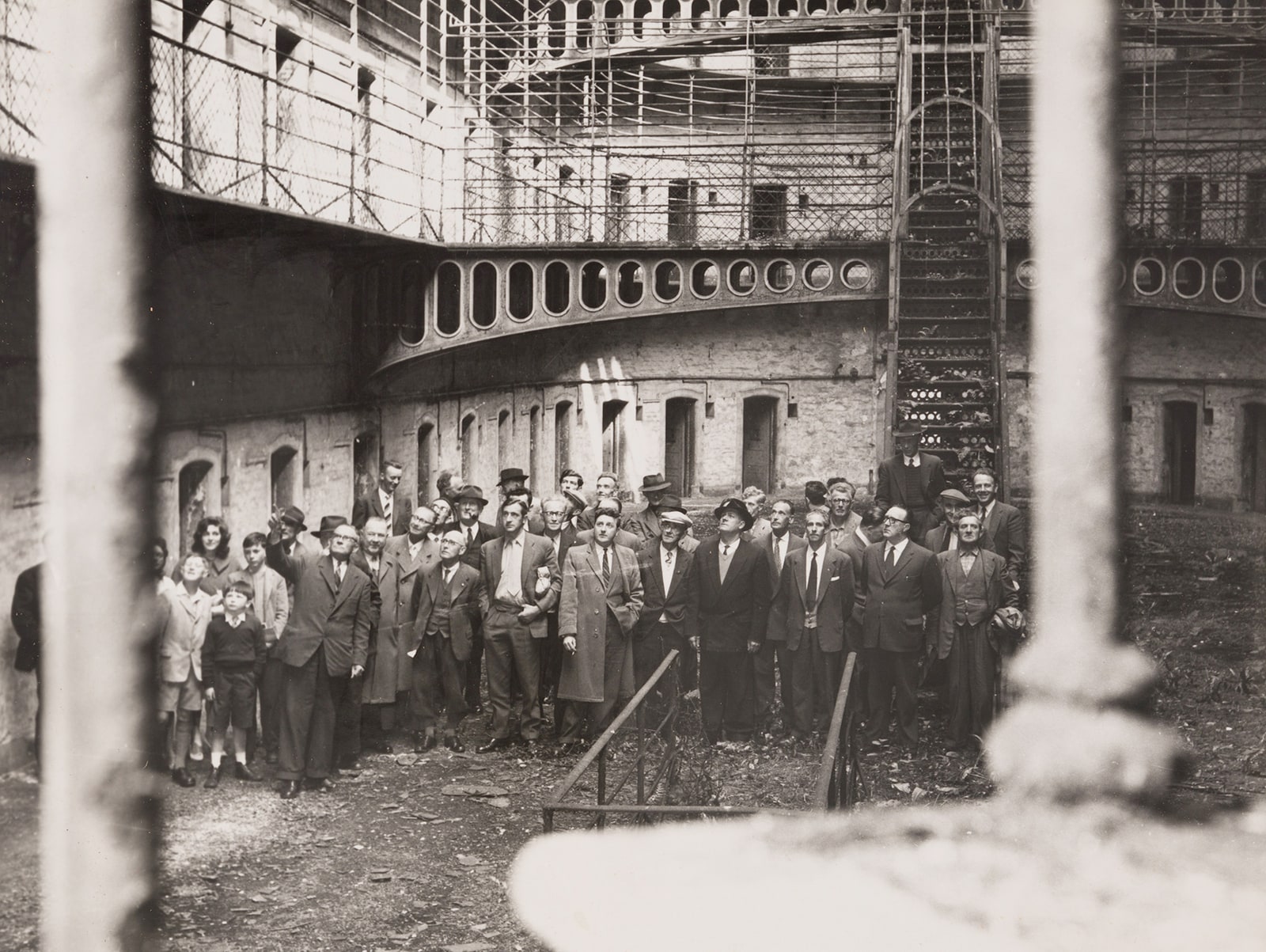
In May 1960, James (Séamus) Brennan guided a group through the ruined East Wing of Kilmainham Gaol in Dublin. He knew the prison from the other side of the cell door: he had been confined in Cell 3 in 1916. By the time of this photograph, he was secretary of the committee working to restore it. A former prisoner had become a custodian of the place that had held him.[1]
The photograph catches a memorial while it is still being made. Visitors have arrived, but the building around them remains visibly damaged. Its survival required people to turn historical attachment into repairs, fundraising and years of unpaid work. The question was also what kind of past the rescued prison would bring into view.
A difficult inheritance
Kilmainham carried memories that could not be fitted into one story of national liberation. Between 3 and 12 May 1916, British firing squads executed fourteen men in its Stonebreakers’ Yard. During the Civil War, the Irish Free State used the prison to hold opponents of the Anglo-Irish Treaty, including people who had recently fought alongside their guards. Éamon de Valera was among the last prisoners released in 1924. Abandonment followed; the formal closing order came in 1929.[2]
These successive uses help explain why an independent Ireland did not immediately find an agreed purpose for the building. Yet painful memory alone cannot explain decades of deterioration. Historian Rory O’Dwyer, writing for the National Graves Association, traces repeated proposals and administrative decisions that failed to become sustained preservation. His account draws attention to the distance between valuing a site and accepting responsibility for its upkeep.[3]
Some schemes would have transformed the surviving evidence. A proposed defence museum involved removing partitions between cells. Another proposal, for records storage, contemplated demolition of much of the complex. O’Dwyer records a government decision in August 1953 to preserve the gaol as a national monument, followed by further delay. The eventual volunteer project received government approval on 26 February 1960.[3]
Preservation was therefore a choice among possible futures for the building. A prison converted into offices, a park or a conventional museum could have commemorated the same events while leaving visitors a very different relationship with the spaces where they occurred. Keeping cells and passages preserved the awkward scale of imprisonment: doors, distances, barriers and rooms that resist becoming merely a backdrop.
The work behind the anniversary
The restoration campaign had a powerful deadline: the fiftieth anniversary of the Easter Rising in 1966. Its language was sometimes devotional. In a letter to veterans’ representative Seán Dowling on 9 June 1958, campaigner Lorcan Leonard proposed making the neglected yard “the most holy spot in Ireland.” The museum reproduces the letter as evidence of the campaign’s ambition.[4]
Delivering that ambition meant clearing vegetation, dealing with pests, replacing broken glass and repairing rotten timber and plaster. The museum’s restoration history records as many as 200 tradesmen giving their evenings and weekends during the 1960s. Money came from public donations, government funding and uses of the building such as film productions.[4]
Another surviving object makes the fundraising tangible: a small cardboard collection box, black and white, with a coin slot on top. The museum catalogues it as an appeal for the restoration. Beside the grander relics of revolution, this modest container records the practical business of keeping a memorial project going.[5]
President de Valera officially reopened the gaol in 1966, returning to a place where he had once been imprisoned. The volunteer committee continued managing it until the handover in 1986.[1] The opening was a public milestone within a much longer undertaking. Repairs continued after the ceremony; in 1986 the site passed into the care of the Office of Public Works.[4]
More lives inside the walls
The volunteers’ collecting gave the new museum a particular emphasis. From 1960 to 1986, the Restoration Society gathered material associated with Irish nationalism and republicanism from 1798 onward, displaying it in the East Wing. After the collection transferred to the state, the museum expanded its collecting to the gaol’s penal history while continuing its political collections. A purpose-built museum opened in 1996.[5]
That extension mattered because most people imprisoned at Kilmainham had been held for ordinary offences. The museum’s account of prison life describes debtors, people convicted of food theft during the Great Famine, and people with mental illnesses confined within the prison system. Overcrowding frustrated the original intention of individual cells. When male prisoners moved into the brighter new East Wing in 1861, women remained in the older, darker West Wing.[6]
A visitor following only the famous prisoners could miss those differences. The same institution held people with radically unequal resources, prospects and public visibility. Its cells can prompt questions about who was remembered by name, whose possessions survived, and whose imprisonment left little beyond an administrative entry.
The museum’s own account supports a change of emphasis, rather than a simple claim that one history replaced another. Its collections include women’s experiences during the Civil War and material from ordinary members of revolutionary organisations.[5] Political imprisonment was itself more varied than a procession of celebrated leaders. Preserving the building made room for these overlapping histories; selecting and interpreting evidence remained continuing work.
Remembering the people who remembered
By the approach of the Rising’s centenary, the restoration had become a history requiring rescue of its own. In October 2015, an appeal sought volunteers and their relatives so their contribution could be recorded and recognised. Damien Cassidy, chairman of the gaol’s Board of Visitors, explained that contact had been lost with some workers and others had died. The surviving institution could no longer take a complete account of its rescuers for granted.[7]
In 2016, surviving members of the Restoration Society and their families were honoured at a reception in the newly adapted courthouse visitor centre. Local reporting recorded Cassidy’s acknowledgement of the many volunteers who were no longer alive to attend.[8]
Brennan’s tour in the 1960 photograph now belongs to both histories: the prison’s and its preservation’s. His presence connects an experience of confinement with a later decision to keep the place accessible. The damaged room around his visitors reminds us how contingent that access was. Kilmainham’s memorial life depended on people who cleared, repaired, collected and explained—and whose own names also needed someone to remember them.
Sources
- Willy Cumming, National Inventory of Architectural Heritage, “Kilmainham Gaol, Inchicore Road, Kilmainham, Dublin 8,” Building of the Month, May 2016 — architecture, restoration milestones and the captioned May 1960 photograph.
- Kilmainham Gaol Museum / Office of Public Works, “1910–1924” — executions, Civil War imprisonment, the end of confinement and formal closure.
- Rory O’Dwyer, “‘The wilderness years’: From Abandonment to Restoration — Kilmainham Gaol 1924–1960,” National Graves Association — competing uses, delayed preservation and approval of the volunteer project.
- Kilmainham Gaol Museum / Office of Public Works, “Restoration” — Leonard’s 1958 letter, voluntary repairs, funding, the 1966 opening and the 1986 handover.
- Kilmainham Gaol Museum / Office of Public Works, “Collection” — restoration collection box 21RE 1G12 04, collecting priorities and the development of the museum.
- Kilmainham Gaol Museum / Office of Public Works, “Prison Life” — ordinary imprisonment, overcrowding and differing conditions for women and men.
- Sinéad O’Carroll, “Did you help restore Kilmainham Gaol? Ireland wants to thank you,” The Journal, October 2015 — appeal to document the restoration workers.
- Dublin People, “Kilmainham Gaol volunteers honoured,” 8 April 2016 — reception for surviving volunteers and their families.