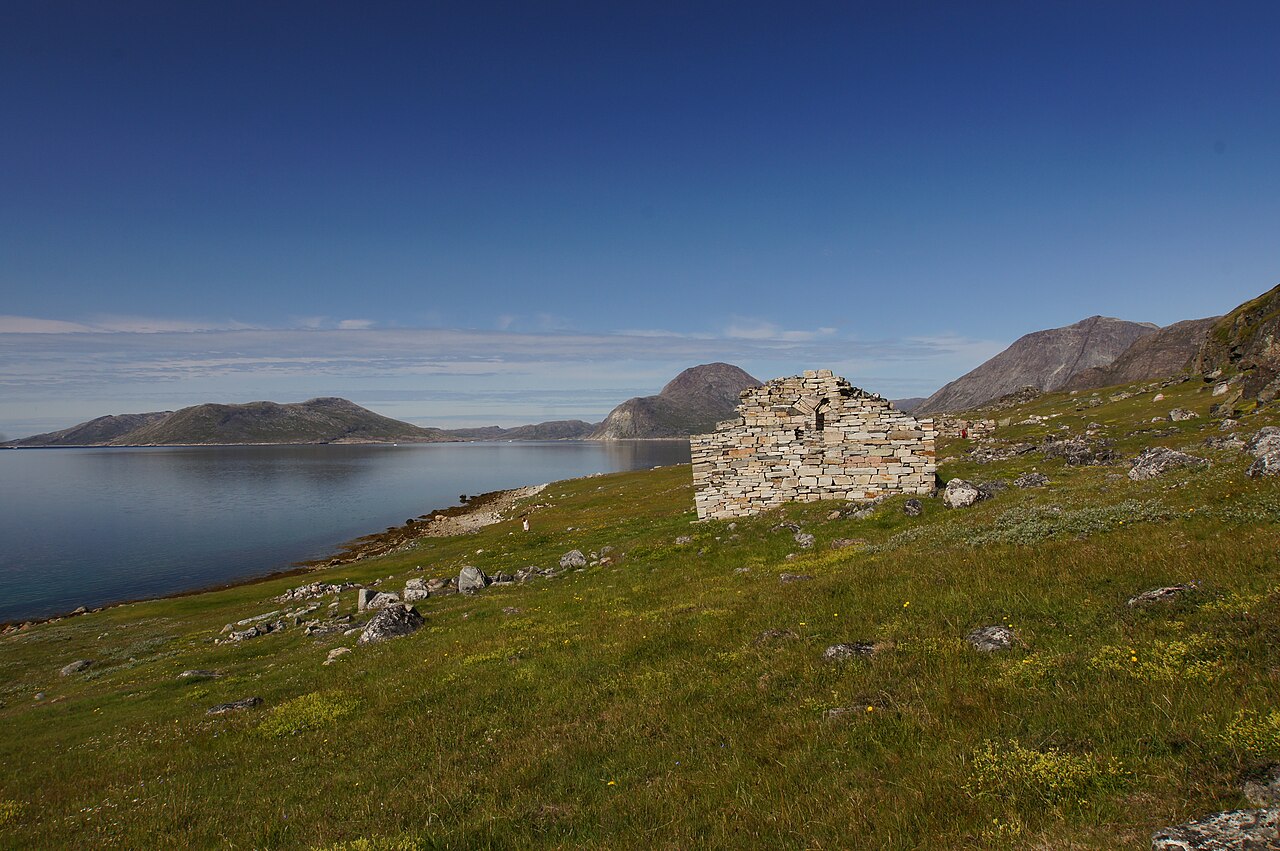
At Hvalsey, the written record ends with a wedding. A marriage celebrated at the stone church in 1408 became the last documented event in Norse Greenland, but nobody who attended knew that later historians would turn it into a closing scene. It was an ordinary claim on the future: two people, witnesses, kinship, property, and a community still able to make a ceremony matter.[1][5]
The silence afterward is why the colony's end attracts single-cause stories. Cooling killed the farms. Inuit conflict destroyed the settlements. Europe forgot the colony. Walrus ivory lost its market. The Norse refused to adapt. Each story takes one real pressure and promotes it into a verdict. None explains the evidence as neatly as its headline suggests.
Researchers now agree on more than the mystery language implies. Icelanders led by Erik the Red settled southwest Greenland around 985. The more northerly Western Settlement was depopulated by the middle of the fourteenth century. The larger Eastern Settlement survived long enough for the Hvalsey wedding, and archaeological dates carry occupation into roughly the middle of the fifteenth century.[1] What remains disputed is not whether conditions worsened, but how those pressures became an ending.
That distinction divides the historiography into two strong readings. One treats the final century as a subsistence squeeze in which drought, changing sea ice, shorter or less reliable growing seasons, and rising local seas eroded the food system until some households could no longer endure. The other treats it as an economic and demographic exit: Greenlanders adapted substantially, but a small export colony lost the trade, shipping, labor, and social reasons that made adaptation worth sustaining. A 2025 study of expert interpretations found broad agreement about environmental and economic pressures but sharp disagreement over whether the last communities died in crisis or abandoned Greenland for opportunities elsewhere.[2]
The best answer is not a vague compromise in which "everything mattered." It is a sequence. Environmental change raised the cost of remaining. A weakening trade system lowered the return. Adaptation bought time, but it could not guarantee ships, people, or a future. Norse Greenland ended when the margin between those forces became too narrow for a small community to reproduce itself.
Image context: the cover is a real photograph of Hvalsey Church in the former Eastern Settlement. Its stone walls, grazed slope, and fjord are more useful than a romantic Viking illustration: they show the farming landscape, coastal exposure, and surviving place where Greenland's last recorded Norse wedding occurred.[1][5][8]
The shared chronology is clearer than the ending
The first guardrail is geographical. The "Eastern" and "Western" settlements were both on Greenland's southwest and west coasts; the names described their relation to each other, not opposite sides of the ice sheet. Farms occupied the rare inner-fjord niches where grass, sedges, scrub, freshwater, and pasture could support cattle, sheep, and goats. Their economy was never simply European farming transplanted unchanged. Middens show heavy use of seals and other wild resources, while walrus tusks, hides, pelts, and rope connected the settlements to Atlantic exchange.[1]
Nor was the colony self-sufficient. The National Museum of Denmark's synthesis notes that Greenlanders imported iron and construction timber and exported animal products, especially walrus ivory. In 1261, affiliation with the Norwegian crown brought a royal trade monopoly. That did not make every farm a commercial outpost, but it tied essential materials and elite authority to a shipping system the settlers did not fully control.[1]
The two settlements then ended on different clocks. Written evidence places the Western Settlement's depopulation around the middle of the 1300s; the Eastern Settlement's last written trace comes in 1408, while radiocarbon and archaeological evidence suggest occupation for several more decades.[1] This staggered chronology weakens the idea of one island-wide fatal event. It allows bad harvests, losses at sea, disease, conflict, or hunger in particular places, but it asks any general explanation to account for contraction across generations.
Diet offers the clearest warning against caricature. Isotope work on human remains shows a gradual, regionally uneven shift from terrestrial food toward marine resources. Settlers in the Western Settlement and southern Eastern Settlement appear to have made that turn faster than communities in the central Eastern region.[6] The finding does not prove abundance or social equality. It shows a real dietary shift consistent with substantial adaptation, even as farming remained central to settlement life.
That is why the debate cannot be "climate versus adaptation." Adaptation is visible inside the climate story. The harder question is whether those adjustments failed to prevent famine or succeeded long enough for people eventually to leave.
Reading one: the food system lost its margin
The environmental case begins with hay, not temperature alone. Livestock could graze during summer, but winter survival depended on stored fodder. A small decline in grass production could therefore propagate through the whole farm: less hay meant fewer animals overwintered, less manure reached fields, herds recovered more slowly, and households had less dairy, meat, wool, and exchangeable surplus.
A 2022 lake-sediment study sharpened this mechanism. Working beside a former Eastern Settlement farm, Boyang Zhao and colleagues found no substantial local temperature change during the settlement period. Instead, their proxies showed a persistent drying trend beginning around 950, continuing through Norse occupation, and peaking in the sixteenth century. The important revision was local: in this part of southern Greenland, declining moisture may have damaged hay production more directly than a simple fall in mean temperature.[4]
That study is strong because it replaces the broad label "Little Ice Age" with a farm-scale pathway. It is also bounded evidence. One lake near one Eastern Settlement farm cannot describe every valley, and a climatic trend that overlaps depopulation does not identify the last decision made in any house. It establishes pressure, not a death certificate.
A second environmental mechanism came from an unexpected direction. As southern Greenland's ice sheet advanced, its added mass drew seawater toward the coast and depressed the nearby crust. A 2023 geophysical study estimated relative sea-level rise of as much as about 3.3 meters outside the glaciated zone during Norse occupation, with roughly 204 square kilometers of modeled inundation across the Eastern Settlement. The rise was progressive rather than a single flood, and many archaeological sites sat close to affected ground.[5]
For farms organized around low coastal pasture, landing places, and movement along fjords, that matters. Retreating shorelines, coastal erosion, disrupted drainage, and the loss of usable lowland could combine with drying on higher ground: too much water in one place, too little where hay had to grow. The model gives the environmental reading another concrete mechanism.[5]
Its limit is similar. Modeled inundation is not a directly dated abandonment layer at every farm. It says the usable landscape was tightening; it does not say whether the last residents starved, consolidated at stronger farms, or boarded a ship. Environmental evidence is unusually good at recovering pressures and unusually weak at supplying the final verb.
Reading two: the colony stopped being worth the voyage
The economic reading starts from the same farms but widens the map. Norse Greenland needed Europe for iron, timber, church connections, and a market for Arctic products. Walrus ivory was particularly important because high-value tusks could justify long voyages from a remote colony. When that circuit worked, Greenland's distance was an asset: it gave settlers access to a commodity European carvers wanted.[1][7]
Archaeology can now follow part of that circuit through the skull sections, or rostra, in which paired tusks traveled. Research combining ancient DNA, stable isotopes, measurements, and butchery traces found that almost all medieval European rostra in the sample likely came from Greenland. Later specimens tended to come from smaller, often female animals and from a genetic branch common farther north. The pattern is consistent with hunters traveling greater distances for diminishing returns as nearer walrus populations were depleted.[7]
At the demand end, elephant ivory reached European markets in greater volume during the thirteenth century, while evidence for mainland European imports of walrus ivory becomes scarce after 1400. The claim is not that a price change directly emptied Greenland. It is that the colony's most portable export was becoming costlier to obtain just as its market weakened. Longer hunts removed labor from farms and exposed crews to danger; lower returns made it harder to exchange tusks for the materials and relationships Greenland could not produce locally.[7]
This reading also changes the meaning of the marine diet. More seal meat is not necessarily a symptom of people passively nearing starvation. It can mark a successful adjustment to local resources. The 2012 interdisciplinary synthesis by Andrew Dugmore and colleagues argues that Norse Greenland built a flexible subsistence system able to absorb major environmental challenges. Its vulnerability came partly from successful specialization: the community was small, isolated, and deeply invested in a social and economic niche that worked until several large systems changed together.[3]
Adaptation, in other words, may have prevented a sudden collapse while enabling a slower one. A farm can survive another winter and still lose young adults, tenants, trading partners, priests, ship crews, or marriage prospects. Once population falls, every departure makes collective tasks harder. The settlement can remain biologically possible while becoming socially thin.
This is where "abandonment" enters the debate, and where evidence becomes inference. Jackson and Dugmore's 2025 interviews with 13 specialists found that nine favored complete abandonment by the mid-fifteenth century; eight of those scenarios involved movement back into Scandinavia or the North Atlantic world. Other interviewees gave more weight to famine, accidents at sea, or conflict.[2] That tally is not a vote that proves migration. It reveals how scholars can accept much of the same climate, settlement, and trade evidence yet imagine different fates for the missing people.
The migration case leans partly on absences: no bodies found in the limited excavated house sample, little osteological evidence of mass starvation, and signs that useful or prestigious objects were not simply left in place. The catastrophe case answers that few final-phase buildings have been excavated, preservation is incomplete, and departure itself required ocean-going ships that Greenlanders may not have possessed in sufficient numbers.[2] Both arguments are reasonable. Neither absence can carry the conclusion alone.
The argument is really over the final verb
The most productive debate is therefore not climate against trade. It is pressure, response, fate.
The pressure evidence is strong: local drying reduced the safety margin for fodder, progressive sea-level rise threatened coastal land, Atlantic travel became harder or less rewarding, and the ivory economy faced depletion and changing demand.[4][5][7] The response evidence is also strong: people increased marine food use, intensified sealing, and maintained the Eastern Settlement for decades after the Western one disappeared.[1][3][6]
Fate is the uncertain step. Did a shrinking remnant suffer a final subsistence crisis? Did households leave over several voyages? Did people consolidate at core farms before dispersing? Did the two settlements follow different paths? Archaeological abandonment is a condition of a place, not a biography of the people who left it.
The strongest present interpretation is a compound one with an asymmetrical ending. Environmental change made each household more dependent on coordination, stored fodder, hunting, and access to the best land. Economic isolation made those achievements less valuable and harder to sustain. The Western Settlement crossed its threshold first; the Eastern Settlement retained better niches and lasted longer. Some deaths from hunger, exposure, accident, or violence are entirely plausible. A synchronized colony-wide death is not required.
Calling the outcome "collapse" is useful only if the scale is stated. For the Greenlandic church organization, farm network, and Norse settlement landscape, this was collapse: those institutions ceased to reproduce themselves locally. For an individual household that sold what it could and moved, it may have felt like migration. The same departure can be terminal for a colony and adaptive for a family.
What would change the balance
Several discoveries could turn inference into a firmer history. Securely dated human remains from multiple late farms showing consistent starvation, epidemic disease, or violence would strengthen the catastrophic ending. Conversely, strontium and oxygen isotopes, ancient DNA, or kinship evidence identifying Greenland-born people in fifteenth-century Icelandic or Norwegian cemeteries would transform the migration case.[2]
Chronology matters just as much. Bayesian last-use dates from many farms, carefully corrected for marine-reservoir effects, could show whether households vanished in a narrow crisis or withdrew in a staggered sequence. Settlement-adjacent climate records in the Western Settlement would test whether the environmental pattern seen near the Eastern farm was shared. Directly dated erosion or inundation layers could connect the sea-level model to particular abandonments.[4][5]
Finally, the trade story needs a tighter terminal record: ship movements, cargo references, ivory prices, and securely dated Greenlandic walrus remains after 1400. If trade collapsed before farm contraction, the economic reading gains force. If imports and export demand remained healthy until after depopulation, subsistence crisis moves closer to the center.[7]
A last record that is not a last day
Hvalsey resists a dramatic ending because the evidence preserved there is social, not catastrophic. The last written trace is a wedding; the standing trace is a church; the surrounding trace is a landscape where farming depended on the sea even when the sea took land away. None reveals the final household or its destination.
That is precisely why the site is the right ending for the debate. Norse Greenland was not destroyed by one cold winter, and it was not rescued simply because its people learned to eat seals. Its communities adjusted intelligently inside a corridor that kept narrowing. Local drying and modeled sea-level rise likely squeezed Eastern Settlement farms. Walrus depletion and weaker trade reduced the payoff for staying. Isolation turned the loss of people into the loss of capacity.
The colony disappeared; the colonists did not necessarily vanish. The evidence is most secure on the first statement and still open on the second. Good history keeps that boundary visible.
Sources
- National Museum of Denmark, "Norse" - institutional overview of settlement chronology, geography, subsistence, trade, the 1261 royal monopoly, and the 1408 endpoint of the written record.
- Rowan Jackson and Andrew Dugmore, "Interpreting Collapse in Norse Greenland: Why Similar Data Produces Different Conclusions," Heritage 8, no. 8 (2025) - University of Edinburgh publication record for the expert-interview historiography study.
- Andrew J. Dugmore et al., "Cultural adaptation, compounding vulnerabilities and conjunctures in Norse Greenland," PNAS 109, no. 10 (2012) - interdisciplinary synthesis of adaptation, specialization, climate, and North Atlantic economic change.
- Boyang Zhao et al., "Prolonged drying trend coincident with the demise of Norse settlement in southern Greenland," Science Advances 8, no. 12 (2022) - lake-sediment reconstruction of local temperature and hydroclimate beside an Eastern Settlement farm.
- Marisa Borreggine et al., "Sea-level rise in Southwest Greenland as a contributor to Viking abandonment," PNAS 120, no. 17 (2023) - geophysical model of relative sea-level rise, inundation, and coastal exposure during Norse occupation.
- Jette Arneborg, Niels Lynnerup, and Jan Heinemeier, "Human diet and subsistence patterns in Norse Greenland AD c. 980-AD c. 1450: archaeological interpretations" (2012) - University of Copenhagen record for the isotope-based study of changing and regionally varied diet.
- University of Cambridge, "Over-hunting walruses contributed to the collapse of Norse Greenland" (2020) - institutional report on Barrett et al.'s ancient-DNA, isotope, and zooarchaeological study of Greenlandic walrus ivory, serial depletion, and changing European demand.
- Wikimedia Commons, "File: Hvalsey Church 2014 03.jpg" by jtstewart - source page for the real 2014 photograph of Hvalsey Church used as the article image.