The lazy version of the Cardiff Giant story says that Americans in 1869 saw a ten-foot stone body, confused it for a petrified ancient person, and paid for the privilege of being fooled. That version is satisfying because it makes the past look naive. It also misses the sharper lesson. The Giant did not work only because people believed. It worked because disbelief, argument, expert scrutiny, religious expectation, newspaper rhythm, and commercial rivalry all fed the same attraction.
The object itself was crude: a gypsum figure planted on William C. "Stub" Newell's farm in Cardiff, New York, then "discovered" by well diggers on October 16, 1869.[2][3] George Hull, Newell's cousin, had arranged the carving and burial after an argument about biblical giants; Fenimore Farm, where the object now sits, describes him as a cigar maker with a get-rich-quick idea whose plot began with a five-ton gypsum block and ended in public sensation.[2] But the hoax's real mechanism was not the sculpture alone. It was a marketplace for deciding what kind of truth people wanted to see.
That is why the Cardiff Giant is stronger as a myth-vs-evidence case than as a simple debunking story. The myth says credulity made the fraud. The evidence says a whole public system made the fraud profitable: biblical literalism offered one interpretive frame, amateur antiquarian speculation offered another, professional geology offered a challenge, newspapers amplified the fight, ticket sales measured curiosity, and P. T. Barnum proved that even a fake of a fake could draw a crowd.[3][4][5][6]
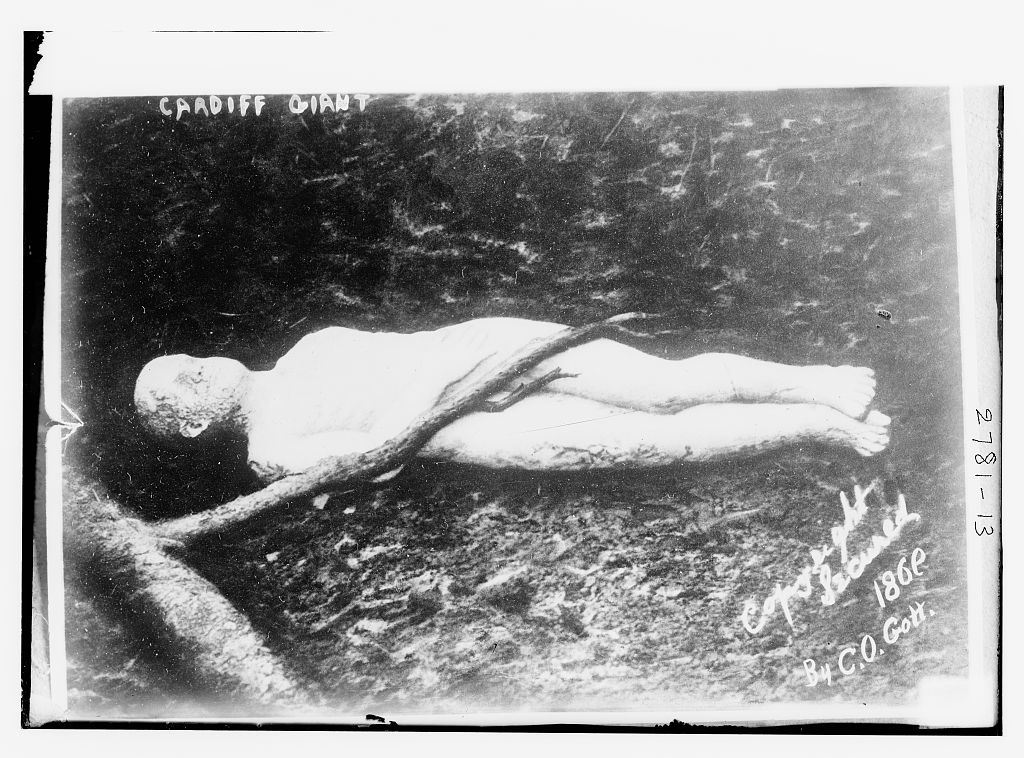
Image context: the cover image is a real archival photograph sourced from the Library of Congress and described by The Public Domain Review as a glass-plate image of the Cardiff Giant. It shows the Giant as display, which suits this article's argument: the object kept working even after the fraud was no longer mysterious.[1]
Myth: people simply thought it was a fossil
The Cardiff Giant was advertised as a "petrified man," but its audience did not share one belief. Some observers treated it as a fossilized human being, sometimes connecting it to the line in Genesis about giants in the earth. Others guessed that it might be an ancient statue. Still others doubted the whole thing almost immediately.[3][5][6] The point is not that all these interpretations were equally good. They were not. The point is that the show thrived inside the gap between them.
Newell understood that ambiguity had commercial value. According to the Onondaga Historical Association account, he covered the figure with a tent and charged spectators to view it; crowds were soon paying as much as 50 cents each.[3] The Massachusetts Historical Society account gives the same pricing sequence more tightly: an initial 25-cent admission became 50 cents after two days as hundreds came to the Cardiff hamlet.[4] Those numbers matter because they show that belief was not the only commodity. People were paying to participate in a controversy.
The figure's physical traits helped sustain the argument for a short time. It had human proportions, pores imitated on the surface, and enough theatrical bodily detail to reward close looking. But gypsum was the wrong material for a body supposedly preserved over ancient time. The more experts looked, the weaker the petrifaction claim became. The Giant was therefore strongest in the short interval before explanation hardened. It was an object designed for that interval: just plausible enough to start talk, just strange enough to make talk continue.
That is why calling the audience "fooled" is too blunt. Many visitors probably came with mixed motives: curiosity, belief, skepticism, fear of missing the region's sensation, or the pleasure of seeing what everyone was arguing about. In modern terms, the Giant was not just misinformation. It was a live event in which people could buy a place inside the uncertainty.
Evidence: the science was contested in public
The scientific story was not one heroic expert walking in and ending the nonsense. It was messier. The Massachusetts Historical Society's account quotes contemporary newspaper discussion in which Professor James Hall, New York's state geologist, did not accept the petrified-human claim but still treated the object as a remarkable possible antiquity.[4] That middle position helped the spectacle. If the Giant was not a body but might be a statue from a vanished past, then there was still something to debate.
Othniel C. Marsh of Yale took the harder line. The Mass Historical Society account summarizes his November 24, 1869 letter as arguing from the gypsum material, burial timeline, and physical evidence toward the conclusion that the object was a humbug.[4] JSTOR Daily likewise notes Marsh's judgment that the Giant was of recent origin and a decisive fraud.[5] That debunking mattered, but it did not instantly empty the tent. Exposure could damage truth claims while strengthening notoriety.
Michael Pettit's scholarly framing is useful here because it treats the episode as a controversy over observation itself. His abstract describes the Giant's shifting meanings as grounded in scientific authority, religious belief, and market relations, and argues that the object blurred boundaries among nature, society, and religion.[6] That is a more durable explanation than "people were gullible." The Cardiff Giant became difficult because different communities claimed different rules for looking.
For a religious literalist, the question could begin with whether the object fit a biblical world. For a geologist, it began with material, erosion, tool marks, and stratigraphic plausibility. For a showman, it began with whether a crowd would pay. For a newspaper, it began with whether the argument could travel. Hull's genius, if the word can be used for a fraud, was to make one object answer all those questions badly enough to keep every camp engaged.
Myth: exposure ended the story
Hull's confession in December 1869 seems like the natural ending. Smithsonian Magazine summarizes the broad arc: the Giant was planted the previous year, became a sensation after the October discovery, moved into commercial display, and was eventually exposed as fake.[7] In a normal fraud story, confession drains the object of power. In the Cardiff Giant story, confession became part of the brand.
The reason is that the Giant had already shifted from evidence to entertainment. Hull's sale to investors, the Syracuse exhibition, and the press argument had turned the object into a public performance.[3][4][5] Once people had heard that the Giant was fake, they could still want to see the famous fake. The value moved from "is this real?" to "this is the thing that fooled, angered, entertained, and embarrassed everyone."
Barnum saw the shift clearly. When the owners refused his offer, he made a copy and exhibited it as the real thing, forcing the original's promoters into the absurd position of defending the authenticity of their own fraud against a rival fraud.[3][4][6] Smithsonian's retelling captures the legal joke: a judge was said to have refused relief unless the Giant could swear to its own genuineness.[6] The line works because by then everyone understood that the marketplace had outrun the truth claim.
Barnum's replica exposes the deepest mechanism. If a fake of a fake could sell, then the audience was not buying evidence alone. It was buying proximity to a story. The original Giant, the copy, the lawsuit, the confession, the expert denunciations, and the newspaper jokes all became layers of the same spectacle. The debunking did not close the show; it changed the show's genre.
Evidence: money, media, and belief reinforced one another
The Cardiff Giant is sometimes remembered as an episode in religious credulity, and that element was real. Hull's plan grew from an argument over biblical literalism, and the Genesis frame gave the petrified-man claim its emotional charge.[2][3][7] But reducing the hoax to religion alone lets the commercial system off too easily.
The money was explicit from the beginning. Newell's tent admissions made the farm a temporary attraction. Hull's investment in quarrying, carving, transporting, aging, and burying the gypsum figure was not a prank with no expected return.[2][3][5] Investors then bought into the show; Barnum tried to buy or copy it; newspapers kept the story alive. The result was not belief versus science. It was belief plus science plus commerce, each intensifying the others.
This is why the Giant fits the Gilded Age so well. It arrived in a country used to religious argument, fascinated by new science, newly good at mass publicity, and comfortable turning wonder into ticketed entertainment. Pettit's abstract calls attention to commercial deceptions and styles of observation; that phrase gets at the heart of the episode.[6] People were not merely deciding whether a claim was true. They were learning how to look in a culture where looking itself could be packaged.
The fraud also fed on local pride and mobility. Cardiff was close enough to Syracuse for news and visitors to move quickly, and the object's later display life carried it into wider circuits.[3][5] Fenimore Farm's current exhibit history is part of that afterlife: the original object was bought in 1947 and remains on display in the museum's Main Barn.[2] A failed truth claim became a durable artifact because the history of the failure became the thing worth preserving.
What the myth gets right
The myth is not useless. The Cardiff Giant really was a fraud, and many people really did want it to be true. The petrified-man story drew strength from a world in which biblical literalism, antiquarian speculation, and public appetite for marvels could meet in one field.[3][6] The hoax also shows how quickly an object can become famous when it flatters existing expectations.
But the better lesson is less smug. The audience was not simply stupid, and the experts were not outside the culture they criticized. The controversy worked because everyone had something at stake in the act of seeing: believers wanted confirmation, skeptics wanted a test case, newspapers wanted circulation, showmen wanted admission money, and scientists wanted authority over public claims about nature and the past.[4][5][6]
That makes the Cardiff Giant a useful historical warning. A false object can survive exposure when the social rewards around it remain intact. Attention, identity, amusement, grievance, and the thrill of being in on the argument can keep a claim valuable after it stops being credible. In that sense, the Giant was not just a nineteenth-century embarrassment. It was an early lesson in how spectacle digests its own correction.
The stone man did not need to be ancient to become historical. It became historical because, for a few months in 1869 and then for decades afterward, Americans kept finding reasons to look at it: first as possible evidence, then as exposed fraud, then as a famous fake, and finally as a museum object that says more about its viewers than about giants. The Cardiff Giant's real trick was not making gypsum look alive. It was making uncertainty pay.
Sources
- The Public Domain Review, "A Very Tall Tale: Photograph of the Cardiff Giant (ca. 1869)" - public-domain image record for the Library of Congress-sourced glass-plate photograph used as the article image.
- Fenimore Farm, "Explore - The Cardiff Giant" - official museum page on the object, George Hull, the gypsum block, the 1868 plot, and the Giant's current display in the Main Barn.
- Onondaga Historical Association, "Today in History: The Cardiff Giant and CNY's Biggest Hoax" - local-history account of the October 16, 1869 discovery, admission fees, Hull's scheme, Marsh's debunking, Barnum's replica, and the object's afterlife.
- Massachusetts Historical Society, "'A Remarkable Deception': The Cardiff Giant Hoax" - collection-based account using contemporary newspaper evidence, Hall and Marsh reactions, admission pricing, Barnum's copy, and later cultural references.
- Matthew Wills, "The Cardiff Giant: The Biggest Hoax of the 19th Century," JSTOR Daily, November 5, 2015 - synthesis of the hoax, the gypsum-carving process, ticketed display, Barnum copy, and links to Franco and Pettit's scholarship.
- Michael Pettit, "'The joy in believing': the Cardiff giant, commercial deceptions, and styles of observation in Gilded Age America," Isis 97, no. 4 (2006), via PubMed abstract and DOI record.
- Kat Eschner, "The Cardiff Giant Was Just a Big Hoax," Smithsonian Magazine, October 16, 2017 - account of the 1869 discovery, interpretive uncertainty, biblical frame, Hull's motive, Barnum's replica, and the hoax's persistence.