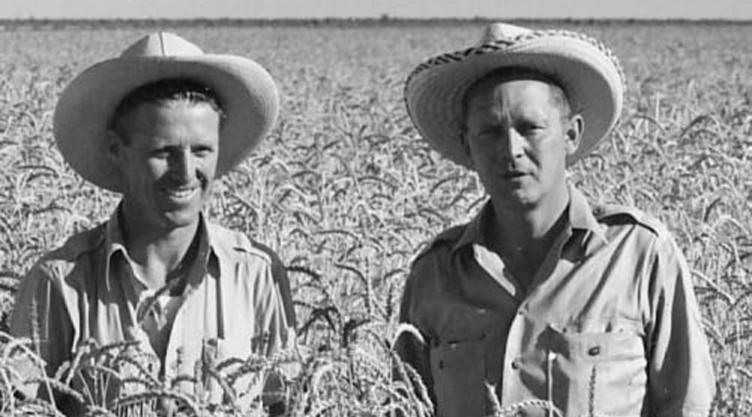
Norman Borlaug is usually remembered in one compressed phrase, "the father of the Green Revolution." The phrase points toward a real historical achievement, but it also hides the mechanism. The sharp question is not whether Borlaug helped raise wheat yields. It is what, exactly, he built that let yield gains move from one field, one valley, and one country into many others.[1][2][3]
The lead photograph is useful because it catches Borlaug early, standing with George Harrar in a Mexican wheat field around 1948.[2] The wheat is still tall. The later semi-dwarf transformation has not fully arrived. That matters because Borlaug's decisive contribution was not a single miraculous seed descending all at once. It was a field system that accelerated selection, stacked traits that could survive real farming conditions, and trained people who could carry the work onward after the first breakthrough.[1][2][3][4]
Timeline anchors: when the system took shape
- 1944: Borlaug leaves DuPont and joins the Rockefeller Foundation's wheat work in Mexico.[1][2]
- 1948: he releases four improved Mexican wheats, including Yaqui 48 and Chapingo 48, after only a few years in the field.[1]
- 1950 / 1956: the Borlaug Center dates Yaqui 50 to 1950 and describes Mexico as self-sufficient in wheat by 1956.[3]
- 1960 / 1963: robust short-straw, disease-resistant lines become central, and by 1963 Mexico is exporting wheat.[1][3]
- 1964 / 1965-1970: Borlaug and collaborators push the package into Pakistan and India; the NAS memoir says wheat yields in those countries nearly doubled between 1965 and 1970.[1][4]
- 1970: the Nobel Peace Prize recognizes the global political meaning of what had begun as a breeding program in Mexico.[5]
These dates show why Borlaug is best read through method rather than legend. The history turns on a sequence of operational choices.
Mexico made Borlaug into a wheat breeder
One reason the later mythology becomes misleading is that Borlaug did not arrive in Mexico as the obvious master of wheat. The University of Minnesota's Borlaug Center is explicit: during graduate school he had never worked with wheat and had taken only a single course in plant breeding.[2] He was trained in plant pathology, finished his M.S. in 1941 and Ph.D. in 1942, then spent 1942-1944 at DuPont before moving to Mexico in 1944.[1][2]
That background helps explain the shape of his later success. Borlaug did not approach wheat as a pure laboratory geneticist. He approached it as a field pathologist confronting a crop that failed under real disease pressure and under practical farming constraints. In 1944, Mexican wheat production was still heavily constrained by stem rust epidemics.[3] The first task was not elegance. It was to make wheat survive and yield.
This is also why his biography cannot be reduced to individual genius alone. The Mexican program gave him a hard problem and a structure in which field failure could not be ignored. The Borlaug Center stresses that he trained local farm youths in the mechanics of crossing wheat and built a large-volume breeding effort with many hands in the field.[3] The history starts with one scientist, but it becomes legible only when the work is seen as organized labor, repeated season after season.
The key invention was a calendar that sped up selection
The best single explanation of Borlaug's historical importance is shuttle breeding. The NAS memoir describes the system clearly: one generation was grown in or near Toluca, at about 2,090 meters elevation, and the next in Ciudad Obregon, near sea level at about 38 meters.[1] The Borlaug Center presents the same logic in plainer terms: summer at high altitude near Mexico City, winter in the Yaqui Valley of Sonora.[3]
This was a direct attack on breeding tempo. Most breeders worked through one generation a year. Borlaug wanted two. The practical gain was obvious: more crosses, more selection, more discarded failures, faster learning.[1][3] The deeper gain was initially accidental. The NAS memoir notes that shuttle breeding selected for reduced sensitivity to day length, or photoperiod insensitivity, which made the resulting wheats more adaptable across regions such as India and Pakistan.[1]
That point is the heart of the article. Borlaug's real breakthrough was not simply higher yield under one controlled set of conditions. It was portability. A wheat line that only thrives in one protected environment is an agronomic success of narrow scope. A wheat line that can move across latitude, season, and farming context begins to alter history.
The resistance he faced makes the mechanism even clearer. The NAS memoir notes that many critics objected to breeding in contrasting environments because they thought good varieties could only be selected under consistently favorable conditions.[1] Borlaug persisted anyway, because speed mattered and because the wrong theory of selection would have left wheat improvement too slow for the problem in front of him.
Short straw turned speed into usable grain
Speed alone would not have been enough. A breeding system also had to produce plants that could translate fertilizer and water into harvestable grain without collapsing. Here the semi-dwarf turn becomes crucial. The NAS memoir traces Borlaug's access to the Norin 10 dwarfing genes through Orville Vogel and Cecil Salmon, then explains why the trait mattered: short, stronger-stemmed plants could carry heavier grain loads without lodging.[1]
The Borlaug Center's version of the story is operational again. It says that by 1960 Borlaug and his group had robust, short-strawed, disease-resistant wheats with large grain heads and yields well above earlier lines.[3] The crucial historical point is that Borlaug was stacking traits, not chasing a single one. Rust resistance mattered. Early maturity mattered. Short straw mattered. Responsiveness to management mattered. The famous wheat packages of the 1960s were valuable because these traits arrived together.[1][3]
Seen this way, the Green Revolution was not a miracle of seeds detached from agronomy. It was the moment when breeding, irrigation, fertilizer response, and disease control were made to cooperate inside one plant type.
Mexico proved the package before Asia scaled it
The Mexican phase matters because it supplied proof that the system could work at national scale. The Borlaug Center says Mexico became self-sufficient in wheat by 1956.[3] The NAS memoir pushes the trajectory farther: by 1963, Mexico was exporting wheat.[1] Those are not small milestones. They mark the shift from experimental success to a state-level food outcome.
Yet even here the historical record warns against a seed-only reading. The same Borlaug Center pages emphasize training, collaboration, and institutions. Borlaug's team did not merely distribute kernels. It taught crossing and field methods, built cadres of breeders, and later hosted international trainees who would return home as what the site memorably calls Borlaug's "wheat apostles."[3][4]
The Pakistan material from the 1961-1969 timeline is especially revealing. In 1964, Borlaug and Ignacio Narvaez brought wheat seed into Pakistan and met resistance from local scientific and bureaucratic circles.[4] The point is important because it shows that adoption was political as well as agronomic. Trials could be mishandled; outsiders could be resented; success required allies who could release funds, fertilizer, training, and price support. The same timeline says Borlaug told President Ayub Khan that Pakistan could become self-sufficient in wheat by 1970, and that state backing then followed.[4]
The NAS memoir gives the larger result: wheat yields in Pakistan and India nearly doubled between 1965 and 1970.[1] Even that should not be read as Borlaug acting alone. It is better understood as the moment when a Mexican field system, plus local policy commitment, crossed into Asian food politics.
Two readings still compete
Reading one: Borlaug as lone savior
This is the public myth. One man breeds miracle wheat, famine recedes, and the world is fed.[5]
Reading two: Borlaug as builder of a portable agricultural system
This reading fits the documentary record better. It keeps Borlaug central, but it places his importance in a more exact location. He combined field pathology, rapid-cycle breeding, semi-dwarf structure, rust resistance, local training, and state adoption into one usable package.[1][2][3][4]
The second reading also explains why Borlaug's work traveled. If his achievement had been one static variety, it would have aged quickly. Instead, he built a system that could keep making better wheat, train successors, and adapt to new places. The biography becomes larger when the hero story becomes smaller.
Why the 1970 Nobel mattered, and what it did not mean
The Nobel Peace Prize in 1970 recognized that crop breeding had become geopolitical.[5] Borlaug's work was no longer only about experimental stations or plant science. It had entered the domain of hunger, state legitimacy, and international stability.
But the prize can mislead if it turns the history into pure afterglow. The central action happened earlier, in the field: two breeding locations instead of one, thousands of crosses instead of a few hundred, short straw instead of lodging, and trainees who could turn imported seed into domestic capacity.[1][3][4] That is the more durable historical lesson. Borlaug's most important invention was not a slogan about abundance. It was an operating system for making wheat improvement travel.
Sources
- Ronald L. Phillips, "Norman Ernest Borlaug, March 25, 1914-September 12, 2009," Biographical Memoirs of the National Academy of Sciences 96 (2015).
- Borlaug Center for Southern Minnesota, "The Accidental Graduate Student" - Borlaug's pre-Mexico training, 1944 move, and the circa-1948 El Batan field photograph.
- Borlaug Center for Southern Minnesota, "The Researcher" - shuttle breeding, Yaqui Valley fieldwork, Yaqui 50, Mexico's wheat self-sufficiency, and the short-straw breakthrough.
- Borlaug Center for Southern Minnesota, "Taking the Mexican 'Miracle Wheat' to the World's Farmers: 1961-1969" - FAO trainees, Pakistan field trials, and the policy conditions for adoption.
- Nobel Prize, "Norman Borlaug - Facts" - 1970 Nobel Peace Prize recognition and award framing.