The familiar memory of Abraham Lincoln’s second inaugural runs straight to its last sentence: “With malice toward none, with charity for all.” Read that way, the address becomes a velvet epilogue to Union victory.
The document itself is harder than that. Delivered on March 4, 1865, with Richmond still unconquered and Appomattox still more than a month away, the speech does not read like a triumphal program for Reconstruction. It reads like a compressed argument about causality, guilt, and political restraint.[1][2][3] Lincoln’s central move is to shift the war away from a simple North-versus-South accusation frame and toward a national reckoning centered on slavery. Only after that turn does the famous language of charity arrive.[1][2]
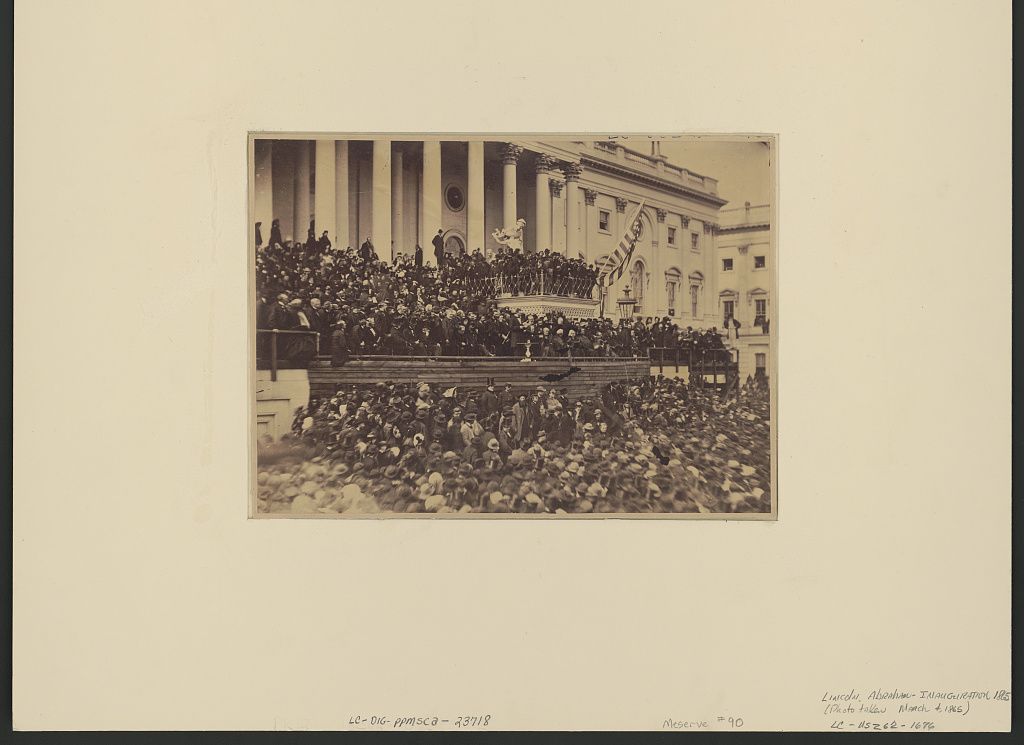
Image context: the hero image is Alexander Gardner’s photograph of Lincoln delivering the address on the east front of the Capitol, used here because the article is about the speech as a public act in a crowded, still-uncertain wartime setting.[3][4]
1) The scene matters: this was not an after-the-fact peace address
Library of Congress materials on the day emphasize how contingent the moment still felt. Washington woke to mud and heavy rain; crowds pushed toward the Capitol; Lincoln read from a prepared copy now preserved in the Library’s Abraham Lincoln Papers.[3][5] That setting matters because later memory often back-projects Union certainty onto the speech. The speech itself does not do that.
Lincoln opens by refusing the normal inaugural genre. There is almost no policy inventory, no elaborate future program, and no extended self-justification. Instead he says there is “less occasion” for an extended address than there had been four years earlier.[1][2] That sentence is easy to skim past, but structurally it does important work: he signals that the main problem is no longer what the administration intends to do. The main problem is how to interpret what the war has already revealed.
Time anchors sharpen that point:
- 1861-03-04: in the first inaugural, Lincoln argued for Union without war and ended with “We are not enemies, but friends.”[6]
- 1863-11-19: at Gettysburg, he turned battlefield death into a civic obligation for “the living,” binding sacrifice to democratic continuity.
- 1865-03-04: in the second inaugural, the frame tightens further, from constitutional crisis to moral causality inside the war itself.[1][2][6]
That sequence shows why this speech feels so compressed. It assumes the audience already knows the political argument over secession. Lincoln uses the second inaugural to ask what kind of meaning the war now compels.
2) The core turn: from partisan blame to shared implication
The most revealing sentence block begins with a cool observation: neither side expected the war to reach its actual scale or duration.[1][2] Lincoln does not flatten the difference between Union and Confederacy. He still names slavery as the interest that insurgents sought to strengthen and extend.[1][2] But he does something more difficult than a victor’s denunciation. He insists that the war’s magnitude outran everyone’s original script.
That is where the address becomes historically unusual. Instead of saying the South alone sinned and the North alone redeemed the republic, Lincoln places both sides under a common horizon of judgment. His phrase “Both read the same Bible” is not sentimental symmetry.[1][2] It is an argument that moral language itself has failed to protect the nation from self-deception.
This move matters for interpretation because it changes the logic of reconciliation. If the war is only a rebellion crushed by superior force, peace can be narrated as restoration through victory. If the war is a judgment in which slavery has implicated the whole national order, then peace requires something more disciplined: the winning side must still resist self-congratulation.[1][2]
3) Slavery appears as cause, but not in a lawyerly register
Lincoln’s handling of slavery is also more exact than the speech’s public afterlife suggests. He does not treat slavery as one issue among many. He identifies it as the cause around which the war gathered force, then asks whether the conflict may continue until the accumulated violence of slavery has been answered in kind.[1][2]
What is striking is the register. This is not the Emancipation Proclamation’s war-powers prose, nor the first inaugural’s constitutional caution. It is causal language carrying theological weight. Lincoln is not claiming privileged access to God’s plan; he explicitly warns against that presumption.[1][2] But he is willing to say that the war may be read as a judgment proportionate to a long national offense.
That distinction keeps the speech from collapsing into piety. Lincoln does not offer providence as comfort. He uses providence to limit the moral vanity of the victors. The North may be militarily ascendant in March 1865, but that ascent does not entitle it to narrate itself as innocent.[1][2]
4) Why the closing sentence lands differently in this structure
By the time the address reaches “with malice toward none,” the speech has already passed through a severe argument.[1][2] Charity is not introduced as softness. It is introduced after Lincoln has stripped the event of easy moral bookkeeping.
That is why the ending works less as absolution than as instruction. The practical verbs matter: finish the work, bind wounds, care for soldiers and families, achieve a just and lasting peace.[1][2] Reconciliation is described as labor under judgment, not as emotional release. The speech offers civic discipline, not amnesia.
Comparing the two inaugurals clarifies the change. In 1861, Lincoln still hopes feeling can pull politics back from rupture; the first inaugural ends by appealing to national affection and memory.[6] In 1865, he no longer assumes affection is enough. The war has already disclosed what sentiment failed to prevent. The second inaugural therefore builds its plea for charity on a darker foundation: after so much blood, the only safe tone is one that combines firmness, care, and moral modesty.[1][2][6]
5) Two strong interpretations
Interpretation A: this is mainly a reconciliation speech
This reading emphasizes the close, the tenderness of the language, and the administrative tasks Lincoln names for the postwar republic. It sees the address as a deliberate lowering of temperature before peace settlement.[1][2]
That reading captures something real. The speech clearly avoids revenge rhetoric, and the closing verbs are practical rather than punitive.[1][2]
Interpretation B: this is mainly a judgment speech
This reading gives priority to the middle section on slavery, providence, and proportionate suffering. On this account, the famous closing line is secondary; the real center of gravity lies in Lincoln’s refusal to narrate the war as simple Northern righteousness.[1][2]
This reading also captures something essential. The address’s most intellectually distinctive material sits in that judgment passage, not in the already-canonized last sentence.
Working assessment
The strongest reading is sequential: the address is a reconciliation speech because it is first a judgment speech. Lincoln earns the right to ask for charity by denying both sides the comfort of a shallow story about the war.[1][2] That sequencing is what gives the address its authority.
Why this address still matters
Documents of national repair often fail because they move too quickly to therapeutic language. Lincoln’s second inaugural shows a harder order of operations. First identify the structure of wrongdoing. Then refuse self-exemption. Then speak about repair.
That is why the speech remains politically alive beyond Civil War history. It shows how a winning coalition can try to govern the aftermath of violence without turning victory into innocence. The speech’s durability comes from that discipline, not from kindness alone.
Sources
- National Park Service, "Lincoln's Second Inaugural Address."
- Miller Center, "March 4, 1865: Second Inaugural Address."
- Library of Congress, "Abraham Lincoln’s Second Inauguration: Scenes from March 4, 1865."
- Library of Congress, "Abraham Lincoln delivering his second inaugural address, March 4, 1865."
- Library of Congress, "Reading copy of Abraham Lincoln's second inaugural address" (Abraham Lincoln Papers).
- Miller Center, "March 4, 1861: First Inaugural Address."