
On 1 July 1916, the opening day of the Somme offensive, the British Army suffered more than 57,000 casualties, including nearly 20,000 dead.[5] The scale is familiar in textbooks. What is easier to miss is how quickly the battle also became a problem of images. The British state wanted evidence of resolve, sacrifice, and momentum. Civilians wanted to know what this industrial war actually looked like. Into that gap came The Battle of the Somme, the 1916 feature documentary assembled from official front-line footage by Geoffrey Malins and J.B. McDowell.[2][3]
The short Imperial War Museums clip embedded below is not the film's most famous fragment. There is no over-the-top charge, no map-room explanation, no grand view of the offensive line. Instead, it shows a dressing station: stretcher-bearers arriving, wounded men waiting, orderlies sorting bodies into the next step of treatment.[1] That narrowness is exactly why the footage still matters. It reveals the Somme not as a single moment of attack, but as a throughput system for damaged men.
That was historically new. The film reached a mass audience while the battle was still being fought, and UNESCO notes that roughly 20 million people saw it in Britain within the first six weeks of release.[4] For a home front that had read communiques and casualty lists but had rarely seen front-line motion pictures, the film made one thing brutally legible: modern battle did not produce only heroic moments. It produced queues, relays, and medical chokepoints.
A filmed battle, and a managed one
The provenance matters before the clip even starts. The Battle of the Somme was an official production, not an accidental camera record. Malins and McDowell worked under War Office authority, using heavy cameras that sharply limited where they could stand and what they could capture in real time.[2][3] Some material in the finished film was genuine front-line footage; some sequences were reconstructed because an actual assault could not be filmed from the lip of the trench under live fire.[2] That mixed status is not a reason to dismiss the film. It is the condition under which early war images became public at all.
The dressing-station sequence sits on the more trustworthy side of that tension. It records a process rather than a theatrical climax. A camera can stage a charge more easily than it can fake the rhythm of tired bearers moving through a cramped aid post, the way men wait without ceremony, or the routine quality of triage under pressure. The YouTube clip's own description is blunt: a dressing station was the first point in the medical chain, where men were assessed, given basic treatment, and sent onward to casualty clearing stations by horse or motor ambulance.[1] Once you know that, the footage stops looking like a miscellaneous wartime scene. It becomes infrastructure.
The archival clip: what to watch for
The first thing the clip shows is not treatment but movement. In the opening stretch, stretcher-bearers and walking wounded enter a sandbagged, cramped zone that feels neither rear-area safe nor front-line spectacular.[1] The station is close enough to danger that everyone moves with urgency, but stable enough to have become procedural. This is one reason the sequence lands so hard. The war is visible not as a clean line between combat and refuge, but as a messy transfer point where men are still half inside the battle.
Around the middle of the clip, the eye begins to notice how impersonal the labor has become. Men wait their turn. Others are helped under cover. The camera catches not one central hero but repeated handoffs: shoulder to shoulder, stretcher to table, path to doorway.[1] Written battle narratives often privilege the instant of wounding or the drama of rescue. This footage makes a different claim. The real scale of attrition appears in the fact that no single case can dominate the frame for long. Another casualty is already arriving.
That is the sequence's deepest historical value. The Somme is often summarized through tactics, command failures, artillery preparation, or casualty totals.[5] All of that matters. But the dressing-station clip shows a different layer of truth: a mass army had to build an intake system for wounded bodies, and that system had to function under fire. Once viewers see that, the battle looks less like a single failed breakthrough and more like an industrial process with human beings moving through it at terrible speed.
What moving images show that text compresses
The clip is only a little over two minutes long, yet it communicates something casualty tables cannot. Numbers abstract damage; the camera shows throughput. One wounded man can still walk. Another has to be carried. A few pause or look briefly toward the lens, but most of the sequence belongs to the staff and bearers who keep the line moving.[1] The effect is cumulative rather than dramatic. You understand the battle by seeing repetition.
It also matters that the footage is silent to us. In the cinema in 1916, viewers would have encountered the film with musical accompaniment and with all the authority that official exhibition could give it.[2][4] Today the clip arrives as a stripped visual record, and that silence sharpens its administrative quality. There is no shouted explanation telling the viewer whom to admire. Instead, the eye keeps returning to practical details: sandbags, duckboards, bodies lifted low, bodies turned sideways to fit through tight space. The war enters history here as handling.
This does not mean the film offers unfiltered truth. Its official status shaped what could be shown, how it was edited, and what it asked civilians to believe about the offensive.[2][3] But the dressing-station material resists easy propaganda because it gives away too much about the war's actual burden. Whatever patriotic framing surrounded the feature, the bodies moving through this clip belong to a system under strain. That strain is not rhetorical. It is visible.
Why the film mattered in 1916, and why the clip matters now
UNESCO's Memory of the World register treats The Battle of the Somme as a landmark because it was among the first feature-length documentaries of war and because it reached an audience of astonishing size during the conflict itself.[4] That combination changed the relation between state, battlefield, and public. Civilian spectators no longer had only still photographs or written summaries. They had duration: enough screen time to watch labor, waiting, and evacuation unfold.
That broader context helps explain why this short clip is stronger than it first appears. It is not merely a medical interlude inserted between more dramatic scenes. It is one of the places where the film accidentally becomes most honest. Official war cinema wanted to narrate endurance and purpose. The dressing station shows the cost ledger that purpose was writing into flesh.
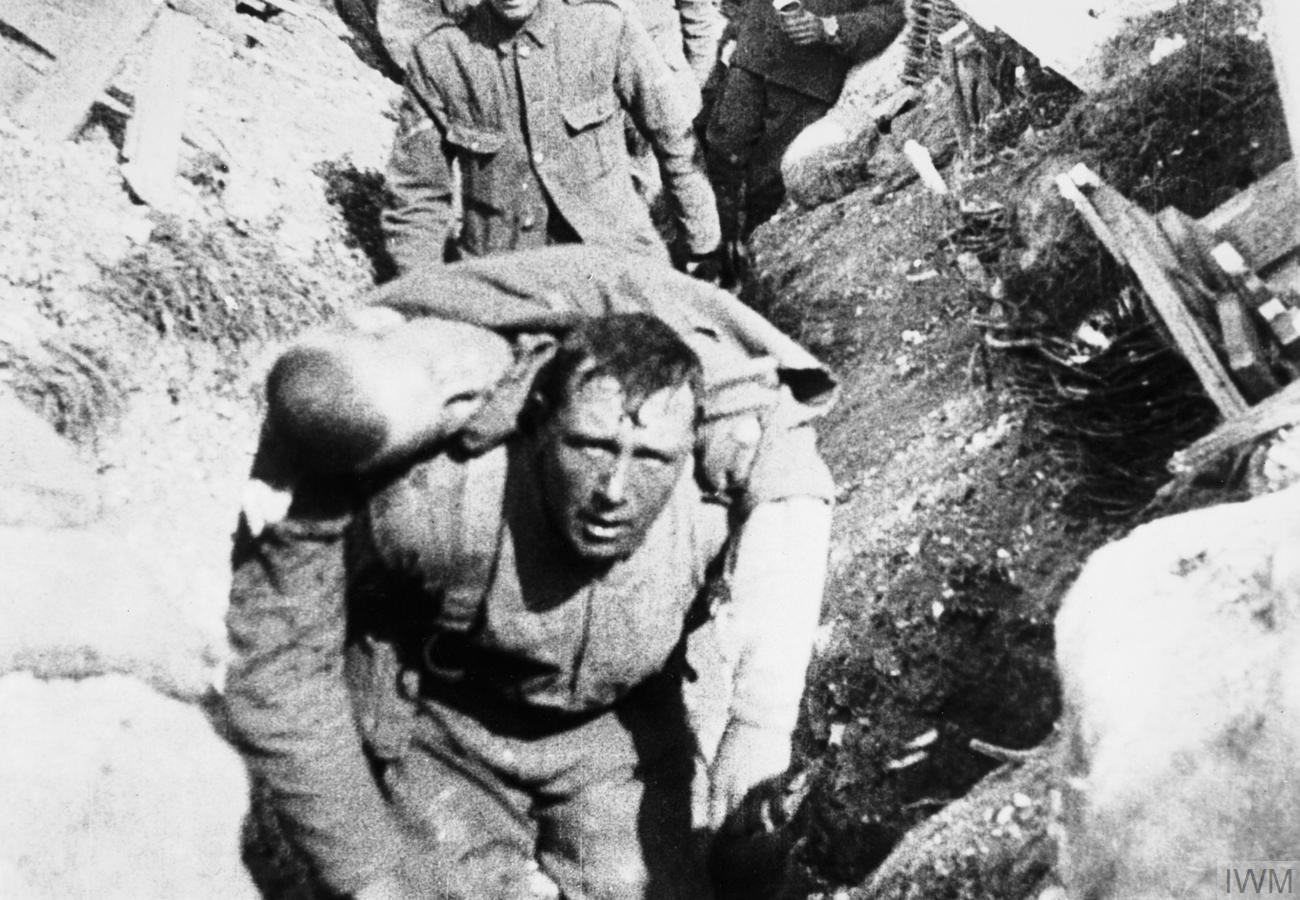
The still image used for this article, also from the film, pushes the same point in a single frame: a wounded body does not leave the battle by itself; someone has to carry it.[6][7] The moving sequence expands that truth from one rescue to a chain. Men arrive, are sorted, are moved on. The battle becomes legible as logistics, not only as courage.
That is why the clip remains worth watching in 2026. A century later, many viewers approach First World War footage looking for visual proof of mud, shellfire, or doomed frontal assault. Those elements matter, but they can turn the war into a set of iconic surfaces. The dressing-station sequence offers a colder education. It shows that the Somme was also a problem of circulation: how a mass army absorbed injury, stabilized the salvageable, and kept the consequences flowing rearward. Few archival fragments make that structure visible as efficiently as this one.
Sources
- Imperial War Museums, "The Battle of the Somme: Dressing station," YouTube clip from the 1916 film with medical-chain context.
- Imperial War Museums, "How the Battle of the Somme was filmed" — on camera placement, front-line conditions, and reconstructed sequences.
- Imperial War Museums, "Geoffrey Malins and the Battle of the Somme film" — on the official cameramen and the film's production history.
- UNESCO Memory of the World, "The Battle of the Somme" — on the film's status and unprecedented wartime audience.
- National Army Museum, "Battle of the Somme" — overview of the offensive and the first day's casualty scale.
- Imperial War Museums, "Britain's Memory of the Battle of the Somme" — on how the film's imagery shaped later public memory of the war.
- Imperial War Museums collection record, The Battle of the Somme, July-November 1916 — object entry for still Q 79501 used in this article.