
On the evening of August 8, 1974, Richard Nixon spoke from the Oval Office and told the country that he would resign the presidency effective at noon on August 9.[1][2][4] By the next day, Gerald Ford had taken the oath, Nixon had delivered farewell remarks to the White House staff, and the departure across the South Lawn toward the presidential helicopter had fixed itself in public memory.[3][5][6] The constitutional fact was simple enough: one president left office and another replaced him. The historical texture was more complicated. The transfer had to be made visible, calm, and sequential for a national audience that had spent two years watching Watergate turn government into spectacle.
That is why the address is worth embedding now. What survives in the footage is not just a statement of resignation. It is a lesson in how a constitutional crisis was reorganized into domestic time. The speech gives viewers a timetable, a frame, and a voice of continuity even while announcing rupture.[1][2] Nixon presents himself as a president still governing for a few final hours, not merely as a defendant cornered by evidence. The next morning's walk to the helicopter completes the same work in visual form: the break is real, but the state still moves in order.[3][5][6]
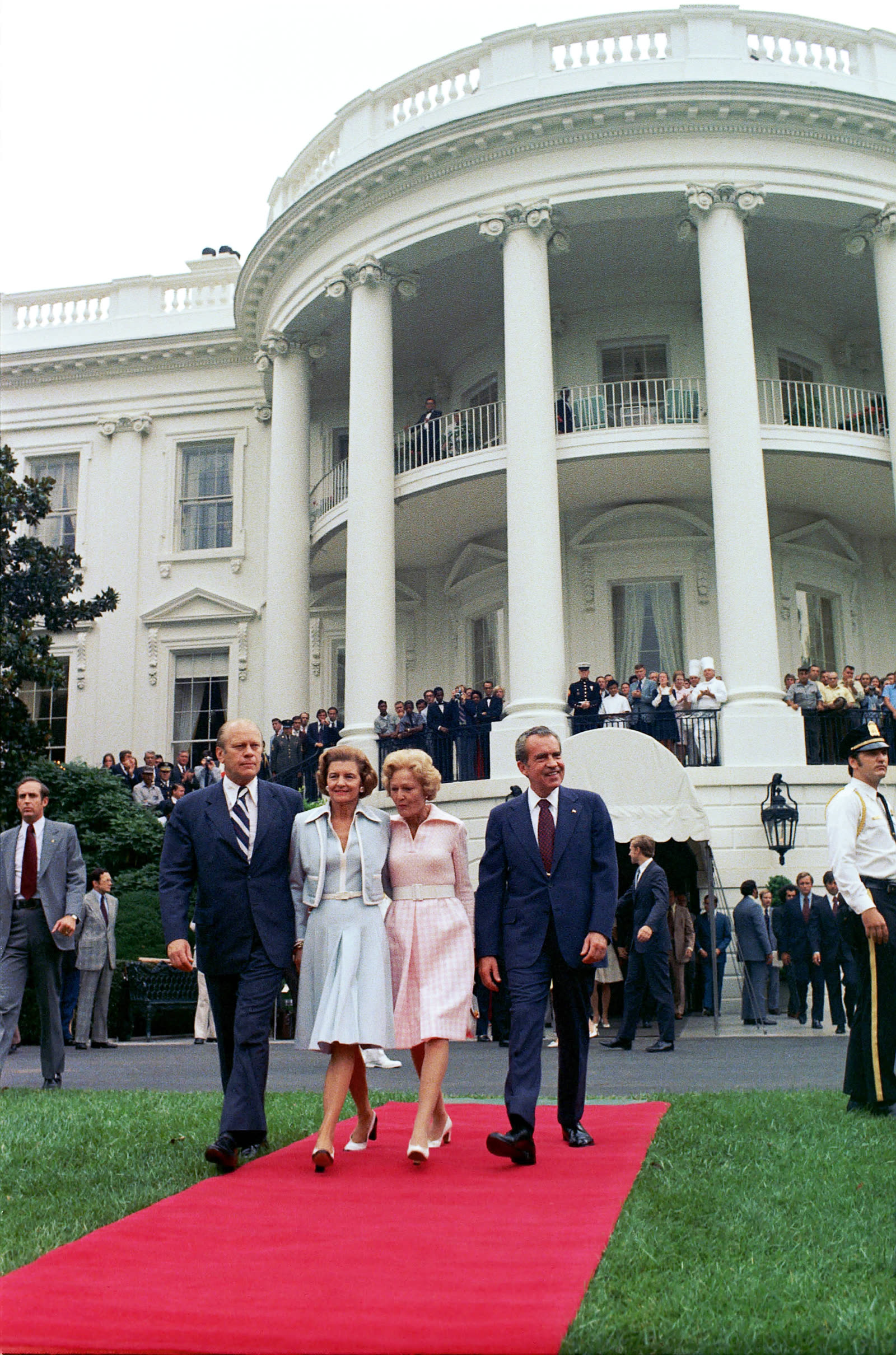
Image context: the cover uses the archival White House photograph of Richard and Pat Nixon walking with Gerald and Betty Ford toward the helicopter on August 9, 1974. It belongs here because this article is about transfer as sequence. The image catches the exact moment when resignation becomes choreography: two couples, one administration ending, another beginning, all held in a single frame.[6]
Historical context: resignation had to become a public schedule, not only a legal result
Nixon's own address gives the essential political fact. Early in the speech he says that in the previous days it had become evident that he no longer had "a strong enough political base in the Congress" to justify continuing the effort to stay in office.[2] That sentence matters because it compresses the larger collapse into a single boundary line: the presidency no longer possessed the support required to finish the term. From there the address moves away from scandal detail and toward institutional management.
This is the part easy to miss when the speech is remembered only as the moment Nixon said he would go. He is trying to convert a degrading political end into a controlled constitutional relay. The argument is not that he has been personally vindicated. The argument is that the office, the Congress, and the country need time back.[2][4] The resignation therefore becomes a schedule: the present president remains in place for the night, the vice president takes office at noon the next day, and the machinery of government is supposed to keep moving without theatrical suspension.[2][5]
That public timetable mattered because the audience for Watergate had already been trained by television. A presidency that had come apart through hearings, transcripts, and nightly reports could not exit invisibly. It had to leave in front of viewers. Inference from the source sequence: the address and the next morning's departure work together as a civic cooling mechanism. They do not heal the crisis. They make the transition legible enough that the constitutional order looks continuous even while one president is conceding failure.[1][3][5]
Video provenance
The embedded clip is C-SPAN's official YouTube upload, "President Nixon Announces Resignation."[1] The channel upload is recent, but the footage is the original White House television address from August 8, 1974, not a retrospective documentary or a dramatization.[1][2] That provenance matters for an archival spotlight. The video preserves the actual pacing, camera stillness, and rhetorical order through which resignation entered American living rooms: desk, flag, presidential seal, direct address, then the announcement that the transfer will occur at noon the next day.[1][2]
Close reading: the address turns collapse into sequence
The opening minute is already doing repair work. Nixon begins, "This is the 37th time I have spoken to you from this office," then places the speech inside the long chain of presidential addresses from the same room.[1][2] That move is structural, not ornamental. He does not open with a confession, an apology, or a legal defense. He opens by claiming continuity of office. The setting helps him. There is no audience noise, no questioner, no visible family, no hallway bustle, only the desk and the direct camera. Television narrows the crisis into a controlled rectangle.
Around the 2:24 to 3:24 mark, the speech reaches its most revealing transition.[1] Nixon says he has "never been a quitter," calls early departure abhorrent to his instincts, and then pivots almost immediately to institutional necessity: America needs "a full-time president and a full-time Congress."[1][2] The crucial sentence follows with almost bureaucratic clarity: "Therefore I shall resign the presidency effective at noon tomorrow."[1][2] This is where the footage becomes historically rich. Personal reluctance is staged only long enough to make the renunciation look dutiful rather than merely forced. The speech wants viewers to hear resignation not as collapse into chaos but as submission to timetable.
That middle passage also shows how television can domesticate constitutional language. The constitutional transfer is not shown through parchment, cabinet meetings, or congressional procedure. It is reduced to a sentence spoken in a familiar room.[1][2] Millions of viewers did not need to know the clause or study the paperwork to understand the sequence. Tonight the president speaks. Tomorrow at noon Ford takes the oath. The camera makes that chain feel immediate and household-sized.
The later portions of the address matter for a different reason. Around 6:52, Nixon says he will leave office "with regret" at not completing his term but "with gratitude" for having served.[1][2] He then spends the closing stretch reclaiming the language of accomplishment and international strategy, moving through Vietnam, peace, and the opening to China before arriving at the line that the People's Republic should "remain not our enemies but our friends" around 8:24.[1][2] This is not incidental throat-clearing. It is an attempt to leave as a president still narrating national purpose. Even in resignation he resists being reduced to Watergate alone.
That resistance is part of what makes the footage stronger than a written transcript by itself. On the page, the speech can look like a sequence of claims. On screen, viewers watch a president keep performing command while announcing its imminent end.[1][2] The body stays composed, the delivery stays measured, and the room stays presidential. The medium lets him borrow the authority of office for the last time in order to explain why he is surrendering it.
Legacy: the South Lawn walk completes what the speech begins
The address did not finish the story by itself. On August 9, 1974, Nixon gave departure remarks to staff, Ford took the oath of office, and the transition acquired its second indispensable image: the walk across the South Lawn toward the helicopter.[3][5][6] If the address organized the transfer in time, the departure photograph organized it in space. The two Nixons and the two Fords move through the same frame, and succession stops feeling abstract. It becomes bodily, directional, almost procedural.
That is why the photograph belongs beside the video. The evening address makes resignation understandable. The next morning's walk makes it visible as a handoff rather than an implosion.[3][5][6] The speech says that constitutional purpose requires a change at noon; the image shows the old and new administrations briefly sharing the same terrain before the separation becomes final. A republic that had looked trapped in scandal now looked, at least for a moment, capable of passing authority from one set of hands to another without breaking the stage on which authority appeared.
The strongest conclusion, then, is not that television redeemed Watergate or softened the underlying damage. It is narrower and more defensible. Television gave the resignation a public form that Americans could inhabit in sequence: address, timetable, oath, farewell, helicopter.[1][2][3][5] Nixon's presidency ended as law at noon on August 9, 1974. It ended as public experience when viewers watched the office detach itself from the man in a room, and then from the lawn.
Sources
- C-SPAN, "President Nixon Announces Resignation," YouTube video, uploaded August 8, 2024.
- Miller Center, "August 8, 1974: Address to the Nation Announcing Decision To Resign the Office of President" - transcript and source note.
- Miller Center, "August 9, 1974: Remarks on Departure From the White House" - transcript of Nixon's farewell before boarding Marine One.
- Richard Nixon Presidential Library and Museum, "August 8, 1974" - almanac entry on the resignation announcement.
- Richard Nixon Presidential Library and Museum, "August 9, 1974" - almanac entry on the farewell, departure, and Ford swearing-in.
- Wikimedia Commons, "File:President Richard Nixon, Pat Nixon, Vice President Gerald Ford, and Betty Ford Walking from the White House to the President's Helicopter.jpg" - archival White House photograph used as this article's image.