By the time Charles Guggenheim's Nine from Little Rock appeared in 1964, the Little Rock crisis already carried two histories at once.[1][2] One was the history Americans usually remember first: in 1957, nine Black students tried to enter Central High School, Governor Orval Faubus used the Arkansas National Guard to block them, a white mob gathered, and President Dwight Eisenhower ultimately sent federal troops so the students could attend class under armed escort.[4] The other history was about what that confrontation looked like from outside the United States. Once the crisis had been photographed, filmed, and broadcast, Little Rock ceased to be only a local segregation battle. It became an argument about whether the United States could claim democratic legitimacy while schoolchildren needed soldiers to reach a classroom.[2][5]
That second history is what makes the restored film worth watching now.[1][2] The documentary is not simply an archival container for dramatic footage. It is itself a historical artifact of interpretation, produced for the United States Information Agency rather than for a local Arkansas audience.[2][5] In other words, the film belongs to the same world as the crisis, but it does a different job. It tries to take a scene of state resistance and mob hatred and reorganize it into a narrative of constitutional correction, educational ambition, and national self-repair.
Seen that way, Nine from Little Rock matters less as a neutral recap than as a Cold War civic brief in documentary form. It shows how the federal government wanted this story to travel: not as proof that American democracy had failed beyond repair, but as proof that a democratic state could be forced, in public, to honor its own law.[2][5]
Historical context: Little Rock became a crisis because law, state power, and public schooling collided in the open
The underlying legal frame came from Brown v. Board of Education in 1954, which held that segregated public schools were unconstitutional.[4] That decision did not dissolve segregation on contact. In Little Rock, the school board adopted a gradual integration plan beginning with the 1957-1958 school year, and nine Black students agreed to enroll at the previously all-white Central High School.[4] What followed is the part that turned the city into national evidence: Faubus used state power to obstruct implementation, and the conflict became too visible for Washington to leave to local management.[4]
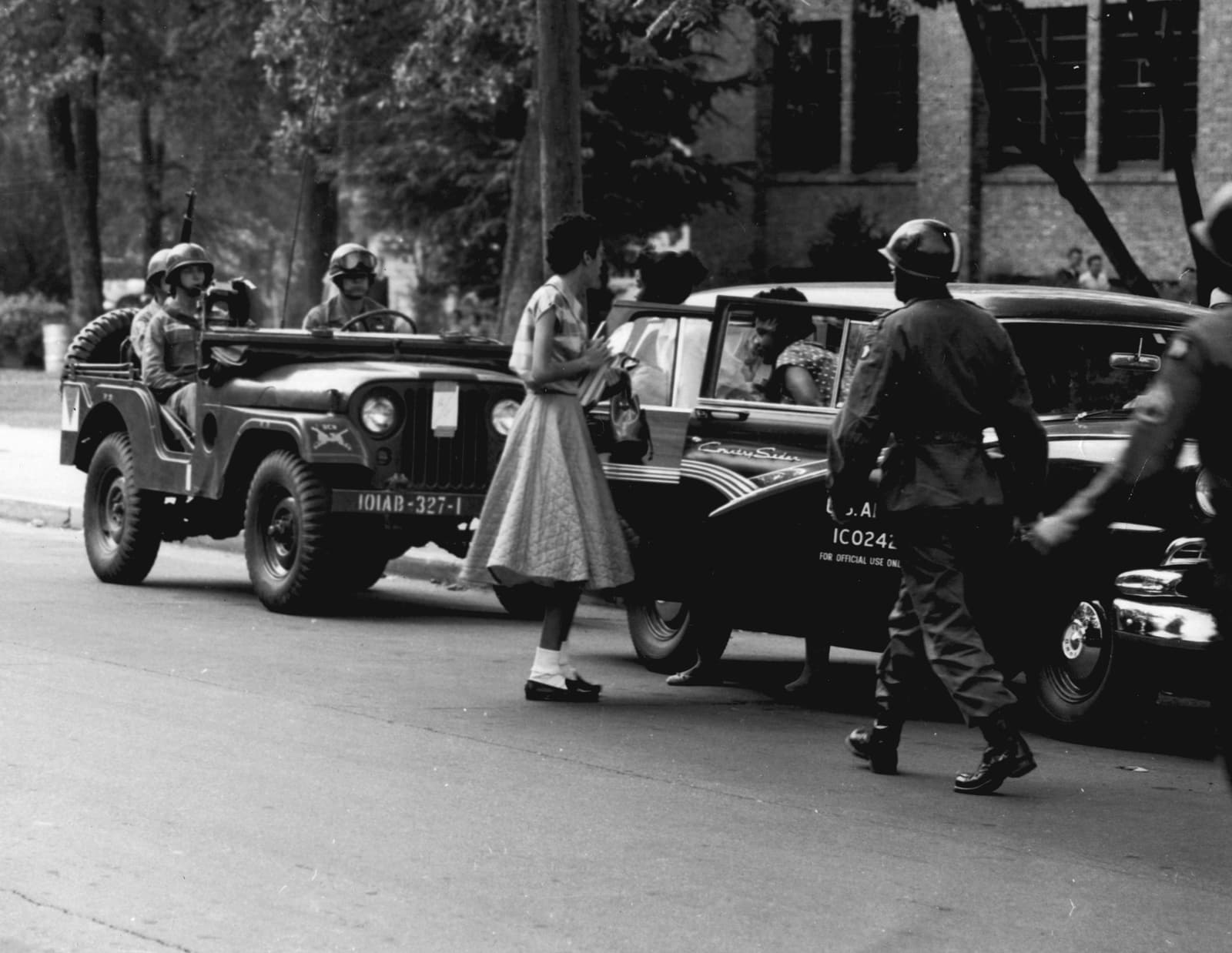
The National Park Service's summary still gives the cleanest factual chain.[4] White crowds gathered. The students were initially kept out. Eisenhower federalized the Arkansas National Guard and ordered the 101st Airborne Division to escort the students to their first full day of school on September 25, 1957.[4] Federal troops then remained at the school during the academic year. The next year, Faubus shut Little Rock's public high schools rather than allow straightforward desegregation.[4] The episode therefore did not expose one bad morning and then end. It exposed how much force the United States had to spend to make the constitutional order visible in one school corridor.
That visibility is what later made the episode useful to the USIA.[2][5] The agency's overseas film work was part of a larger system of international outreach and political persuasion.[5] So when Guggenheim made Nine from Little Rock for USIA, he was not entering a blank space. He was working with an already famous embarrassment. The documentary had to acknowledge the violence because the world had already seen it. But it also had to show something else: that the story could be narrated as a difficult but functioning democratic correction rather than as an irredeemable racial collapse.
Image context: the cover uses an archival photograph of soldiers from the 101st Airborne escorting African American students to Central High in September 1957. It belongs here because the article turns on a visual paradox the film keeps returning to: public education as an ordinary civic institution, guarded into legality by military force.[6]
Video provenance
The embed below is the U.S. National Archives upload of the restored 1964 documentary.[1] The Archives' film page identifies it as an Oscar-winning short produced and directed for the United States Information Agency by Charles Guggenheim.[2] The same page notes that NARA's Film Preservation Lab digitally restored the film in 2015 on the fiftieth anniversary of its Academy Award, while the National Archives catalog places it in Record Group 306, the records of the U.S. Information Agency.[2][3] That provenance matters because it tells us exactly what kind of object we are watching: not raw 1957 footage alone, but a later federal film built to circulate internationally.
Close reading: the film turns a segregation battle into a drama of law made visible
The opening minutes establish the documentary's strategy almost immediately.[1] Jefferson Thomas narrates over images of ordinary school life and asks how one should look back at Little Rock. The crisis is introduced not as a local dispute over school administration but as a field on which the meaning of American law will be tested in public. Around the 1:50 to 3:30 stretch, the film compresses the standoff into a stark sequence of waiting students, raised flags, marching soldiers, and a spoken insistence that rights written in law must mean something in practice.[1][4] The effect is carefully architectural. The film is interested in sidewalks, doors, hallways, and stairs because those are the places where constitutional language either acquires force or reveals its emptiness.
That is also why the military imagery matters so much. The soldiers are not decorative background. They are the documentary's answer to the central embarrassment of the story. If Little Rock exposed the fragility of desegregation, the film counters by showing the federal state stepping into the frame with discipline, order, and visible command.[1][4] The camera does not linger on endless street chaos. It lingers on marching formations, controlled entrances, and the closing of doors behind the students. The message is plain: the state is late, but the state has arrived.
The most revealing choice comes after the crisis footage. Around the 5:20 mark, the film leaps forward seven years and begins profiling members of the Little Rock Nine in colleges, classrooms, student-newsroom offices, and research settings.[1] Minnijean Brown talks about journalism; Elizabeth Eckford speaks from Central State College; Thelma Mothershed describes her desire to teach; Ernest Green appears not only as a graduate student but as a researcher using data and machines to challenge prejudice.[1] The documentary could have spent its full running time on the mob, the governor, and the troops. Instead, it reallocates much of its energy to aspiration.
That structural choice is the key to the film's historical value. It shows that the documentary's argument is not merely that Black students endured white resistance. It is that access to equal schooling produces citizens whose seriousness, competence, and ambition can be made legible on camera.[1][2] Inference from the film's design: Guggenheim and USIA are not satisfied with proving that federal force opened a door once. They want viewers abroad to see what comes after the door opens. College campuses, laboratories, and campus newspapers become evidence that integration is not only morally required but socially productive.
The scene with Ernest Green's research material is especially revealing in that respect.[1] Around the 15-minute mark, the film links data, social science, and computing imagery to the struggle against rumor and prejudice. That is more than a biographical update. It folds civil rights into a language of modern expertise. The future it wants to display is not simply interracial coexistence. It is a modernizing America in which Black advancement belongs inside universities, professional life, and knowledge systems. For an agency built to address international audiences, that was a useful claim to broadcast.[5]
What this archival footage preserves now
Because the film is so shaped, it can be watched on two levels at once.[1][2] First, it preserves indispensable evidence of how the Little Rock crisis was remembered within a few years of the event, before it settled into textbook shorthand. Second, it preserves a federal attempt to discipline that memory. The documentary does not erase violence; its opening depends on violence having happened. But it steadily converts the crisis into a narrative of lawful correction and educational futurity.
That does not make the film dishonest. It makes it legible as a state artifact. The value of the restoration is precisely that viewers can now read the film as both document and argument.[2][3] It contains authentic historical footage and authentic student voices, yet it also carries the pressure of its commission. The USIA did not need an open wound; it needed a usable answer to one.[2][5]
The result is why Nine from Little Rock still feels unusually sharp. The film never solves the contradiction at its center. It wants to celebrate democratic self-correction, but the image it must keep returning to is children entering school under armed protection.[1][4][6] That tension is the history. The documentary's achievement is not that it makes Little Rock comfortable. It is that it shows how much work the United States had to do, visually and politically, to persuade the world that constitutional principle was stronger than segregationist power.
Sources
- U.S. National Archives, Nine from Little Rock, 1964 - Restored, official YouTube upload.
- National Archives, "Nine From Little Rock, 1964" - film overview, USIA production note, Oscar history, restoration note, and catalog links.
- National Archives, "Restoring Nine from Little Rock" - Film Preservation Lab restoration notes on the 2015 restoration.
- National Park Service, "Arkansas: Little Rock Central High School National Historic Site" - chronology of the 1957 integration crisis, federal intervention, and later school closure.
- National Archives, "The USIA Motion Picture Collection and African American History" - context on USIA film holdings, overseas dissemination, and the collection's role in presenting African American history through federal film.
- Wikimedia Commons, "File:Operation Arkansas, Little Rock Nine.jpg" - archival photograph of 101st Airborne soldiers escorting African American students to Central High School in September 1957.
Editor’s Pick Review
This piece wins the 24-hour curation window on execution quality and evidence control. It keeps a clear archival question from lead to close, grounds interpretation in verifiable institutional sources, and uses the embedded film as a primary artifact rather than decoration. The argument stays disciplined: legal timeline, provenance chain, close reading, then historiographical payoff.
It also passes the stricter image gate cleanly. The lead visual is an immersive, topic-grounded archival photograph directly tied to the core claim, and the article avoids analytical/diagram-style visuals entirely. Translation coverage is publication-grade and structurally aligned with the English source, supporting cross-language editorial consistency for the pick.