
Richard Nixon's September 23, 1952 broadcast is usually remembered by its most sentimental prop: Checkers, the black-and-white cocker spaniel that a Texas supporter had sent to the Nixon children.[1][2][6] That memory is accurate, but too small. The deeper historical importance of the speech is that it showed how television could turn a political accusation into a domestic inspection. Nixon did not merely deny wrongdoing. He invited viewers to audit his life: salary, debts, mortgage, insurance, travel expenses, wife's clothes, children's attachment to a dog, and the emotional costs of public service.[1][2]
The crisis began inside the 1952 Eisenhower-Nixon ticket, after reporting about a privately raised fund used to support Nixon's political expenses.[2][5] The question was whether the Republican vice-presidential nominee had benefited improperly from donors while presenting himself as an anti-corruption figure. In an earlier media age, the answer might have been negotiated through party leaders, newspaper editorials, and a written statement. Nixon chose a different forum. He went on national television and radio, spoke for roughly half an hour, and asked the public to decide whether he should remain on the ticket.[1][2][4]
That choice makes the archival video embedded below worth more than nostalgia. The broadcast preserves a hinge moment in American political communication: the candidate as narrator, accountant, husband, father, defendant, and performer in one frame. The Smithsonian's television-in-politics overview places the Checkers speech among the early cases in which television changed how voters judged candidates, not simply by carrying policy claims but by making personality and family presentation into political evidence.[3] The moving image matters because the speech's argument depends on seeing Nixon try to make sincerity visible.
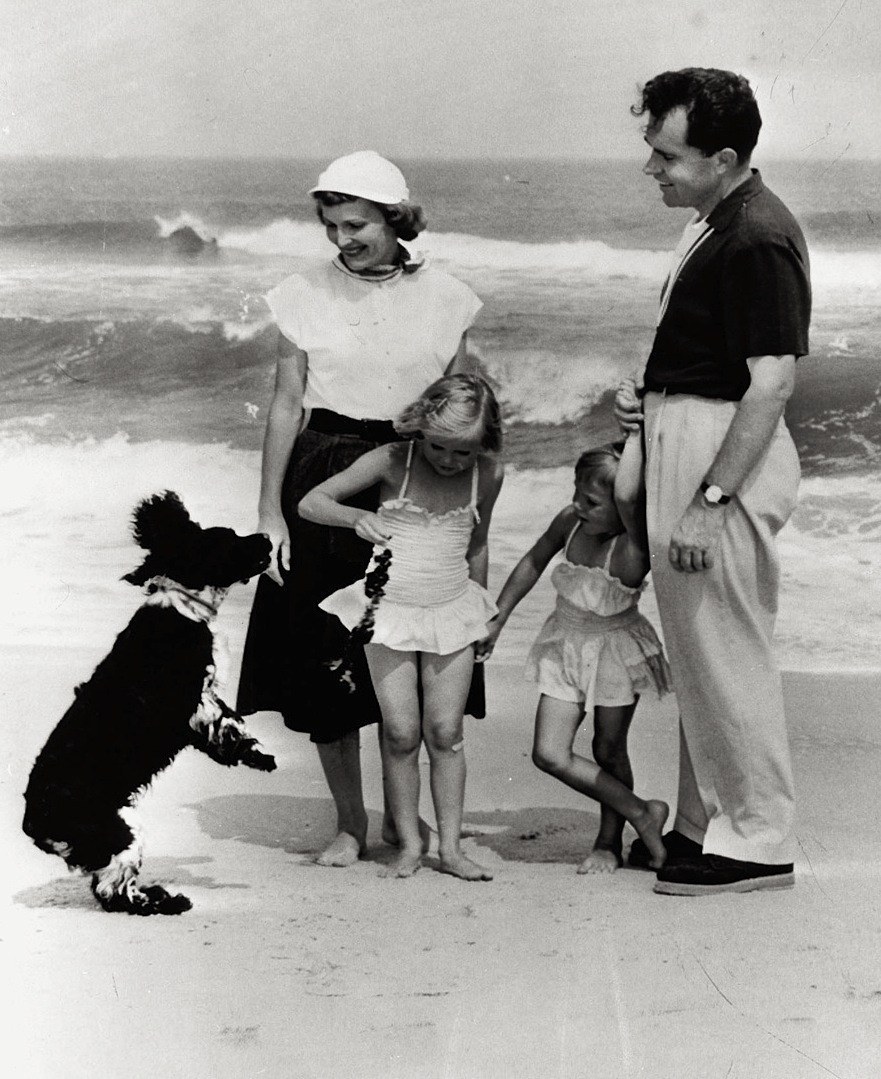
Image context: the lead image is a real archival family photograph from the Nixon Library / NARA collection, reproduced by the White House Historical Association.[6] It is not a generated visual or diagram. It shows the domestic cast that the broadcast recruited into public meaning: Richard and Pat Nixon, their daughters, and Checkers, the dog whose name became shorthand for the whole performance.
The Archival Broadcast
The embedded video is the Richard Nixon Foundation's full-version YouTube upload of the Checkers Speech.[1] The clip preserves the broadcast as a sustained direct address rather than a later documentary excerpt. Nixon sits at a desk, reads and looks up, moves through paper-heavy explanation, and then shifts into biography and family story. Its provenance is institutional rather than anonymous: the upload comes from the foundation associated with the Nixon Library environment, while the Berkeley media archive preserves the speech as an audio item under the title "Richard Nixon Fund Speech, 1952."[1][4]
The first thing the video shows is how deliberately Nixon slows the scandal down. Around the opening minutes, he does not start with Checkers or with family feeling. He starts with the accusation, the fund, and the need to answer plainly.[1][2] The desk setting matters. It makes the broadcast look like a document review conducted in a living room rather than a rally speech. Nixon is trying to establish the terms of judgment: if the issue is money, then the audience should hear a money account; if the issue is character, then the audience should hear what kind of household those accounts support.
That sequence is historically sharper than the popular memory of the dog. The dog arrives late because Nixon first needs viewers to accept the audit format. He describes expenses, tax obligations, loans, life insurance, a modest home, and family finances before he turns the pet into the line everyone remembers.[1][2] In a courtroom, that would look like evidence followed by appeal. On television, the two forms merge. The viewer is asked to treat an itemized personal budget and a child's dog as parts of the same credibility claim.
Television Makes A Ledger Intimate
What makes the speech feel so strange now is its mixture of bookkeeping and confession. Nixon's American Rhetoric transcript shows how much of the address is built from enumeration: what the fund was for, what it was not for, what he earned, what he owed, what he owned, and what gifts he had accepted.[2] This is not the language of a modern apology video, even though it is an ancestor of that genre. It is more procedural and more exposed. Nixon tries to make virtue measurable by listing obligations.
Television changes the force of that list. In print, the inventory might read as defensive clutter. On screen, it becomes a character performance. The camera lets Nixon turn ordinary financial limits into embodied humility: no mink coat for Pat, no hidden fortune, no lavish private life. That line of argument was gendered and domestic, and it depended on asking Pat Nixon's appearance, restraint, and household role to authenticate her husband's public career.[1][2] The broadcast therefore did not keep family life outside politics. It made family life the site where politics could be judged.
This is why the Checkers speech belongs in a history of media as much as in a history of campaign finance. The Smithsonian's television politics page emphasizes that television encouraged voters to evaluate candidates through images, personality, and home-like familiarity, not only through party platforms.[3] Nixon's broadcast is an early demonstration of that shift. The fund controversy was technical enough to be boring and serious enough to be fatal. Television gave Nixon a way to translate it into something viewers could feel competent to judge: does this man seem honest when he explains his own household?
The Dog Is A Small Object With A Large Job
Checkers works in the speech because the dog is both trivial and nonnegotiable. If the question is whether Nixon used donor money improperly, a pet should be beside the point. Yet the whole emotional design of the broadcast turns on that beside-the-point quality. Nixon says, in effect, that whatever else critics demand, the children will keep the dog.[1][2][6] The claim is not legal. It is moral and theatrical. He draws a boundary around the family and then asks viewers to admire the boundary.
That move did several jobs at once. It softened Nixon, who could otherwise seem combative and lawyerly. It turned a gift into a test of ordinary affection rather than influence. It shifted attention from donors to daughters. And it gave the speech a memory object. Most listeners would not retain the fund's structure, the exact financial details, or the full sequence of expense claims. They could retain Checkers. The dog made the broadcast portable.
The White House Historical Association's photo page, using Nixon Library / NARA imagery, shows how completely Checkers entered the public family story.[6] A later family photograph with the dog feels almost like a sequel to the broadcast because the speech had already made the pet politically legible. This is not because Checkers caused the crisis to vanish by magic. It is because the broadcast proved that a small domestic image could carry a candidate through a complicated legitimacy test.
What The Broadcast Changed
The immediate result was survival. Nixon remained Eisenhower's running mate, and the Republican ticket went on to win the 1952 election.[5] But the larger consequence was methodological. The broadcast taught campaigns that television could be used not only for slogans and appearances but for direct crisis management. A candidate could bypass some party intermediaries, enter the home, present himself as the best interpreter of his own conduct, and ask viewers to become a jury.
That model carried risks from the beginning. It rewarded intimacy, but intimacy can narrow politics into personality. It rewarded disclosure, but disclosure can be selective. It rewarded emotional proof, but emotional proof is not the same thing as full accountability. Nixon's speech succeeded partly because it turned a structural question about donor support into a personal question about sacrifice and sincerity.[1][2][3] The conversion was brilliant political communication. It was also a warning about how easily public finance, private biography, and television feeling could be fused.
Seen now, the most revealing feature of the video is not the famous dog line alone. It is the way Nixon keeps moving between files and feelings. He wants the audience to believe that the ledger and the living room tell the same story. That is why the broadcast still has historical force. It marks a moment when American politics learned that television could make character visible, or at least make character look visible, by arranging documents, family, voice, posture, and one unforgettable dog inside a single frame.[1][2][3][6]
Sources
- Richard Nixon Foundation, "Checkers Speech (full version)," YouTube video of Nixon's September 23, 1952 broadcast.
- American Rhetoric, "Richard M. Nixon: Checkers Speech" - transcript of Nixon's televised September 23, 1952 campaign-fund address.
- Smithsonian National Museum of American History, "On Television" - exhibition essay on television's role in changing political campaigning and candidate presentation, including Nixon-era examples.
- UC Berkeley Media Resources Center, "Richard Nixon Fund Speech, 1952" - archival audio item page for the speech.
- Associated Press, "Today in History: September 23, Nixon delivers the 'Checkers' speech" - historical calendar entry noting the speech's campaign context and outcome.
- White House Historical Association, "Richard Nixon with Checkers Dog" - archival Nixon Library / NARA family photograph source used as this article's image.