The strangest thing about Duck and Cover is not that it told children to get under desks during an atomic attack. The strangest thing is how calmly it made that instruction feel like a normal school skill. The 1951-1952 film, produced by Archer Productions with federal civil-defense sponsorship and distributed through Castle Films, uses a singing cartoon turtle, classroom scenes, street scenes, and adult narration to turn nuclear danger into a behavioral script.[1][2][4] It does not ask children to understand strategy, weapons design, fallout physics, or geopolitics. It asks them to recognize a flash, drop low, cover exposed skin, and wait for adult order.
That reduction is the historical point. By the early 1950s, the United States had entered a Cold War in which civil defense had to do emotional work as well as practical work. The Soviet atomic test of 1949, the Korean War from 1950 onward, and the creation of the Federal Civil Defense Administration placed civilians inside national-security planning in a new way.[3][4] Officials needed citizens to feel endangered enough to participate, but not so doomed that participation seemed pointless. Duck and Cover solved that communications problem by making nuclear preparedness small, repeatable, and child-sized.
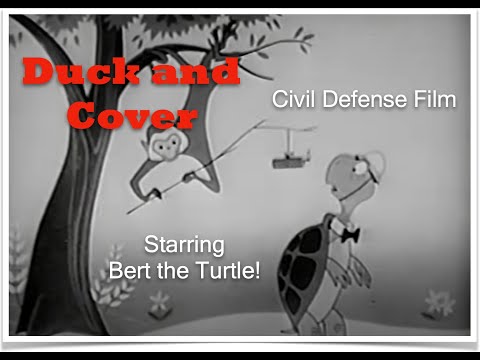
The archival film embedded below matters because it preserves that conversion in motion. A written pamphlet can tell us the program existed; a government history can explain why civil defense mattered; a later essay can track the film's withdrawal and afterlife. The film itself shows the emotional technology: Bert's shell, children's desks, picnic blankets, street curbs, walls, windows, and the repeated pairing of danger with a simple motion.[1][2][4][5] Its world is frightening, but never chaotic for long. There is always something to do.
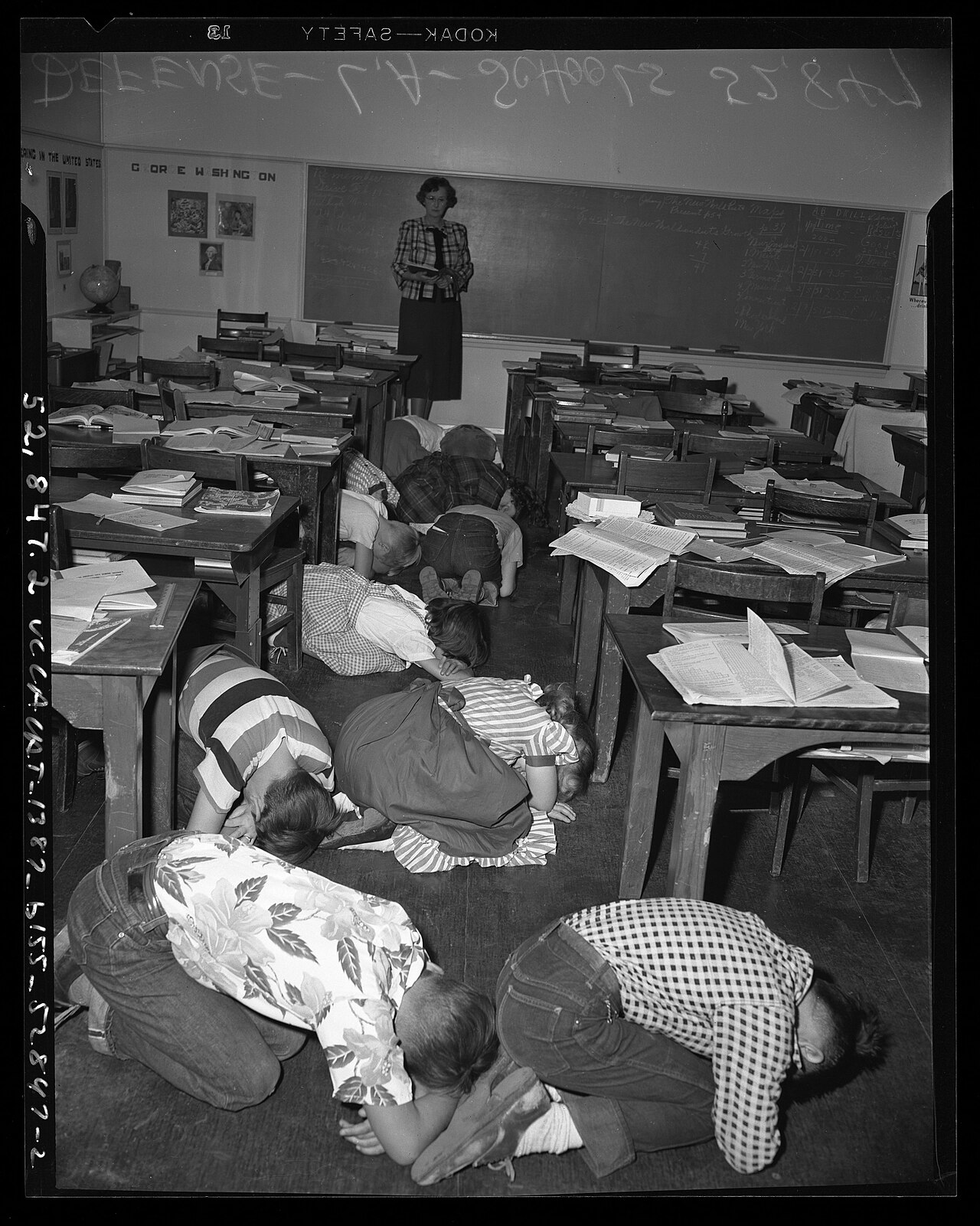
Image context: the lead image is a real Los Angeles Daily News photograph of children ducking during an atom-bomb drill, preserved through UCLA and Wikimedia Commons.[6] It is not a diagram or generated illustration. It shows the film's central premise becoming bodily routine: the classroom desk is transformed from school furniture into a symbolic shield.
The Archival Film
The embedded video is the public YouTube copy titled "Duck And Cover (1951) Bert The Turtle." The Internet Archive's Prelinger item identifies the film as an Archer Productions work from 1951, lists its topic as atomic-nuclear civil defense, gives a runtime of a little over nine minutes, and notes its selection for the 2004 National Film Registry.[2] A Library of Congress blog post in the free-to-use National Film Registry collection likewise describes Duck and Cover as a 1951 U.S. Office of Civil Defense film for schoolchildren about what to do during an atomic or other weapons attack.[5]
Why A Turtle Could Carry The Bomb
Bert the Turtle is easy to laugh at because the mismatch is so severe: a cheerful animated animal stands in for thermonuclear dread. But that mismatch is exactly why the film worked as mass instruction. A direct film about incinerated cities, blast radii, radiation sickness, or mass evacuation would have overwhelmed its intended audience and likely alarmed parents, teachers, and school boards. Bert converts fear into pattern recognition. Danger appears; Bert retreats into a shell; children learn that their own bodies must imitate that motion when no shell exists.[1][4]
The Oregon History Project's pamphlet page helps explain the scale and media strategy behind this. It says the Federal Civil Defense Administration produced the pamphlet in 1951, distributed 20 million copies, and extended the campaign through film, record album, and radio program.[4] That is not a minor classroom supplement. It is a multi-format public-education campaign designed to make civil defense recognizable across the daily life of children. The film's simplicity was not evidence that officials had no larger strategy. It was the strategy.
The film also avoids making the enemy central. It mentions atomic attack, but it keeps the child's attention on nearby objects and immediate posture. That choice depoliticizes the moment of instruction. Children are not being asked to understand the Soviet Union, Truman-era security policy, or the costs of nuclear deterrence. They are being trained to execute a reflex. The resulting lesson is almost procedural: if outside, get low against a wall or curb; if inside, move away from windows and get under cover; if warned, obey quickly; if surprised by flash, do not wait for an adult to explain what happened.[1][2]
That procedural tone is why Duck and Cover belongs in history as more than Cold War kitsch. It is a document of state pedagogy. It shows a government trying to make a new category of catastrophe teachable through the old grammar of school discipline: listen, practice, repeat, line up, follow instructions, control panic.
Civil Defense Before Fallout Changed The Lesson
The film's confidence also has to be placed in its narrow historical window. The National Park Service's civil-defense history describes early Truman-era proposals as treating thermonuclear weapons too much like a more extreme version of conventional air warfare, before the implications of hydrogen weapons and radioactive fallout were fully understood or acknowledged by officials.[3] In that context, Duck and Cover emphasized survivability through simple precautions, while shelters against blast and heat were discussed but often dismissed as prohibitively expensive.[3]
This does not mean the advice was wholly irrational under every imaginable condition. If a person was far enough from a blast to avoid immediate thermal and pressure destruction, dropping low and covering exposed skin could reduce injury from flying glass, debris, and heat flash. The problem is that the film's calm classroom logic could not carry the full range of nuclear realities. By 1954, the Castle Bravo hydrogen-bomb test made fallout's reach dramatically harder to ignore; the National Park Service notes the test's unexpectedly large yield and severe fallout consequences in the Marshall Islands and beyond.[3] A school desk might make sense for glass. It did not solve radioactive fallout, urban firestorms, mass sheltering, evacuation failure, or the political problem of preventing nuclear war.
That is why Duck and Cover is historically revealing rather than merely absurd. It captures the moment when officials still hoped civil defense could be taught as quick individual conduct. Later policy moved toward fallout shelters, building surveys, and debates over whether government should finance massive public protection systems.[3] The film belongs to the earlier phase, when the classroom drill could stand in for a broader civil-defense promise.
What The Film Shows That Later Memory Flattens
Modern viewers often remember Duck and Cover as a punchline: naive children under desks, protected by nothing. That memory contains truth, but it flattens the archive. The film is not only saying "a desk can save you." It is showing how a society tries to domesticate fear. Notice how many ordinary spaces the film recruits: a classroom, a home, a picnic, a sidewalk, a bus, a street. Nuclear war is made imaginable not through command centers but through places children already know.[1]
That spatial choice matters. The film does not tell children they can leave history. It tells them history may enter recess, lunch, windows, streets, and classrooms without warning. The home front is no longer a metaphor. It is an actual front of preparedness. In this sense, Duck and Cover belongs beside fire drills and air-raid drills, but it also exceeds them. Fire and conventional bombing had visible precedents. Atomic attack carried a scale of destruction that the film could only miniaturize, never fully describe.
The later archive adds another twist. Wikisource preserves a transcript that makes clear how explicitly the film presented itself as an official civil-defense work made in cooperation with the Federal Civil Defense Administration and the Safety Commission of the National Education Association.[5] The Internet Archive item shows the opposite side of the afterlife: a preserved public-domain moving image with hundreds of thousands of views, reviews, downloads, and metadata long after the immediate civil-defense assumptions had changed.[2] Bert remained legible because the image was simpler than the policy environment that produced him.
The Legacy: A Nine-Minute Film About Control
The lasting value of Duck and Cover is not that it gives us usable nuclear-emergency doctrine in any complete sense. It gives us a nine-minute record of control as a Cold War aspiration. The film tries to control children's posture, classroom emotions, adult authority, the visibility of fear, and the gap between national danger and personal agency.[1][4][5] It tells viewers that catastrophe becomes less terrifying when it can be rehearsed.
That aspiration was not unique to children. The National Park Service history shows that civil defense under Eisenhower turned repeatedly toward cheaper mass evacuation ideas, private shelter construction, public information, and eventually building-survey methods for fallout protection.[3] All of those programs shared a problem: how to make civilians part of nuclear strategy without admitting that survival depended on variables far beyond individual discipline. Duck and Cover is simply the most memorable child-facing version of that dilemma.
The archival image of children under desks and the film of Bert retreating into his shell therefore belong together.[1][6] One is real classroom practice; the other is the media script that made the posture meaningful. Neither should be read as pure fraud or pure safety science. Together they show a society trying to convert world-ending danger into a set of gestures small enough for a school day. That is why the film still has historical force. It is funny, eerie, and inadequate all at once, because the problem it tried to solve was not only how to protect children from a bomb. It was how to make children, teachers, and parents believe that order could still be performed under the shadow of nuclear war.
Sources
- Best Film Archives, "Duck And Cover (1951) Bert The Turtle," YouTube video copy of the civil-defense film.
- Internet Archive / Prelinger Archives, "Duck and Cover" - public-domain item page with Archer Productions metadata, runtime, topic tags, download files, and National Film Registry note.
- National Park Service, "Civil Defense Through Eisenhower" - institutional history of early Cold War civil defense, Duck and Cover, hydrogen-bomb fallout, shelter debates, and policy shifts.
- DocsLib mirror of Oregon Historical Society / Oregon History Project, "Duck and Cover, Civil Defense Pamphlet" - text of the 1951 FCDA pamphlet record covering campaign distribution, Alert America, school showings, and Bert the Turtle.
- Wikisource, "Duck and Cover" - validated transcript identifying the film as an official civil-defense work produced with the FCDA and the National Education Association safety commission.
- Wikimedia Commons, "File:Atom bomb drill at school in Los Angeles, Calif., circa 1951.jpg" - source page for the Los Angeles Daily News archival classroom-drill photograph used as the article image.