The easy Ghost Army story is irresistible: a few artists inflated rubber tanks, German reconnaissance mistook theater for armor, and Allied soldiers won battles by making war look like stagecraft. That version is not false so much as incomplete. The dummy tanks were real, and they were visually absurd up close. But the 23rd Headquarters Special Troops did not succeed because rubber could magically impersonate steel. It succeeded when visual props, radio traffic, loudspeaker soundscapes, unit markings, convoys, officer behavior, and local rumor all told the same false story at once.[1][2]
The evidence starts with the unit's design. Activated on January 20, 1944, the 23rd was a deliberately mobile, multimedia tactical deception force with an authorized strength of 82 officers and 1,023 men under Colonel Harry L. Reeder.[1] The National WWII Museum describes it as capable of simulating two whole divisions, about 30,000 men, through visual, sonic, and radio deception.[1] That ratio is the clue. A thousand people could not physically become 30,000. They could only make an enemy intelligence system believe that 30,000 were nearby.
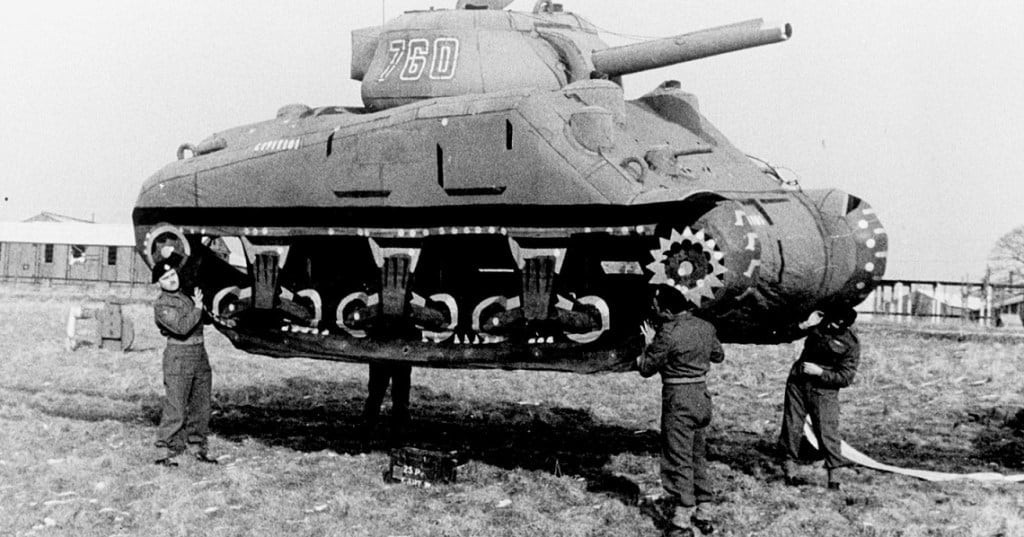
The photograph attached to this article preserves the myth's most famous object: soldiers lifting a dummy Sherman tank as if a tank had become theater canvas.[5] It belongs here because it also punctures the myth. If four men can carry the "tank," then the tank alone was never the trick. The trick was to arrange the battlefield so that the enemy saw it from the wrong distance, heard supporting evidence, intercepted confirming radio messages, and encountered human performances that made the false unit feel administratively alive.
Myth: the inflatables did the deceiving
The inflatable tank is the perfect museum object because it compresses the whole story into one image. It is funny, legible, and photogenic. But battlefield deception depended on what the observer did not get to inspect. From the air, in partial camouflage, at speed, or through haze and distance, a dummy tank could register as armor. At walking distance it could become a joke. The Ghost Army's problem was therefore not "make a perfect tank." It was "control the conditions of recognition."[1][2]
That distinction changes the history. The 603rd Engineer Camouflage Battalion supplied much of the visual deception, but the 23rd also needed radio operators and sonic specialists.[2] The Ghost Army Legacy Project's overview emphasizes that each deception required the unit to impersonate a different, larger American formation. The men changed bumper markings, staged phony headquarters, sent false radio traffic, and let local civilians hear planted stories in cafes and roads where informants might be listening.[2] In other words, the visual prop was one clue in a larger intelligence puzzle.
The myth also flatters the object at the expense of timing. Decoys were often placed under darkness, arranged where reconnaissance might plausibly see them, and camouflaged imperfectly enough to be found. Perfect concealment would defeat the purpose. The target was not a careful museum visitor. It was an enemy staff trying to update a map under pressure.
Evidence: the system had to agree with itself
Operation Brest shows why the system mattered. In August 1944, as American forces pressed against the German-held port of Brest, the 23rd used visual, radio, and sonic deception together for the first time.[3] The Legacy Project's operation history describes the objective as enlarging the apparent American force, drawing German attention toward the flanks, and supporting VIII Corps' plan for an assault on August 25, 1944.[3] If the Germans saw dummy armor but heard no traffic, no movement, no artillery coordination, and no headquarters behavior, the illusion would thin out quickly.
The sonic element is especially useful for breaking the tank myth. The 3132nd Signal Service Company Special used sound trucks to project recorded armor and infantry noises into the night.[3] Sound did not replace visual deception; it gave the scene depth. A tank park should not be silent. A unit preparing to move should have engines, maintenance, voices, and traffic. The Ghost Army's soundscape helped persuade listeners that the visual tableau belonged to a living formation rather than a collection of props.
Radio deception worked the same way. Armies are bureaucracies with antennas. A division leaves traces: call signs, message volume, net discipline, staff habits, and the ordinary chatter of units coordinating themselves. False radio traffic gave the phantom formation a nervous system. The enemy could intercept a pattern, compare it with what aerial reconnaissance seemed to show, and draw the wrong conclusion for rational reasons.[1][2]
Myth: it was harmless theater behind the lines
Calling the Ghost Army theatrical can make the work sound safer than it was. The unit was armed lightly, with nothing heavier than .50 caliber machine guns, and the National WWII Museum notes that the 23rd took part in 22 large-scale deceptions in Europe from Normandy to the Rhine.[1] Their assignment often required them to appear close enough to danger to be believed. A fake force that never risks contact is not a convincing force.
The danger also came from what success meant. If German artillery, patrols, or reserves responded to the fake formation, the deception force could become the place where real fire landed. The 3133rd Signal Service Company Special, operating separately in Italy with about 200 men, offers a blunt example. During an April 1945 deception connected to the Allied assault on the Gothic Line, postwar reporting cited by the Legacy Project said 24 of 35 dummy tanks were knocked out by enemy fire.[3] The equipment was fake; the shells were not.
This is the better boundary between myth and evidence. The Ghost Army did practice illusion, but it practiced illusion inside combat geography. The men were not simply artists dressing a set. They were soldiers placing a false center of gravity where the enemy might shoot, shift reserves, or hesitate.
Evidence: deception exploited the enemy's method
The most successful deception does not ask an enemy to become foolish. It gives the enemy enough credible fragments to make the wrong professional inference. Operation Viersen in March 1945 is remembered because the 23rd helped suggest a Rhine crossing away from the real assault point.[4] AP's account of the later Gold Medal ceremony describes it as one of the unit's largest missions: German forces were drawn toward the river opposite the deception instead of the U.S. Ninth Army's actual crossing area.[4] The point was not that German intelligence could not tell rubber from steel. The point was that all available indicators seemed to fit a plausible operational story.
That is why personnel mattered. The 23rd included artists, engineers, professional soldiers, and draftees; later accounts often name figures such as Ellsworth Kelly, Bill Blass, and Art Kane because the artistic afterlives are striking.[1][4] But the unit's work was not art in the gallery sense. It was applied recognition management. Artists knew how to make surfaces read from a distance. Radio operators knew how formations sounded administratively. Engineers knew how equipment, tracks, and site layout should look. Soldiers knew what behavior would seem normal to other soldiers.
Congress's later Gold Medal legislation captures the broader category better than the popular rubber-tank shorthand. Public Law 117-85 recognized the 23rd Headquarters Special Troops and the 3133rd Signal Service Company for deception operations in Europe during World War II.[6] The statutory language matters because it honors units, not objects. The achievement was collective method.
Myth: the story was always known
The Ghost Army now feels like a ready-made documentary subject: artists, secrecy, battlefield spectacle, and a clean moral payoff. But its public memory is relatively late. The U.S. Army article accompanying the archival tank photograph states that the unit's efforts were classified until 1993.[5] Later public accounts, museum exhibitions, advocacy, and the 2022 Gold Medal law brought the unit into wider recognition.[4][6]
This delay shaped the myth. When a secret operation becomes public long after the event, the most visual elements often carry the story first. Photographs of inflatable tanks do what files, radio logs, and operation reports cannot do at a glance. They recruit attention. The risk is that attention becomes explanation.
The archival image should therefore be read twice. First, it shows the astonishing material fact: a tank that can be lifted by hand. Second, it shows why the tank cannot be the whole explanation. Anyone close enough to see those men carrying it would know the truth. The Ghost Army's skill lay in making sure the decisive observers were not that close, and that every other sign available to them pointed toward the same false conclusion.
The stronger version of the story
The better Ghost Army story is not less strange than the myth. It is stranger because it treats deception as a working system. A dummy tank needed a credible road. A road needed tracks. Tracks needed traffic. Traffic needed radio. Radio needed unit identity. Unit identity needed people behaving as if the imaginary formation had officers, problems, schedules, noise, and paperwork. The whole illusion had to be good enough for wartime intelligence, not good enough for leisurely inspection.
That is why the Ghost Army belongs in history rather than trivia. It shows that battlefield knowledge is assembled from fragments, and that fragments can be authored. Between 1944 and 1945, small deception units learned to write false evidence across sight, sound, signal, and social space.[1][2][3] Inflatable tanks were the visible joke. The serious lesson was that an army could manipulate the process by which another army decided what was real.
Sources
- The National WWII Museum, "Ghost Army: The Combat Con Artists of World War II" - exhibition page summarizing activation, size, command, 22 deceptions, and multimedia tactical-deception role.
- Ghost Army Legacy Project, "23rd Headquarters Special Troops" - overview of the unit's mission, components, impersonation work, and visual/radio/sonic methods.
- Ghost Army Legacy Project, "Official History of the 23rd Headquarters Special Troops" - operation histories for Brest, Bettembourg, and the 3133rd Signal Service Company Special.
- Associated Press, "Ghost Army members who deceived Nazis with battlefield ruses in WWII given Congressional Gold Medal" (March 21, 2024) - ceremony report with unit scale, Italy detachment, and Operation Viersen context.
- Amanda Sullivan, "Fort Leonard Wood examines WWII 'Ghost Army' deception tactics," U.S. Army (June 9, 2021) - Army article and National Archives image source for soldiers moving an inflatable tank.
- U.S. Congress, Public Law 117-85 / S.1404, "Ghost Army Congressional Gold Medal Act" - statutory recognition of the 23rd Headquarters Special Troops and 3133rd Signal Service Company.