George Washington asked his officers to trust a government that had failed to pay them. The difficulty of that request runs through his address of 15 March 1783. He defended Congress, condemned the use of the army to force its hand, and promised to keep pursuing the officers’ claims himself. His argument depended on holding those commitments together.[1]
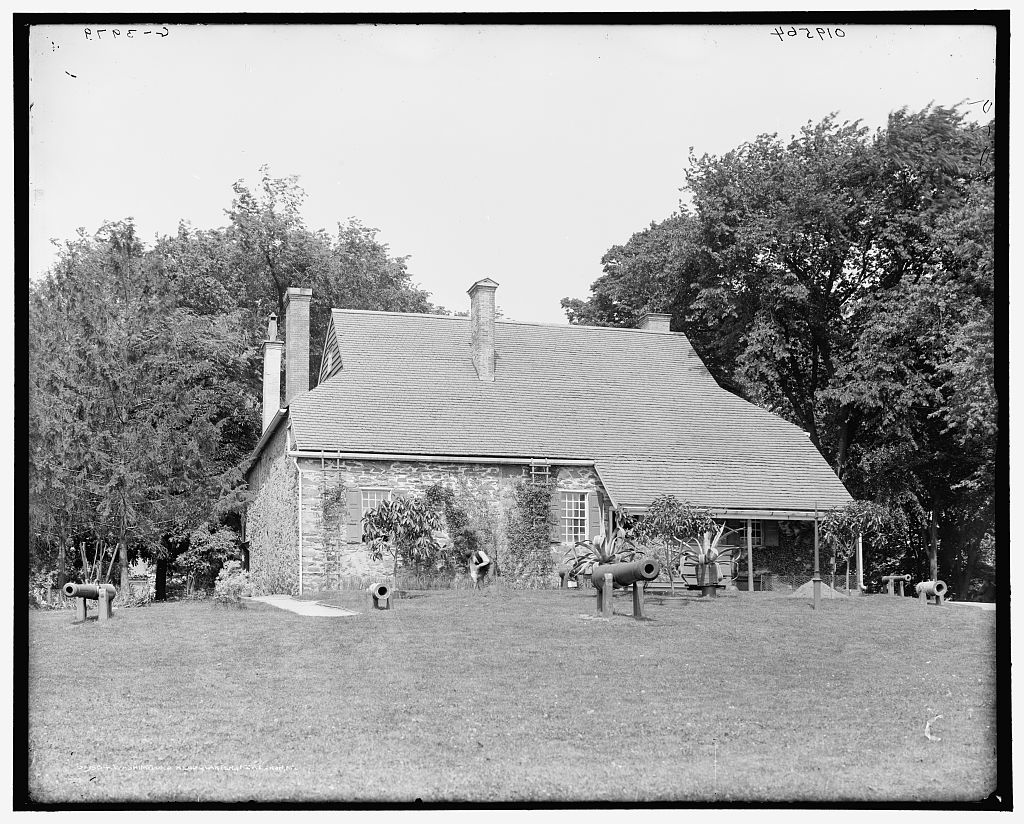
The officers gathered at the New Building in the New Windsor cantonment, near Washington’s headquarters at Newburgh, New York. Congress depended on requisitions from the states, whose unreliable contributions had left the army short of money. As the war approached its end, officers feared that dispersal would leave their claims easier to ignore. An anonymous address circulating on 10 March made that fear the reason to act while they still possessed their arms.[2][3]
Reading the two appeals together reveals a struggle over what military service entitled its survivors to demand. Washington’s answer placed a limit on the means they could use. His next letter to Congress placed a corresponding burden on the government they were being asked to obey.
The fear of going home
The anonymous writer understood that peace could look threatening to men who had spent years pursuing it. His address moves from shared hardship to a question about bargaining power: if the country neglected its officers while their swords remained useful, what treatment could they expect after returning to private life?[3]
Its imagined veteran grows old in poverty, dependent on charity. That prospect gives the appeal its force. The writer does not begin with a constitutional theory of military government. He begins with the humiliation of having served a country that might leave the servant destitute. He then urges the officers to move their appeal from the government’s sense of justice to its fear.[3]
Two alternatives follow. If peace comes, they should retain their arms; if war continues, they should withdraw to unsettled territory and leave the country exposed. The address also tells them to distrust anyone recommending further moderation. Together, those moves make patience appear both dangerous and dishonorable.[3]
The identity and coordination of the people behind the crisis remain subjects of historical disagreement. The surviving appeal nevertheless establishes the pressure being urged: continued military cohesion was to become an instrument for securing payment. It does not, by itself, establish a detailed operational plan to overthrow Congress.[2][3]
Permission to deliberate
Washington’s first intervention changed the meeting. His 11 March general orders disapproved of the anonymously summoned gathering but called an authorized assembly for Saturday, 15 March. General and field officers, a representative from each company, and staff representatives would hear the army committee’s report from Congress. The senior officer present would preside and report their deliberations to him.[4]
This was a consequential choice. He gave the grievance a place within the army’s procedures. His order expressly invited discussion of further measures to obtain the object sought, which he described as just and important. Officers were being asked to deliberate under recognized authority.[4]
The address delivered four days later makes the same distinction explicit. Washington explains that opposing the hurried meeting did not mean opposing an opportunity to “make known your grievances.” He then invokes his years alongside the army: he has witnessed its distress, defended its reputation and understood his own standing as inseparable from its conduct.[1]
That passage supplies the basis for his criticism. A commander who appeared indifferent to unpaid service would have had difficulty asking for more endurance. Washington presents himself as a witness to the injury before explaining why the proposed remedy would deepen it.
Who would the army leave behind?
When Washington turns to the threatened withdrawal, he makes the anonymous writer’s abstraction concrete. The country left undefended contains the officers’ wives, children, farms and property. Taking families into the wilderness would expose them to hunger and cold; leaving them behind would place them among the people abandoned.[1]
This is an argument about consequences as well as loyalty. The army cannot neatly separate the government it resents from the households it has been fighting to protect. Washington asks the officers to imagine carrying out the proposal beyond the satisfying moment of declaring it.
The peace alternative presents a different danger. Retaining arms until Congress complies would turn military force toward the country itself. Washington describes the prospect as civil discord and bloodshed. His language is deliberately alarming, but it is a warning about where coercion might lead, rather than proof that every officer had already agreed to that destination.[1]
He also challenges the instruction to suspect anyone advocating moderation. If dissenting advice is disallowed, he says, “reason is of no use to us.” The immediate point concerns freedom to argue within this dispute. The anonymous appeal claims to defend the officers’ interests while narrowing the range of judgments they are permitted to make.[1][3]
Washington’s own speech is hardly free of emotional pressure. It invokes families, comradeship, honor and posterity. The difference lies in the action those appeals support: continued deliberation, respect for Congress and advocacy through a commander who promises to remain engaged.
The promise went in both directions
Washington assures the officers that Congress intends to do justice and explains its slowness through the competing interests it must reconcile. These are assurances he asks his audience to accept; the speech itself cannot establish that Congress will find the money.[1]
His letter of 18 March to congressional president Elias Boudinot makes that limitation especially revealing. Reporting the officers’ unanimous proceedings, Washington asks Congress to “verify the predictions” he has made. He has vouched for the government in front of the army. Now he asks the government to justify that confidence.[5]
The letter defends compensation beyond ordinary wages and connects dependable funding with national credit and future tranquility. Its urgency survives the meeting’s peaceful outcome. In Washington’s account, restoring discipline has increased the officers’ claim to gratitude; it has not extinguished their claim to payment.[5]
On 22 March, Congress offered eligible officers five years’ full pay in place of the lifetime half-pay previously promised. The resolution allowed payment in money or securities bearing six percent annual interest, according to Congress’s convenience. Acceptance was organized collectively by state lines or corps, rather than left to each serving officer separately.[6]
That was a change in the terms of compensation. It was not proof that cash had immediately reached every claimant. The distinction matters because an ending in which a speech makes everyone loyal and everyone paid would erase the problem the documents preserve.
Washington had asked the officers to surrender a dangerous way of making themselves heard while maintaining their right to seek redress. His subsequent appeal to Congress completes the argument: the government’s authority required restraint from the army, and its credibility required action on the debt.
Sources
- George Washington, Newburgh Address, 15 March 1783. National Constitution Center—full text of the prepared address; analysis here concerns the document rather than later accounts of its delivery.
- Michael Hattem, updated by Zoie Horecny, “Newburgh Conspiracy.” George Washington’s Mount Vernon, 26 March 2025—financial context, meeting location and historical uncertainty about the crisis’s coordination.
- Anonymous, “Address to the Officers of the Army,” 10 March 1783. Gilder Lehrman Collection, GLC02437.01994, via AM Digital—Henry Knox’s copy in Samuel Shaw’s hand; public transcript of the appeal and accompanying summons.
- George Washington, General Orders, 11 March 1783. Founders Online, National Archives—order establishing the authorized officers’ meeting; early-access transcription.
- George Washington to Elias Boudinot, 18 March 1783, “Letter to the President of Congress.” Teaching American History—transcription credited to Founders Online, covering continued advocacy and the request that Congress fulfill his assurances.
- Continental Congress, resolution on half-pay commutation, 22 March 1783. Gilder Lehrman Collection, GLC02437.02017, via AM Digital—public transcript of the certified copy, including securities and collective acceptance provisions.
- Detroit Publishing Company, “Washington’s headquarters, Newburgh, N.Y.,” circa 1906. Library of Congress, LC-D4-19564, digital image det.4a13488—archival photograph downloaded from the Library’s image service.