In June 2022, Euston station installed a projection screen and graphics near the ramp to platforms 8–11 to commemorate its demolished Doric Arch. Network Rail explained that the arch had stood inside the later station footprint, away from the surviving lodges on Euston Road.[1]
A passenger looking for it at the road entrance would therefore be remembering the wrong place. That small displacement opens a larger question. Once a landmark has been demolished, what can its photographs, salvaged fragments and memorials actually preserve?
A gateway becomes an obstruction
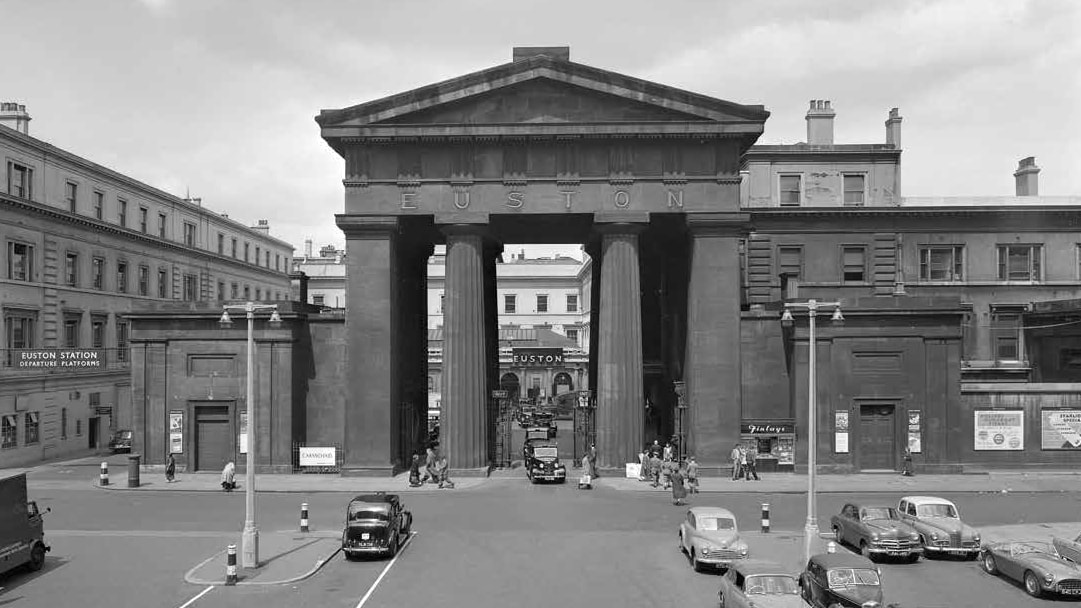
Euston opened on 20 July 1837, initially serving a line as far as Boxmoor. Philip Hardwick's monumental gateway gave the new railway an architectural entrance. Behind it, the original station had just two platforms, for arriving and departing trains. The Great Hall added during the expansion begun in 1846 occupied the space between gateway and platforms.[2]
The sequence matters. What became a celebrated historic ensemble had itself accumulated around a growing transport business. Network Rail's history describes repeated enlargements, followed by plans for a complete rebuild associated with mainline electrification. In that account, the land occupied by the arch and hall was needed to reorganise train movements.[2]
Preservationists faced an argument about the railway's future, not merely a dislike of old stone. But accepting the need for better trains did not settle whether the gateway had to disappear. The dispute concerned which parts of the past could travel into the new station, and who would pay to move them.
The price of keeping it—and the time to find it
In a Commons written answer on 12 July 1961, transport minister Ernest Marples defended the reconstruction through electrification, traffic growth and ageing Underground lifts. He reported that advisers considered preservation on the existing site impracticable. Dismantling and re-erecting the arch elsewhere, without its flanking lodges, was estimated at £190,000; straightforward demolition at £12,000.[3]
These were estimates presented by the government making the decision. They establish its stated comparison, rather than independently proving that every possible design had been exhausted. Marples acknowledged the arch's historical importance while concluding that keeping it did not justify the expenditure.[3]
Testing that conclusion would require an independently costed alternative that could also meet the railway's operating needs.
Money was only one boundary. On 1 August 1961, MP Tom Driberg asked for a delay while preservation or re-erection by public subscription was explored. Parliamentary secretary Keith Joseph refused, citing disruption to the urgent Underground works. Driberg also challenged the assumption that competent architects could not incorporate valuable old features into a new scheme.[4]
The exchange exposes a practical condition of preservation: alternatives need time to become proposals, attract support and secure funds. A proposal for private contributions had little room to develop if the construction timetable could not accommodate a fundraising campaign. The official answer closed that interval.[4]
The railway engineer who kept the dimensions
Demolition in 1961–62 removed the structure, but generated another kind of survival.[1][5] Bruce Allen Ormerod, the resident British Railways engineer at Euston, measured the arch during its destruction. Historic England's catalogue records plans, sections and perspective drawings, preserved in sets on different materials. His photograph album includes views before and during demolition, including the interior.[5]
This complicates an easy division between railway modernisers and people who cared about the past. The record was made by someone working within the railway. His measurements could preserve relationships between parts even as those parts were separated.
The collection entered the English Heritage Archive in 2012.[5] Its institutional survival gives later viewers something more exact than an attractive silhouette. Yet a measured drawing cannot reproduce the experience of passing beneath a gateway. Recording and retaining a building answer different needs; the excellence of the former cannot retroactively deliver the latter.
Stone recovered, architecture still missing
Some of the masonry acquired a remarkably unceremonious second use. A contemporary Londonist report described stones recovered from the Prescott Channel in east London in May 2009, where material from the arch had been used to fill a hole in the waterway bed. The report connected their recovery with the campaign to rebuild the arch and with canal work for the Olympic site.[6]
The fragments carried two histories at once. They were pieces of Hardwick's gateway, but their location also documented what happened after demolition: material valued for its weight and usefulness, detached from the architectural relationships that once made it a monument.
Recovering such stone changes what a reconstruction campaign can ask for. Original fabric might be incorporated into a rebuilt structure. It does not, by itself, resolve the design, location, missing material or funding. A recovered block is evidence of survival, not evidence that the building has returned.
A memorial can locate a loss
The 2022 installation, funded by the Railway Heritage Trust, placed an image near the old location within a working station. In the announcement, the trust's executive director Andy Savage condemned demolition rather than relocation.[1]
Each surviving form asks something different of its audience. Ormerod's archive permits examination. Recovered masonry gives a rebuilding proposal material to work with. A station display can interrupt an ordinary journey long enough to explain what stood there.
Their value depends on keeping those distinctions visible. A photograph can show an intact arch; a fragment can connect a hand to its original stone. Neither preserves the old passage through it. Remembering Euston well means holding together the richness of what survives and the particular experience that demolition ended.
Sources
- Network Rail, “Video installation pays tribute to Euston station's former Doric Arch,” 1 June 2022 — memorial location, Railway Heritage Trust commentary, demolition period and National Railway Museum photograph.
- Network Rail, “The history of London Euston station” — opening, Hardwick's gateway, station expansion and the railway's account of redevelopment.
- House of Commons, “Euston Station (Doric Arch),” written answer, 12 July 1961 — Ernest Marples's statement of operational requirements and comparative cost estimates.
- House of Commons, “Euston Station (Doric Arch),” 1 August 1961, vol. 645, cols. 1118–1119 — Tom Driberg and Keith Joseph on public subscription, design and delay.
- Historic England Archive, B A Ormerod Collection: Euston Arch, OMD01 — measured drawings, photographic record and acquisition history.
- Dean Nicholas, “Arise, Poor Doric: Euston Arch Stones Recovered,” Londonist, 18 May 2009 — contemporary reporting on recovered masonry and the rebuilding campaign.