On the evening of 30 June 1836, spectators gathered around Guernsey's harbour to watch Henry Trengrouse demonstrate his shipwreck rescue apparatus. A rocket fired from the brig Daphne carried a line across the water on its second attempt. A heavier rope followed. Then a young man climbed into a suspended chair and began the journey toward the pier.[1]
He stopped halfway. The travelling mechanism jammed, leaving him bobbing above and occasionally into the water until a boat collected him. A lighter boy subsequently completed the crossing, with some wet interruptions. Reporting the trial on 4 July, the Comet hesitated to condemn equipment it thought insufficiently prepared. But its practical reservation was sharp: getting a line across looked easier than securing a rope that could carry a person safely.[1]
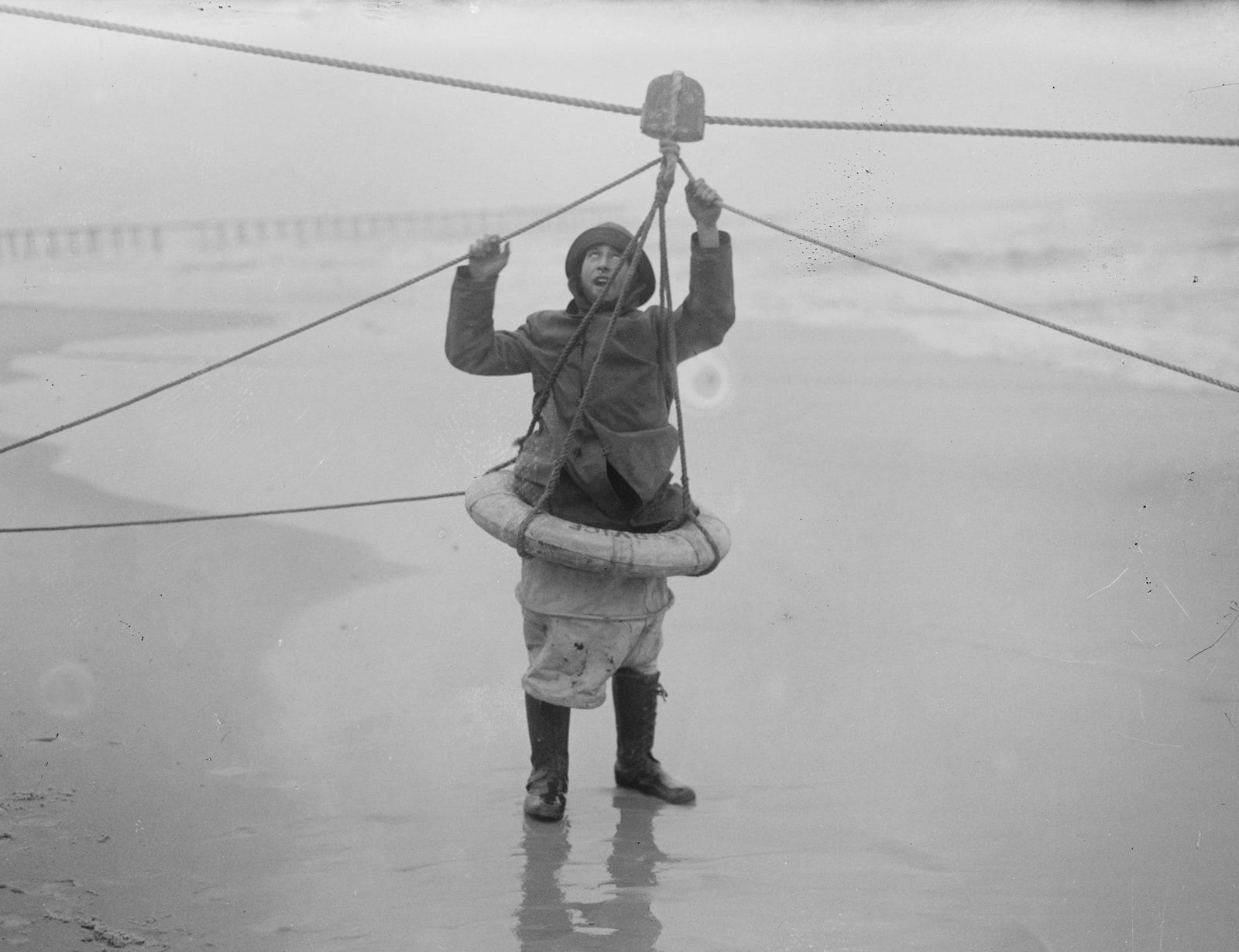
That distinction explains the later breeches buoy, the life ring with canvas breeches in which shipwreck survivors could be hauled ashore. Its success depended on a sequence of transfers: a light line brought equipment, equipment established a stronger connection, and people on both sides made that connection usable. A gunshot began the work; it could not complete it.[2][3]
The first line could fetch the next
The problem was especially cruel on a coast where a ship could ground within sight of safety. Heavy surf might prevent a small rescue boat from approaching. A connection through the air offered another way across that narrow, dangerous distance.[2]
By 1878, American ordnance officer David A. Lyle had developed a small, accurate line-throwing gun for coastal lifesaving stations. It fired a projectile carrying a light rope. The important distinction was between throwing the initial connection and transporting the load: the gun delivered a means of drawing more substantial gear across. Nobody was supposed to ride the first line.[2]
The operating sequence separated support from movement. In the American apparatus, the people aboard hauled in the shot line, bringing out a pulley block and a hauling rope called the whip. Once the block was secured aboard, the whip could bring over the heavy supporting rope, or hawser. The buoy travelled along that support while rescuers hauled it back and forth with the whip.[3][6]
On the beach, a buried wooden anchor held the system; tackle tightened the hawser and a wooden support lifted it above the water. These fittings turned an aerial connection into something capable of bearing a passenger. Each depended on work already completed at the other end.[3]
Instructions had to make the crossing too
Here was the difficulty that a description of the gun alone could conceal. The shore crew needed help from the people it was trying to save. Someone aboard had to retrieve the line and secure the arriving gear. The National Park Service's account of Outer Banks rescues identifies exhaustion and unfamiliarity with the procedure as reasons that this essential cooperation could fail.[3]
Rescue equipment therefore included tally boards: durable instructions sent out with the ropes. The National Park Service's Assateague Island collection describes a small wooden board, often shaped like a paddle, carrying English directions on one side and French on the other. The instructions told people aboard how to secure the hauling rope's pulley block.[4]
The board makes the communication problem tangible. A mariner might be able to haul a rope without knowing where the arriving apparatus belonged or what should happen next. Sending the directions with it reduced the distance between receiving an unfamiliar object and putting it to use. The wooden board belonged to the rescue mechanism as surely as the pulley did.
Britain's arrangements exposed a further constraint. On 5 May 1893, MP Hugh Luttrell asked the House of Commons whether the English and French directions on ship rocket apparatus could also include German and Spanish. Board of Trade president A. J. Mundella replied that experimental boards had been made, but officials had been advised that the larger size would disadvantage an object dragged through water, rocks and wreckage.[5]
That answer records an administrative judgment, rather than proving that additional languages were impracticable. Mundella reported the advice his department had received; the exchange supplies no comparative test results. What it does reveal is a design choice with consequences at both ends: more explanation could help the recipient while making the message harder to deliver. A direction that survived the journey still needed someone who could understand it.[5]
Rehearsing the whole crossing
The U.S. Coast Guard's 1921 station instructions treated the operation as a coordinated exercise. Men had assigned duties, but the manual also required them eventually to practise one another's positions. While some established the connection with the gun, others prepared the heavier equipment. Speed came partly from work proceeding together without one group obstructing another.[6]
The rules resisted convenient substitutes. Drills were to use equipment of service size, apart from permitted shorter lengths of the hauling and supporting ropes. A crew had to bury its sand anchor and land a man in the buoy; an already buried anchor was generally unacceptable. After a station's first month, the exercise was required weekly.[6]
Those requirements give the harbour demonstration's stranded passenger a larger historical meaning. A successful shot could impress spectators while leaving the passenger's journey unresolved. The later drill tested the complete operation, including the awkward work of digging, fastening, hauling and receiving a person ashore. Read this way, repetition made the dependencies visible before a wreck made them urgent.
Even disciplined practice could not command the weather or restore the strength of exhausted survivors. What the apparatus offered was a way to turn a fragile first connection into repeated crossings, provided enough of the ship, equipment and human cooperation remained intact. The rescue began when the line arrived. It became possible when someone at the other end knew what to do with it.
Sources
- Priaulx Library, “Mr Trengrouse's Rocket Apparatus, June 1836” — transcription of the Comet, 4 July 1836, reporting the Guernsey demonstration.
- National Park Service, Springfield Armory National Historic Site, “David Lyle and his Life Saving Gun” — development of the gun and the progression from light line to rescue carrier.
- National Park Service, Cape Hatteras National Seashore, “The Breeches Buoy” — beach apparatus, shipboard cooperation, anchoring and operational limitations.
- National Park Service, Assateague Island National Seashore, “Tally Board,” Boathouse Artifacts collection — wooden instruction board with English and French directions; photograph by Lisa Giris.
- UK Parliament, Hansard, 5 May 1893, vol. 12, col. 199, “The Ship Rocket Apparatus” — Luttrell's question and Mundella's response; the digital heading transcribes “Rocket” as “Eocket.”
- United States Coast Guard, Instructions for United States Coast Guard Stations (Government Printing Office, 1921), pp. 96–114, especially §§371–372, 380–386 — rigging sequence, drills and rotation of duties; digitized copy.
- Bain News Service, breeches-buoy photograph (1919), Library of Congress collection, ggbain.29970 — Wikimedia Commons reproduction and provenance.