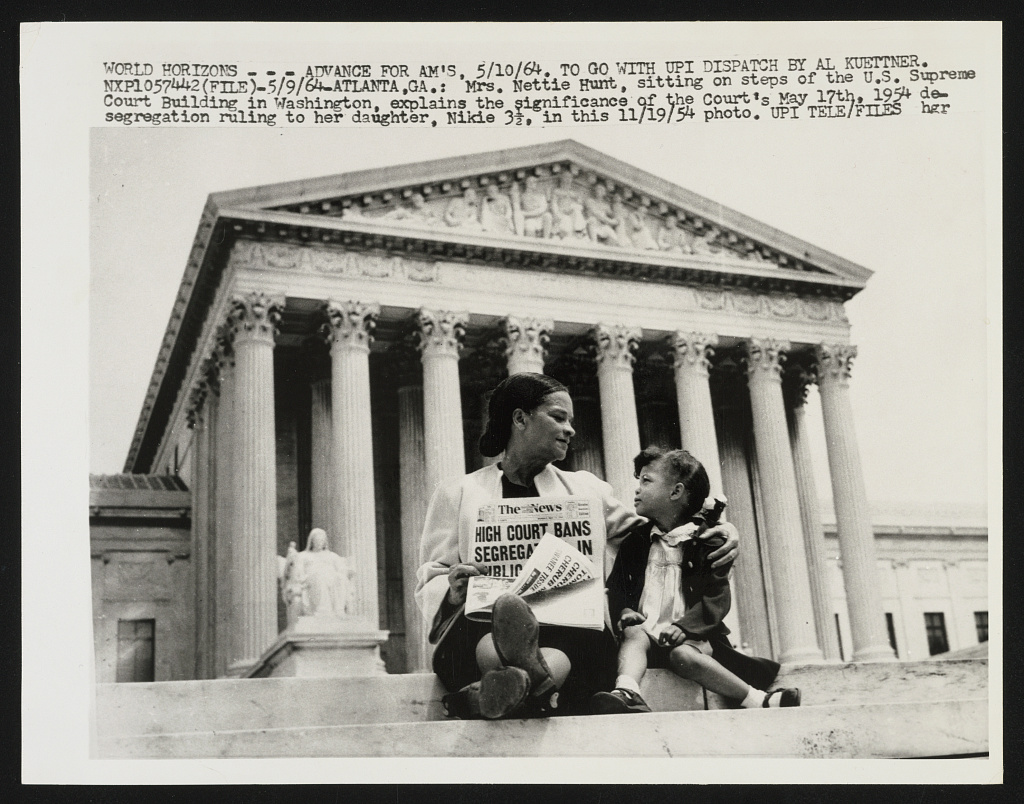
The Library of Congress photograph of Mrs. Nettie Hunt sitting on the Supreme Court steps with her daughter Nikie is one of the clearest public images attached to Brown v. Board of Education.[6] It shows a mother turning constitutional doctrine into an everyday explanation. That is a useful way to approach the opinion itself, because Brown did not persuade the Court by offering a building-by-building audit of unequal schools. It persuaded by saying that the state's own act of racial separation changed what public education meant for the child who had to live under it.[1][3]
The sharp question, then, is textual and historical at once: what exactly did the Court say on May 17, 1954 that made segregation in public education unconstitutional, and why did that same opinion leave such a large enforcement problem behind?
First layer: Brown arrived as a coordinated attack on the logic of segregation, not a local Kansas dispute
The published opinion is short, but the case posture was broad. The Court heard arguments in December 1952, ordered reargument, heard the case again in December 1953, and issued the unanimous opinion in May 1954.[1] The syllabus to Brown bundled the Kansas case with appeals from South Carolina, Virginia, and Delaware; the District of Columbia dispute, Bolling v. Sharpe, was decided separately the same day and then grouped with the school cases in the 1955 remedy phase.[1][2]
That structure matters because it kept the Justices from treating Topeka as an odd municipal record. The NAACP Legal Defense Fund had spent years assembling a litigation path that moved from graduate-school equality suits toward a direct challenge to segregated public education itself.[5] By the time Brown reached the Court, the issue was no longer whether one district had worse textbooks or more dilapidated classrooms. The issue was whether state-enforced separation could survive even where "tangible" factors looked comparable on paper.[1]
Second layer: Warren refused to win on original intent alone
One of the opinion's most important moves appears early and is easy to miss. Warren wrote that the history of the Fourteenth Amendment was "inconclusive" on public education.[1] That was a major choice. The Court could have tried to settle the case by claiming a clean original answer from 1868. Instead, it admitted the historical record did not yield one straightforward rule for twentieth-century school systems.[1][3]
From there the opinion shifted the ground of decision. Public education, Warren wrote, had to be judged in light of its "present place in American life."[1] Once a state undertook to provide schooling, that opportunity had to be made available to all children on equal terms.[1] This is the hinge of the opinion. It treated schooling not as one more municipal service but as a civic institution that shapes status, preparation, and belonging.
That move gave the Court a way around the narrowest reading of Plessy v. Ferguson. The question no longer turned on whether buildings, salaries, transportation, or course catalogs could be equalized. It turned on what state law was doing when it sorted children by race inside an institution that had become central to democratic life.[1][3][4]
Third layer: the opinion made segregation itself the constitutional injury
This is where the close reading becomes decisive. In the Kansas case, the lower court had found substantial equality in the physical facilities and other tangible factors.[1] If the Court had stayed inside the old equalization framework, that finding would have favored the school board. Instead, Warren turned to the social meaning produced by law.
The most cited line in the opinion says segregation "generates a feeling of inferiority" in the minority child that may affect the heart and mind in a lasting way.[1] The sentence is famous, but its real importance lies in the mechanism it names. The injury does not depend on an inventory gap alone. It comes from official separation backed by state authority. The opinion quotes the Kansas findings that segregation with the sanction of law carries an inferiority signal and then says modern authority supports that finding, including the social-science materials listed in footnote 11.[1]
Only after making that move does Warren arrive at the sentence everyone remembers: "Separate educational facilities are inherently unequal."[1] Read in sequence, that line is less a slogan than a conclusion drawn from the Court's redefinition of the problem. Once public schooling is treated as a civic status institution, racial separation cannot be cleaned up by equal buses, equal pay scales, or equal brickwork. The segregation itself is what makes equality impossible.
The Nettie Hunt photograph helps explain why this reasoning traveled so far.[6] A parent did not need to parse the whole opinion to grasp its public meaning. The ruling said that a state's assignment of a child to a racially marked school carried a constitutional injury in the assignment itself.
Fourth layer: Brown's moral clarity arrived before its remedy did
The opinion's restraint also built its largest weakness. On May 17, 1954, the Court decided the constitutional question but restored the cases to the docket for further argument on relief.[1] That signaled caution. The Justices had reached unanimity on invalidating school segregation, yet they had not agreed on how fast district courts should force change on resistant states and localities.[3]
The answer came a year later in Brown II, decided on May 31, 1955.[2][3] There the Court directed lower courts to supervise admission to public schools on a racially nondiscriminatory basis "with all deliberate speed."[2] Warren also told district judges they could consider physical plant, transportation, personnel, attendance areas, and revision of local laws and regulations when evaluating transition plans.[2]
That language had an obvious administrative logic. The Court was confronting systems, not single classrooms. Yet the phrasing also opened a delay structure. "Deliberate" gave recalcitrant authorities room to move slowly, litigate endlessly, and translate constitutional defeat into procedural drag.[2][5] The opinion that had made segregation itself unconstitutional thus handed implementation to a second stage where local resistance could reorganize.
Two readings still compete
Reading one: Brown as a genuine constitutional break
On this reading, Brown matters because it broke the legal legitimacy of state school segregation at the doctrinal level.[1][3] It told courts and legislatures that equal protection in education could no longer be measured by counting desks and comparing payrolls. The state could not racially classify children inside public schooling and still call the system equal.
Reading two: Brown as a deliberately narrow doorway
On this reading, the opinion won unanimity by staying narrower than its moral force suggested.[1][2] It confined itself to public education, leaned on the modern role of schools and on the injury of imposed inferiority, and postponed the hardest remedy fight into a second opinion. That strategy made the constitutional breakthrough possible and, at the same time, guaranteed a longer political struggle over what the breakthrough would actually require.[2][5]
Both readings are defensible because they describe different parts of the same document. Brown is radical in what it says about state-imposed separation, careful in how it gets there, and visibly unfinished once the question turns from principle to timetable.
Why the opinion still reads as short, strategic, and unfinished
The enduring force of Brown v. Board of Education lies in that combination. Warren's opinion did not win by proving that every segregated Black school had worse inputs than every white school. It won by arguing that a democratic state injures equality when it uses public education to stamp children with racial rank.[1][3] Yet the next year's remedy opinion showed how hard it was to turn that principle into immediate institutional change.[2]
That is why the photograph on the Supreme Court steps still belongs beside the text.[6] The constitutional rule became historic because people outside the Court understood its meaning at once. The implementation fight lasted because officials inside school systems understood it too.
Sources
- Brown v. Board of Education of Topeka, 347 U.S. 483 (1954) - Supreme Court opinion PDF hosted by the Library of Congress.
- Brown v. Board of Education (Brown II), 349 U.S. 294 (1955) - remedy opinion PDF hosted by the NAACP Legal Defense Fund.
- National Archives, "Brown v. Board of Education (1954)" - milestone document overview and implementation context.
- Library of Congress, "Brown v. Board of Education: A Resource Guide" - collection guide to the case, surrounding materials, and historical context.
- NAACP Legal Defense Fund, "Brown v. Board of Education" - case history and litigation significance.
- Library of Congress Prints and Photographs Division, "Mrs. Nettie Hunt, sitting on steps of Supreme Court, holding newspaper, explaining to her daughter Nikie the meaning of the Supreme Court's decision banning school segregation."