The Navajo code talkers are often remembered through one adjective: unbreakable. The word is useful only if it does not turn the story into magic. Their World War II code worked because several hard things were made to operate together: a language few outsiders knew, a second layer of substitution, an alphabet for spelling unknown words, memorized procedures, radio discipline, and combat deployment in the same Marine units that needed fast tactical traffic.[3][5][6]
The causal question is therefore not simply why Japanese cryptanalysts could not read Navajo. It is why spoken Diné could move through a battlefield quickly enough to be useful while remaining opaque enough to be secure. A secret language alone would have been fragile. A paper codebook alone could have been captured. A slow cipher machine alone could have missed the tempo of amphibious warfare. The code talkers' value came from combining cultural knowledge, designed vocabulary, and trained radio work into one human communications system.
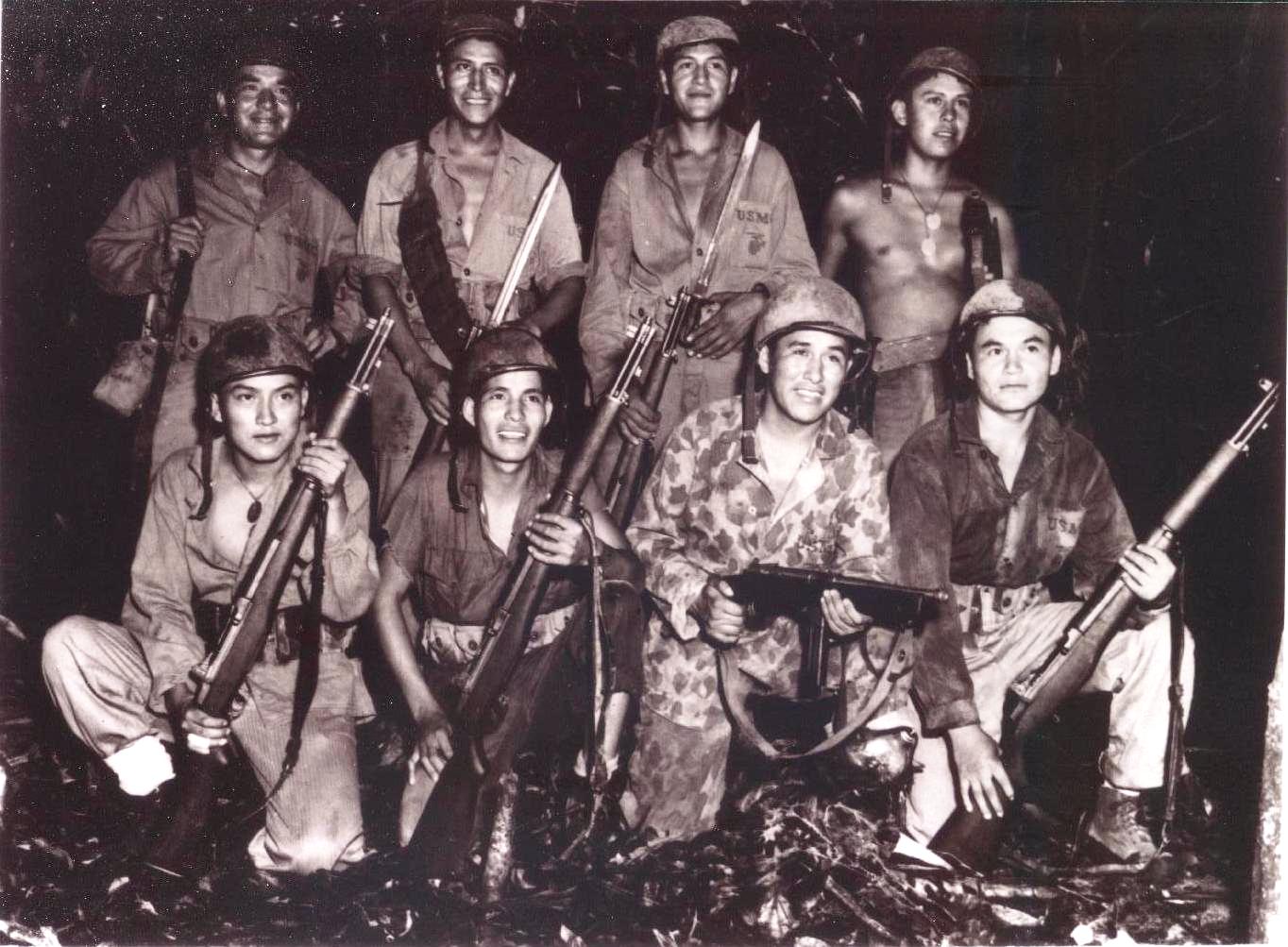
The cover photograph keeps that mechanism grounded.[1] It shows Marine code talkers in the Bougainville operation in December 1943, not posed as symbols but placed in the military world where the system had to function. The jungle setting, uniforms, and field equipment make the point visually: this was language under operational pressure.
The First Layer Was Scarcity, Not Mystery
The Marine Corps did not invent the idea of Native code talking in 1942. The National WWII Museum notes that at least fourteen other Native nations served as code talkers and places the practice's first wartime test with the Choctaw Telephone Squad and other Native communications specialists in World War I.[7] Navajo code talking was the largest and best-known version, but it belonged to a broader military discovery: languages suppressed or marginalized inside the United States could become powerful against enemies who lacked speakers, grammars, dictionaries, and cultural access.
That first layer mattered because radio traffic could be intercepted. If the message moved in plain English, the enemy could use it. If it moved through a conventional cipher, the sender and receiver needed equipment, keys, time, and protection from capture. Spoken Navajo changed the problem. The CIA's account emphasizes that the language was not widely written and that very few non-Navajo people spoke it.[6] That did not make it supernatural. It made it a rare communications medium at the exact moment the military needed tactical messages to travel fast.
Scarcity by itself was not enough, though. A bilingual enemy linguist, a captured speaker, or repeated traffic patterns could still create openings. The Marines and the first recruits had to turn a language into a field code.
The Second Layer Was Design
In May 1942, the first twenty-nine Navajo recruits arrived in San Diego, then trained at Camp Elliott in radio operation and message transmission.[3][5][6] There, the initial group and communications personnel built the first code. The National Archives' Prologue account says it began with 211 terms: Navajo words assigned new military meanings, plus a system for representing the twenty-six English letters.[3] The CIA and National WWII Museum both note that the vocabulary later expanded to 411 terms.[6][7]
This design solved two different problems. First, common military words needed speed. If every reference to a plane, ship, rank, or weapon had to be spelled letter by letter, the system would bog down. So the code used compact substitutions: birds could stand for aircraft, and "iron fish" could stand for submarine.[3][6][7] Second, war always produces words outside the prepared list: place names, names of officers, unusual equipment, misspellings, and urgent clarifications. The alphabet layer let code talkers spell what the vocabulary did not already cover.[3][7]
The result was not simply Navajo speech. It was Navajo plus a memorized military overlay. That distinction is central. An interceptor who somehow knew ordinary Navajo would still have to know that an animal, bird, or everyday word was being used as a tactical term. The code added semantic misdirection on top of linguistic scarcity.
The Third Layer Was Memory
Paper codebooks create a security problem. They can be lost, photographed, copied, or captured. The code talkers reduced that risk by memorizing the code and training until recall was practical under pressure. Intelligence.gov describes the code as something each code talker had to memorize, and the National Archives Prologue article says they demonstrated the ability to send messages under adverse conditions, including from moving positions.[3][5]
Memory also changed the speed profile. A code that lives only in a manual forces the operator to look up words. A memorized code can move at the pace of trained speech and listening. The CIA account describes a test in which code talkers translated, transmitted, and retranslated a message in two and a half minutes, compared with a much longer process by ordinary methods.[6] The exact comparison should not be overread as a universal battlefield constant, but it captures the operational claim: the system was fast because the key lived in trained people.
That human-key structure had a cost. It required recruitment, schooling, pair work, radio skill, and trust. It also placed code talkers in danger. The National WWII Museum notes that code talkers often worked in pairs, with one operating the radio and the other relaying and translating, and that radiomen in the Pacific were especially exposed because they had to keep moving while transmitting.[7] The code's security depended on bodies in hazardous places.
The Fourth Layer Was Combat Fit
A secure system that cannot fit the unit's tempo is historically interesting but militarily marginal. The Navajo code talkers mattered because they were deployed where Marine communications needed speed across major Pacific operations.[5][6][7] By April 1943, the National Archives education account notes, the initial recruits were attached to Marine divisions in the South Pacific while additional recruits were nearing completion of training.[5]
The image source and National Archives materials show how field-specific the work was. The Bougainville photograph comes from Marine Corps archival holdings and identifies named code talkers participating in the December 1943 operation.[1] A related National Archives teaching item describes Henry Bake Jr. and George H. Kirk operating a portable radio in a jungle clearing close behind the front lines.[4] That setting matters. The code was not waiting in a headquarters file. It had to survive mud, heat, noise, fear, confusion, and the ordinary friction of battle.
The most famous operational claim concerns Iwo Jima. CIA gives the often-repeated figure of six Navajo code talkers sending more than 800 messages without error during the battle, while the National Archives education account points to Iwo Jima reports as evidence of both the program's limitations and its secure radio value.[5][6] The point is not that one number proves the entire program. The point is that the code had become a practical communications service at scale: trained Marines embedded in units, carrying tactical messages that had to be both fast and secure.
The Final Layer Was Secrecy After Victory
The code's wartime success created a postwar silence. The National WWII Museum states that code talkers were told not to tell even family members about their communications work because the military wanted the codes kept classified for possible future use.[7] CIA dates public recognition after the operation's declassification in 1968, with later recognition including President Reagan's 1982 declaration of Navajo Code Talkers Day and the 2001 Congressional Gold Medal for the original twenty-nine.[6]
That silence shaped memory. For decades, the code talkers' work circulated less visibly than many other World War II stories, even though the National Archives now preserves photographs and subject files tied to code talker administration, tasks, and service.[2] The delayed recognition is not a footnote. It is part of the causal chain by which an operational system became a public historical legacy: first classified utility, then veterans' memory, then institutional recovery, medals, classroom materials, and museum interpretation.[2][4][6][7]
There is also an irony that cannot be separated from the mechanism. The National WWII Museum points out that many Native people had experienced boarding-school systems that punished Indigenous language use, yet the U.S. military then asked Native speakers to use those languages for national defense.[7] The code talkers' achievement was not that the state generously discovered hidden value. It was that Native speakers carried knowledge their communities had preserved despite assimilation pressure, then turned it into disciplined military work.
Why "Unbreakable" Is Too Small
Calling the Navajo code unbreakable is not wrong as shorthand, but it hides the engineering of the achievement. The code resisted decryption because it was not a single thing. It was a layered system: Diné language scarcity, military substitution, alphabetic spelling, memorized keys, trained radio operators, pair procedures, combat placement, and long classification.[3][5][6][7]
Each layer covered a weakness in another. Language scarcity made interception harder. Substitution made ordinary language knowledge insufficient. Memorization reduced capture risk. Radio training made the code usable under pressure. Pair work supported accuracy. Classification protected the method after the war. None of those elements alone explains the outcome; together they made a battlefield communications system that matched the Pacific war's demand for speed and secrecy.
That is why the Bougainville photograph is such a strong historical image.[1] The men in it are not merely representatives of a code. They are the code's operating environment: speakers, Marines, radiomen, memorized-key holders, and witnesses to a war in which a language once targeted for suppression became a tactical advantage. The history is not only that the code could not be read by the enemy. It is that it could be carried, remembered, spoken, heard, translated, and trusted when seconds mattered.
Sources
- Wikimedia Commons, "File:Code talkers on Bougainville, 1943 (7973456676).jpg" - source page for the archival USMC photograph used as the article image.
- National Archives, "Code Talkers" - research guide to Code Talker subject files and photographs, including digitized Marine Corps photograph records from 1943-1948.
- National Archives, "Semper Fidelis, Code Talkers" - Prologue article on the first twenty-nine recruits, Camp Elliott training, 211-term code, alphabet system, and July 1942 recruitment expansion.
- DocsTeach, National Archives, "Navajo Indian Code Talkers Henry Bake and George Kirk" - primary-source teaching record for the December 1943 photograph of code talkers operating a portable radio near the front lines.
- National Archives, "Memorandum Regarding the Enlistment of Navajo Indians" - education page on Johnston's proposal, the February 1942 demonstration, Camp Elliott training, 211-to-411 term expansion, Iwo Jima reports, classification, and recognition.
- CIA, "Navajo Code Talkers and the Unbreakable Code" - institutional account of Philip Johnston's proposal, code design, 211-to-411 term expansion, speed tests, Iwo Jima message traffic, and recognition timeline.
- The National WWII Museum, "American Indian Code Talkers" - overview of Type 1 and Type 2 code structure, paired radio work, battlefield danger, secrecy, declassification, and later recognition.