The first circumnavigation is often told as if one name could hold it. Say "Magellan" and the whole route seems to appear: five ships, a western passage, the Pacific, spices, and a globe finally proven by sailing. That shorthand is useful, but historically too smooth. The voyage that left Spain in 1519 and returned in 1522 became durable memory precisely because it cannot be reduced to one hero, one nation, or one endpoint.
UNESCO's Memory of the World register names the object more carefully: the first voyage of circumnavigation by Fernao de Magalhaes and Juan Sebastian Elcano, 1519-1522.[1] That title already contains the tension. Magellan initiated and commanded the expedition, but Elcano concluded the world circuit after Magellan was killed in the Philippines. The documents matter because they preserve a voyage that changed European knowledge of South America, the Pacific, and the scale of the planet, while also recording how fragile and improvised the achievement became once the expedition started losing ships, officers, and men.[1][2]
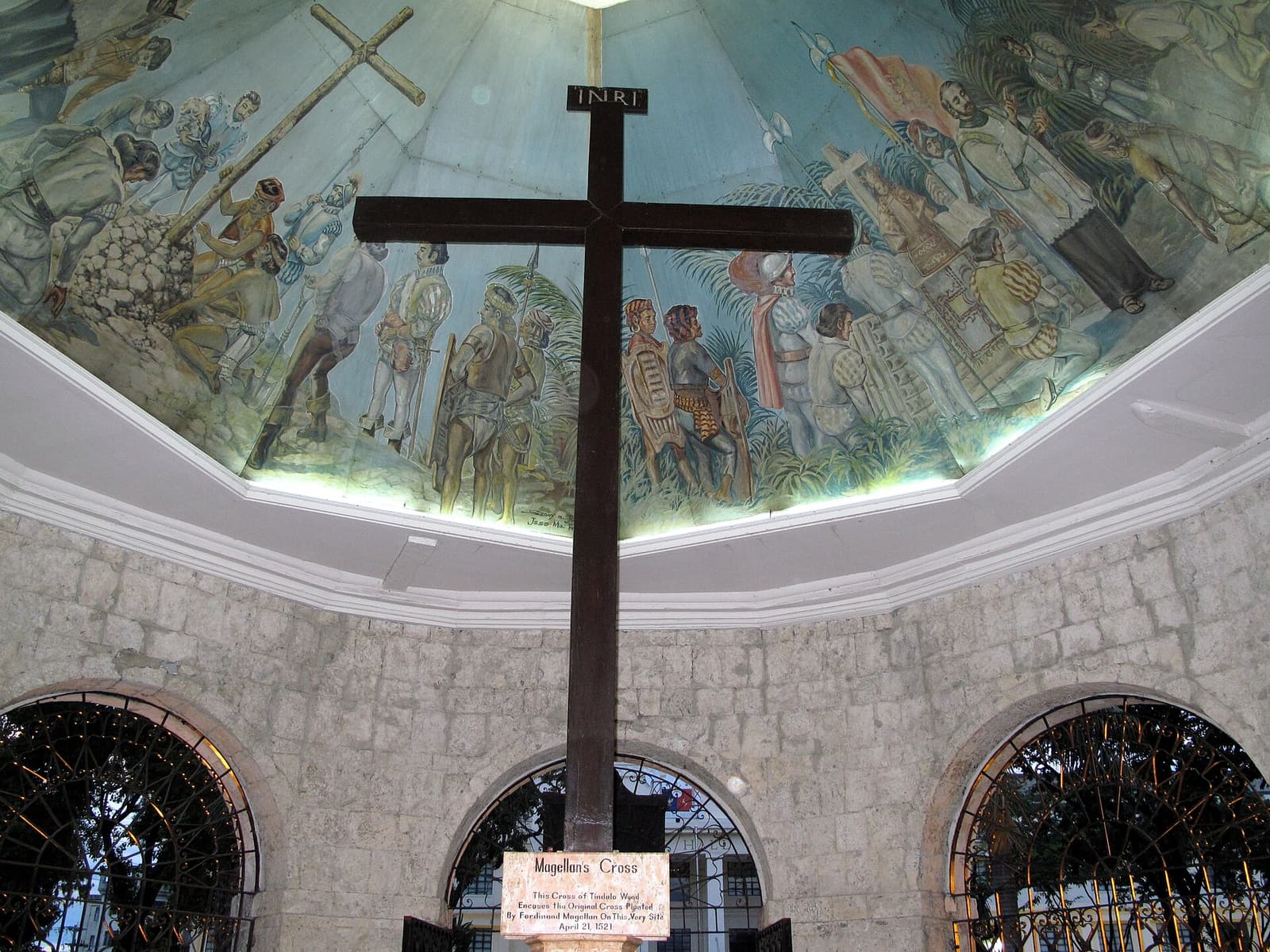
The Cebu photograph above is deliberately not a map. A route map would make the voyage look cleaner than it was. Magellan's Cross, as photographed inside its pavilion, keeps the story grounded in a commemorative place where arrival, conversion, local resistance, colonial memory, tourism, and Philippine historical marking all press against the usual European exploration narrative.[6] The circumnavigation survives in memory as a completed loop. In lived sequence, it was a broken chain.
The route was not the same as the memory
The expedition began as a Spanish-backed attempt to reach the Moluccas by sailing west. The fleet of five ships left in 1519 with Trinidad, San Antonio, Concepcion, Victoria, and Santiago; only Victoria returned.[5] That basic arithmetic matters more than it first appears. A story of triumph can hide the attrition that made the triumph possible. By the end, the completed circuit belonged not to the original plan intact, but to the one remaining vessel and the reduced crew who could still move it.
Contemporary accounts preserved in the Project Gutenberg edition make the expedition feel less like a clean heroic arc and more like a series of partial records: Pigafetta's narrative, pilot notes, letters, and other early witnesses all try to stabilize a moving disaster after the fact.[2] Their value is not only that they tell us what happened. They show why commemoration needed documents. Without written accounts, later memory would have even fewer tools for distinguishing command, witness, rumor, defeat, and completion.
UNESCO's register emphasizes that the voyage made the vastness of the Pacific newly graspable to Europeans and helped overturn older assumptions about a world dominated by land masses.[1] That claim is important, but it should be read beside the expedition's human disorder. Knowledge of the globe did not arrive as a serene revelation. It came through mutiny, hunger, navigational uncertainty, local diplomacy, violence, ship loss, and retrospective paperwork.
Mactan interrupts the explorer script
The Philippine portion is where the one-name story breaks most visibly. On April 27, 1521, Magellan died at Mactan. The National Historical Commission of the Philippines marker for Ferdinand Magellan's Death places the event at Liberty Shrine in Lapu-Lapu City and records that Magellan was wounded in an encounter with soldiers of Lapulapu.[3] The same marker then turns immediately to the later chain: Victoria, commanded by Elcano, left Cebu on May 1, 1521 and reached Sanlucar de Barrameda on September 6, 1522, completing the first circumnavigation.[3]
That marker does a lot of memory work in a few lines. It does not let Magellan's death remain a standalone martyr scene, and it does not let Elcano's completion erase the Philippine battlefield. It binds the two into one place-based text: here Magellan died; from here the surviving voyage eventually continued; later, elsewhere, the circuit closed.[3]
The Lapulapu marker at the same broad shrine landscape makes the other memory claim explicit. It identifies Lapulapu and his men as having repulsed Spanish invaders on April 27, 1521, killing Magellan and making Lapulapu the first Filipino to repel European aggression.[4] This is not just a local footnote to a European voyage. It is a competing center of gravity. In one memory system, Mactan is the tragic interruption of a global expedition. In another, it is a foundational victory against foreign force.
The National Quincentennial Committee's Mactan explainer reinforces why this matters in 2021-era commemoration. It treats the Battle of Mactan not as a decorative episode but as an event whose meaning has to be argued through sources, indigenous agency, and the problem of what exactly the Filipino public commemorates five hundred years later.[7] Memory here is not passive inheritance. It is a decision about whose action becomes legible.
Elcano completes what Magellan cannot finish
Elcano's role has its own memorial problem. If the voyage is called simply Magellan's circumnavigation, the man who actually commanded the returning Victoria becomes an afterthought. If it is called simply Elcano's achievement, the preparation, command, strait passage, and Pacific crossing under Magellan disappear. The better term, Magellan-Elcano, is not polite compromise. It is historical accuracy in compressed form.
Fundacion Elkano's ship-focused account makes the material point sharply: Victoria was the only one of the five expedition vessels to return in 1522, and with Elcano in command it became the first vessel to circumnavigate the globe.[5] That phrasing shifts memory from individual fame to operational survival. The completion was not an abstract idea. It was a ship, reduced manpower, spices, damaged bodies, and the decision to keep sailing west across hostile and poorly controlled waters.
The strongest way to remember Elcano is therefore not as the man who stole Magellan's ending, but as the commander who turned a shattered expedition into a completed circuit. Magellan made the westward project possible; Elcano made the return fact. The two roles are not interchangeable, and the distinction matters because commemoration often rewards the person who names the ambition more readily than the person who survives the final execution.
Documents keep the loop from becoming legend
The first circumnavigation became globally meaningful because it was both a journey and a documentary event. UNESCO's Memory of the World listing is a reminder that the voyage's afterlife rests on records: preparations, testimonies, and accounts that let later readers reconstruct the movement from European planning to oceanic evidence.[1] Pigafetta's account and the related contemporary writings preserve scenes that no monument can fully carry: negotiation in Cebu, tension around Mactan, the burning of Concepcion after the crew was too reduced to manage three ships, and the onward movement toward Borneo and the Moluccas.[2]
This documentary layer does not make the sources innocent. Pigafetta wrote from inside the expedition and from inside its assumptions. Spanish, Portuguese, Basque, Italian, and Philippine memories later selected different heroes and different wounds. But the documents are what keep the story from hardening into pure emblem. They force sequence back into the monument.
The result is a commemoration with four centers rather than one. Magellan represents command, ambition, and the violent limits of imperial confidence. Lapulapu represents local resistance and the Philippine refusal to treat Mactan as merely an explorer's death scene. Elcano represents completion, seamanship, and the returning Victoria. The documents represent the conversion of suffering and distance into shareable knowledge.[1][2][3][4][5]
That is why the first circumnavigation still matters as memory. It did not simply prove that a ship could go around the world. It created a durable argument over what such proof should mean. Was the voyage a Portuguese navigator's vision in Spanish service, a Basque captain's completion, a Philippine victory at Mactan, a documentary milestone in global knowledge, or an early warning that global connection often arrived through coercion? The answer is yes, but not all at once and not from the same shore.
The cleaner the story gets, the less historical it becomes. The circumnavigation was not one name moving smoothly around a globe. It was a chain of command changes, local encounters, deaths, documents, and commemorative places. Its memory remains powerful because the loop closed, but its meaning remains alive because the loop never closed around only one person.
Sources
- UNESCO Memory of the World, "First Voyage of Circumnavigation by Fernao de Magalhaes and Juan Sebastian Elcano (1519-1522)" - register page on the voyage's documentary significance, global-knowledge impact, and 2023 registration.
- Project Gutenberg, The first voyage round the world, by Magellan - public-domain edition of Pigafetta and other contemporary accounts, including Mactan, Cebu, ship loss, and onward navigation.
- National Historical Commission of the Philippines, "Ferdinand Magellan's Death" - registry page for the Mactan marker, including the April 27, 1521 death and Victoria's later Elcano-commanded return.
- National Historical Commission of the Philippines, "Lapulapu" - registry page for the Liberty Shrine marker framing Lapulapu and his men as repelling Spanish invaders on April 27, 1521.
- Fundacion Elkano / Google Arts & Culture, "The First Ships to Circumnavigate the Globe" - ship-focused account of the five expedition vessels, Victoria's return, and Elcano's command.
- Wikimedia Commons, "File:Magellan's Cross-1, Cebu.JPG" - source page for the 2009 photograph of Magellan's Cross used as the article image.
- National Quincentennial Committee, "Battle of Mactan Beyond Textbooks" - Philippine quincentennial resource on the Mactan battle, Lapulapu, Magellan, and commemoration.