The National Security Act is often remembered as if it built the modern U.S. defense state all at once in July 1947.[2] That memory is tidy, and historically too clean. The more useful reading is mechanical. The first law created a workable shell: one secretary above the services, a National Security Council to connect military questions with foreign policy, a Central Intelligence Agency, and an independent Air Force.[2] But the shell was also a compromise. It coordinated, yet it did not fully concentrate authority.
That is why the act needed a second pass. By March 1949, Harry Truman was telling Congress that the 1947 structure had value, but also a structural defect: the Secretary of Defense was supposed to be accountable, yet the statute left too much power elsewhere.[3] The service secretaries retained broad autonomous authority, boards stood between the secretary and the instruments he was meant to direct, and the whole arrangement still looked too much like a confederation of armed services rather than a genuine executive department.[3]
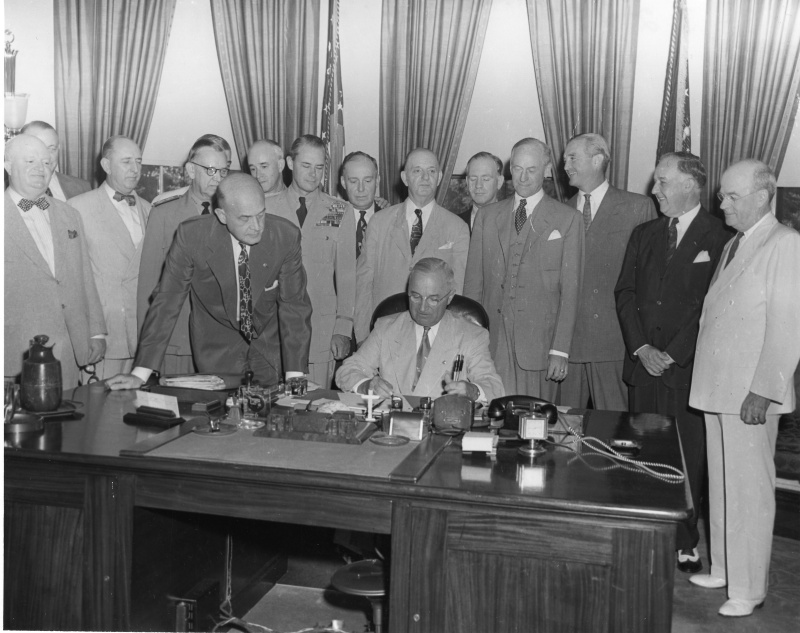
The lead image shows Truman signing the National Security Act Amendments of 1949 on August 10, 1949.[5] It belongs with this article because the real causal story runs through that second moment. The National Security Act mattered in 1947 because it made unification politically and legally possible. It became durable in 1949 because Congress and the President thickened civilian control and made it easier to identify who actually governed the system.[2][3][4][5]
Time anchors
- 1945-12-19: Truman asked Congress to create a unified Department of National Defense, arguing that modern war required integrated strategy, budgeting, and civilian control rather than interservice competition.[1]
- 1947-07-26: the National Security Act of 1947 became law.[2]
- 1949-03-05: Truman asked Congress to reorganize the National Military Establishment because the 1947 statute had exposed clear limits in the Secretary of Defense's authority.[3]
- 1949-08-10: Truman signed the National Security Act Amendments of 1949, converting the National Military Establishment into the Department of Defense and enlarging the secretary's control.[4][5]
The original problem was coordination, not simply bigness
Truman's December 19, 1945 message is the best place to start because it defines the problem before the Cold War vocabulary hardens.[1] He does not ask for unification because large institutions are automatically better. He asks for it because World War II had exposed a mismatch between modern warfare and inherited administrative form. Land, sea, and air no longer operated on separate clocks; strategy, procurement, intelligence, and budgeting had to be coordinated together.[1]
That message is strikingly concrete. Truman argues that the United States could not let the services plan against different assumptions, compete openly for funds, and then force the President and Congress to reconcile separate claims after the fact.[1] He describes the Joint Chiefs of Staff as a committee dependent on voluntary cooperation, useful in war but too fragile to serve as the sole peacetime answer.[1] He also insists that civilian control is weakened when two department secretaries act as partisans for separate services rather than as one responsible civilian authority.[1]
That logic matters because it shows what unification was supposed to do. The aim was not only to reduce duplication. It was to change the level at which decisions were made. Strategy, program, and budget were to be treated as parts of the same national-security argument.[1] In that sense the National Security Act was an answer to a sequencing problem: the state needed a place where military planning, foreign policy, and resource allocation could meet before disputes reached the President as a pile of incompatible departmental claims.
The 1947 act created a usable shell
The Office of the Historian's summary captures what the 1947 law actually built.[2] It reorganized the War and Navy Departments into a National Military Establishment headed by a Secretary of Defense, created the National Security Council, established the CIA out of wartime and immediate postwar intelligence bodies, and placed the new Department of the Air Force inside the larger structure.[2]
This was not a trivial first step. It created institutions that later presidents would keep because they solved recurring executive problems.[2] The NSC gave the White House a regular forum for connecting defense questions to diplomacy. The CIA created a standing civilian intelligence organization. The Air Force settlement recognized that air power had outgrown its earlier subordinate administrative status.[2]
Yet the key word is still shell. The very design that made the law politically passable also limited its first-round power. The services kept their own secretaries. The new secretary sat above them, but not yet with the degree of authority one would expect from the head of a fully integrated executive department.[2][3] The act made coordinated direction possible; it did not finish the hard constitutional and bureaucratic work of making that direction unmistakably authoritative.
Eighteen months of experience exposed the weak joint in the design
Truman's March 5, 1949 message to Congress is unusually revealing because it does not repudiate the 1947 act.[3] In fact, he says the law provided a "practical and workable basis" for beginning unification and for coordinating military policy with foreign and economic policy.[3] He even lists concrete gains: coordinated purchasing arrangements, joint training and education, work toward a uniform code of military justice, and improved linkage between military, foreign, and economic policy through the NSC and the National Security Resources Board.[3]
The weakness he identifies is more precise. The system could coordinate, but it still could not assign full responsibility cleanly. Truman says the Secretary of Defense's duties were too limited and too specifically cabined by statute.[3] Duties not explicitly given to the secretary remained vested in the service secretaries, who were still authorized to deal directly with higher authority.[3] Many important powers also sat in boards and agencies whose authority did not flow clearly through the secretary.[3]
That is the heart of the mechanism. A coordination structure can still fail if no one at the top has enough lawful authority to turn coordination into decision. The 1947 design reduced friction, but it did not yet solve the accountability problem. If the President and Congress wanted to know who was truly responsible for running the military establishment, the answer remained blurred.[3]
Truman makes the point in near-diagnostic terms. The act, he says, failed to provide "a fully responsible official with authority adequate to meet his responsibility."[3] That phrase is the hinge of the whole episode. Modern executive systems do not break only because they lack committees or information. They also break when authority and responsibility are mismatched. The National Security Act's first version created shared machinery; its second version tried to align responsibility with power.
The 1949 amendments turned coordination into governable civilian control
The August 10, 1949 signing statement shows what Congress accepted in the second round.[4] Truman says the amendments converted the National Military Establishment into an executive Department of Defense, placed the Army, Navy, and Air Force within it as military departments, and gave the Secretary of Defense direction, authority, and control appropriate to his role as the department's head.[4] The law also provided a Deputy Secretary, three Assistant Secretaries, a Chairman of the Joint Chiefs of Staff, and stronger financial-management machinery including a comptroller structure.[4]
This is why the 1949 photograph matters more than a generic 1947 commemoration shot would.[5] It catches the moment when the state moved from coordinated coexistence toward more explicit civilian hierarchy. The service departments still existed. The amendments did not abolish interservice rivalry or dissolve the military branches into one anonymous mass.[3][4] What they did was make it harder for the structure itself to excuse blurred responsibility.
The bargain, then, was never to erase the distinct services. It was to keep them as departments while placing them under unified civilian direction.[2][4] In other words, the mechanism was not merger by flattening. It was control by hierarchy plus coordination. The 1949 amendments made that hierarchy more legible.
Why the two-step sequence matters now
The durable lesson is that the national-security state was not born as one finished blueprint. It emerged through a correction cycle. The 1945 proposal defined the wartime lessons: modern conflict demanded integrated strategy, budget, intelligence, and civilian control.[1] The 1947 act created a usable institutional shell around that insight.[2] The 1949 amendments then repaired the shell's most obvious defect by giving the Secretary of Defense stronger authority and by turning the National Military Establishment into a genuine executive department.[3][4]
That sequence matters because it prevents two easy myths. One myth says the 1947 law instantly produced a centralized machine with fully settled lines of power. The other says the early postwar system was only a loose symbolic gesture. The sources support neither reading. The first law achieved real gains; the second law reveals that those gains were still administratively incomplete.[2][3][4]
So the best way to read the National Security Act is not as a single founding moment, but as a two-stroke institutional mechanism. First came the recognition that voluntary coordination among rival services was no longer enough.[1] Then came the harder recognition that coordination without a fully empowered civilian head would not hold.[3] The image of Truman at the desk in 1949 is therefore not an epilogue. It is the point at which the compromise starts to look governable.[5]
Sources
- Harry S. Truman, "Special Message to the Congress Recommending the Establishment of a Department of National Defense" (December 19, 1945) - Truman's case for integrated strategy, budget, civilian control, and a unified department before the 1947 act existed.
- U.S. Department of State, Office of the Historian, "National Security Act of 1947" - overview of the institutions created by the 1947 law, including the NSC, CIA, Department of Defense precursor, and Department of the Air Force.
- Harry S. Truman, "Special Message to the Congress on Reorganization of the National Military Establishment" (March 5, 1949) - Truman's diagnosis of the 1947 law's weaknesses and his argument for stronger secretary authority and a true executive department.
- Harry S. Truman, "Statement by the President Upon Signing the National Security Act Amendments of 1949" (August 10, 1949) - summary of what the amendments changed in secretary authority, departmental form, staff structure, and financial management.
- Harry S. Truman Library & Museum, "President Harry S. Truman Signing National Security Act Amendment of 1949" - photo record for the archival image used in this article, with date, description, and accession metadata.