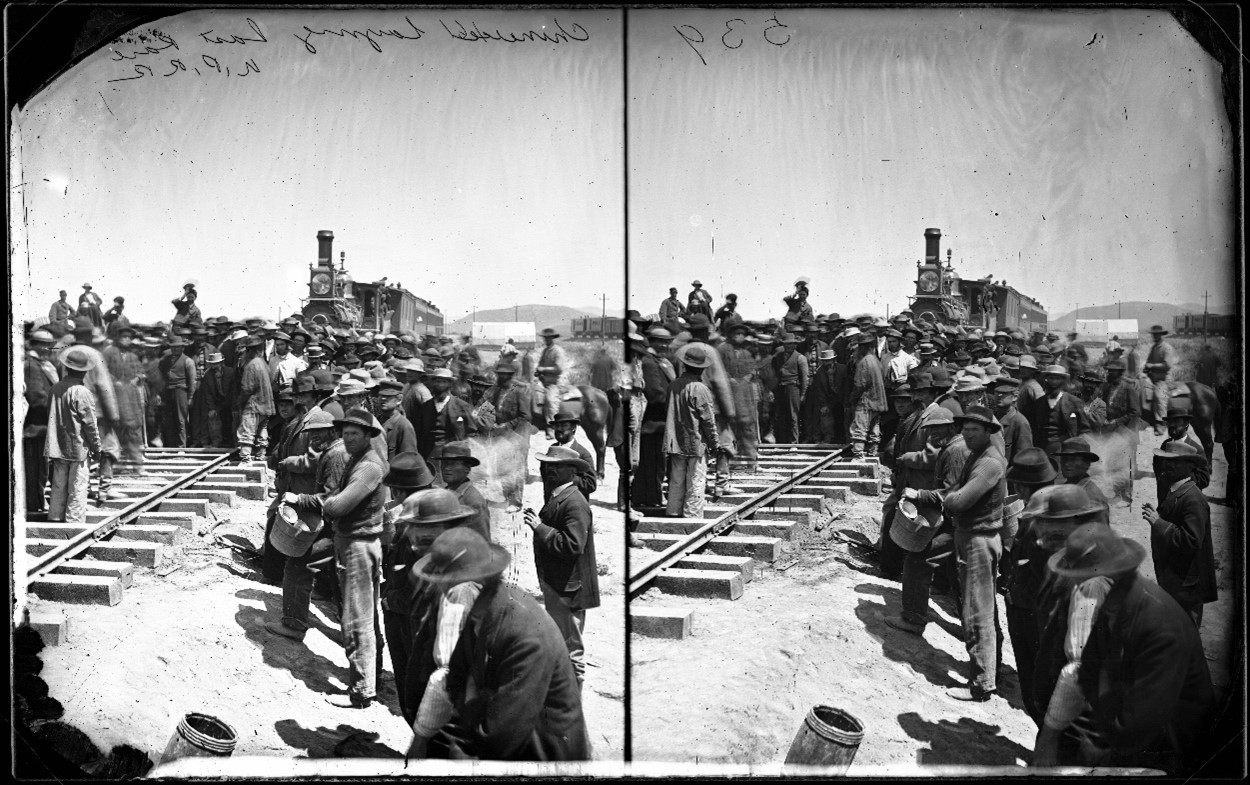
The first transcontinental railroad is still easy to summon in one familiar image: locomotives nose to nose, executives and foremen posing, the ceremonial spike turning a sprawling construction campaign into a single national instant.[1][2] That image is not false. It is just too small for the history now being written around the railroad.
The sharper question is historiographical rather than commemorative: what changed when historians stopped treating the golden-spike ceremony as the whole story and started asking who built the line, who paid for it, and who disappeared from the public frame?[1][3][4][5][6]
Image context: the hero image shows rail being laid at Promontory Summit rather than the better-known handshake photograph. It is useful because this article is about what comes back into view once historians move from ceremony to labor.[5]
Timeline anchors: how the story and the memory changed
- 1862: the Pacific Railway Act authorizes the Central Pacific and Union Pacific, tying railroad construction to federal law, subsidy, and land policy.[1]
- 1864-1867: the Central Pacific turns heavily to Chinese labor; by the later construction years Chinese workers make up most of its workforce, and in June 1867 they stage a major strike over wages and hours.[3]
- May 10, 1869: the rails meet at Promontory Summit; the famous celebratory photographs fix the event in public memory, while other records note that eight Chinese men moved the final rail into place before the ceremonial spikes were driven.[2][3][5]
- 1882: anti-Chinese politics harden into federal exclusion law, helping explain why Chinese railroad labor could be economically indispensable and still be pushed to the edge of national memory.[4]
- 2011-2019: newer scholarship and public-history work push back against triumphal shorthand by emphasizing labor, racial exclusion, archaeology, and the railroad's dependence on public power.[5][6]
Those dates matter because they show that the railroad has never been only one thing. It was at once an engineering feat, a labor regime, a state-backed corporate project, and later a memory object that different generations kept rearranging.
First map: the railroad as national union and engineering triumph
The oldest durable interpretation treats the railroad as the infrastructure of continental union. In this frame, the key move happens in law and then in ceremony. The Pacific Railway Act appears as the enabling state decision, the meeting of the rails at Promontory appears as the operational climax, and the payoff is compression: a trip once measured in months is cut to about a week.[1]
The famous Library of Congress image of East and West shaking hands at the laying of the last rail helped stabilize that reading.[2] Its visual logic is managerial and ceremonial. Engines face each other. Men in positions of authority occupy the center. Completion reads like agreement, coordination, and national closure. For a long time, that was enough to organize the story.
This interpretation has real strengths. It explains why the railroad felt epochal to contemporaries. It linked the Atlantic and Pacific coasts, made federal ambition visible, and condensed years of dispersed labor into one symbolic instant. But the frame also has an obvious cost. It turns the railroad into a story of finishing rather than a story of building. Once that happens, the workers become background texture and the financing structure becomes almost invisible.
Second map: labor recovery and the problem of the missing workers
The corrective interpretation begins by putting the workforce back into the center of the picture. The National Park Service's recent history of Chinese railroad labor is explicit: the Central Pacific turned to Chinese workers after white labor proved unstable and scarce, and by the later years of construction Chinese migrants made up most of that company's labor force.[3] The same page also restores facts that the standard ceremony story barely carries: the June 24, 1867 strike, the record-setting 10 miles and 56 feet of track laid in one day on April 28, 1869, and the role of eight Chinese men in moving the final rail into place on May 10.[3][5]
That labor-centered history does more than add names to a preexisting national triumph. It changes the argument. The railroad no longer looks like a self-propelled achievement of executives and surveyors. It looks like a system that depended on exhausting, dangerous, racially stratified manual work in mountains, tunnels, snow, and desert.[3][5]
The strongest public-history statement of the memory problem comes from the NPS essay on Asian Americans and Pacific Islanders in the making of the nation. It notes that about 20,000 Chinese workers comprised most of the Central Pacific labor force and says the Chinese workers were deliberately kept out of the celebratory golden-spike photograph.[4] That matters because it shows the historical gap is not only archival accident. It is also staged omission.
The phrase "silent spikes" captures one part of the difficulty: very little first-person correspondence or diary material from the Chinese workers survives in accessible form.[3] But archaeology has changed that landscape. The NPS article on the archaeology of Chinese laborers argues that camp remains, artifacts, and route-level material evidence can recover lives that older narrative history left generalized or unnamed.[5] In other words, the labor history of the railroad became stronger not because a single lost memoir appeared, but because historians widened the definition of evidence.
Third map: the railroad as a corporate-state machine
Another interpretive shift pushes in a different direction. Instead of asking only who labored, it asks what sort of political economy the railroad represented. Richard White's Railroaded, in the Stanford History summary, attacks the old triumphal version directly. The transcontinentals appear there as giant corporations built on proliferating debt, dependent on public largess, intertwined with corruption, and powerful enough to rearrange the landscape of the West while provoking antimonopoly backlash.[6]
This reading does not deny the railroad's importance. It denies the innocence of the standard myth. The Pacific Railway Act itself points toward that larger framework. The road was not simply a private entrepreneurial miracle that the state applauded from the sidelines. It was authorized, structured, and materially supported through federal power.[1] Once that is kept in frame, the golden spike stops looking like the inevitable reward for ingenuity alone. It becomes the public seal on a much larger bargain between government authority, corporate ambition, and labor extraction.
This is where the historiography becomes more interesting than a simple debunking exercise. The point is not that the railroad failed to unify the continent. It did help do that. The point is that national integration was produced through institutions and costs that older celebratory narratives softened or ignored.
Where the main disagreement now sits
The strongest disagreement is no longer over whether the railroad mattered. It is over what should count as its central meaning.
Interpretation A: national integration remains the primary meaning
This view still has force because the legal authorization, the coast-to-coast link, and the ceremonial joining at Promontory were historically consequential in their own right.[1][2] If one wants to explain why the event entered textbooks so quickly, the answer lies here. The railroad was a continental threshold.
Interpretation B: the decisive historical meaning lies in labor, exclusion, and public power
This interpretation argues that the older last-spike story misidentifies the railroad's real structure. The essential facts are not only the meeting of the rails but the Chinese-majority workforce on the Central Pacific, the exclusion of those workers from the most famous commemorative image, the archaeology of missing lives, and the dependence of the project on public subsidy and corporate privilege.[3][4][5][6]
What would change the assessment?
If a large new body of Chinese workers' first-person letters or diaries surfaced, historians could describe intention, conflict, kinship, and political consciousness with much greater precision, not just through payrolls, newspapers, and camp remains. If route-level studies linked labor evidence even more tightly to federal financing and local political decisions, the corporate-state interpretation would become sharper still. For now, the argument turns on an uneven archive: ceremony is richly pictured, labor is partially reconstructed, and power is often clearest when legal and financial records are read against the commemorative myth.
Why the map changed
The historical map changed because the archive changed. Public memory began with a photo-op and a completion ritual.[2] Later scholars and park historians asked different questions and accepted different kinds of evidence.[3][4][5][6] Once that happened, the railroad no longer looked like one clean line joining East and West. It looked like a stack of stories built on top of each other.
That is the most useful way to read the transcontinental railroad now. The golden spike still belongs in the story, but not as the whole explanation. It is the ceremonial capstone of a project made by federal law, migrant labor, racial exclusion, debt-financed corporate expansion, and a century-long struggle over who gets to stand in the picture.[1][2][3][4][5][6]
Sources
- U.S. National Archives, "Pacific Railway Act (1862)" - on federal authorization, the joining of the rails at Promontory on May 10, 1869, the shortened travel time, and the railroad's route context.
- Library of Congress Prints and Photographs Division, "East shakes hands with West at laying last rail" - photo record for the famous Promontory ceremony image, dated May 10, 1869.
- National Park Service, "Chinese Labor and the Iron Road" - on Central Pacific labor recruitment, the 1867 strike, the eight Chinese men who moved the final rail, and the "Silent Spikes" problem.
- National Park Service, "Asian Americans and Pacific Islanders in the Making of the Nation" - on the roughly 20,000 Chinese workers on the Central Pacific and their exclusion from the celebratory golden-spike photograph.
- National Park Service, "The Archeology of Chinese Laborers Who Connected the Country" - on camp archaeology, the record-setting April 28, 1869 tracklaying push, and the absence of Chinese workers from the best-known celebration photographs.
- Stanford Department of History, "Railroaded: The Transcontinentals and the Making of Modern America" - summary of Richard White's interpretation of debt, public largess, corruption, and the collapse of triumphal golden-spike myths.