By seven in the evening, people in Napier were writing telegrams on whatever scraps of paper they could find. The temporary office at Hastings Street School had opened about an hour earlier. It had customers and telegraphists, but no working telegraph outlet. That night, the messages went south by motorcar, accompanied by operators who could help send them from offices beyond the damaged network.[1]
It was 3 February 1931. Earlier that day, HMS Veronica had used wireless to call for assistance after the Hawke's Bay earthquake. The schoolhouse queue reveals another part of the rescue: a signal leaving a ship and a resident reaching a relative were different achievements. How did a city whose communications had broken begin to make itself heard?[1][3]
A ship beside a broken town
The magnitude 7.8 earthquake struck at about 10:47 a.m. In Napier and Hastings, falling masonry made both buildings and streets dangerous. Fire followed in Napier's business district. Water pressure failed as the reservoir emptied; an attempt to pump seawater ran into another obstruction when shingle blocked the hoses. People digging through wreckage faced advancing fire as well as continuing aftershocks.[2]
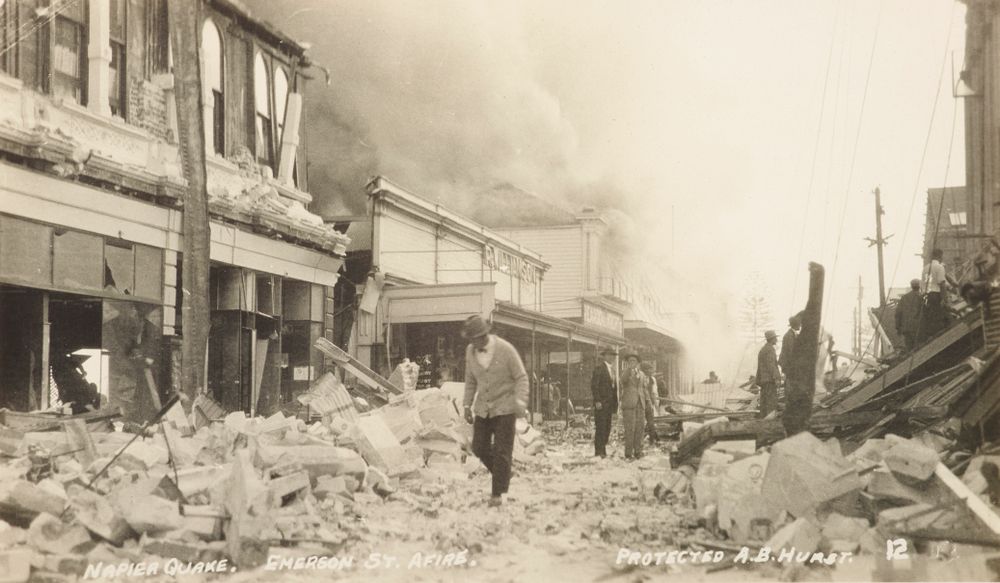
Arthur Hurst's photograph of Emerson Street preserves that second emergency. Te Papa identifies the print as a view of the street afire in 1931.[7] Smoke and damaged buildings occupy the same scene. The photograph cannot tell us which telephone connection failed first, but it shows why surviving the initial shaking did not mean a building—or the equipment inside it—was safe.
Veronica had berthed that morning on a routine visit. The changing harbour bottom left her aground. Her position was precarious, yet her wireless could still reach the naval base in Auckland. The Navy Museum's account reproduces a signal sent at 10:54 a.m., reporting the shaking and the ship's condition.[3] A working transmitter had survived inside the disaster area.
What the signals could establish
The exchange reproduced by the museum becomes more urgent as information accumulates. At 11:14, Auckland asked whether cruisers were needed. At 11:53, Veronica requested medical assistance. By 1:31 p.m., the report described a town apparently engulfed in fire. These times follow the museum's published transcription, which draws on naval radio history and a later documentary account; they should not be mistaken for a synchronized survey of the whole city.[3]
Their sequence matters more than a heroic image of one perfect distress call. The first message established contact. Subsequent messages established needs. On the receiving end, assistance could be assembled while people on the scene were still discovering the extent of the damage. Uncertainty about the total destruction did not prevent a specific request for doctors.
Even the radio connection required coordination. The naval communications history Auckland Radio's Shaky Beginnings records that Veronica was told during the afternoon to keep watch with Wellington Radio. An instruction initially omitted a frequency; a later order specified one, though the author leaves its relationship to Wellington's frequency unresolved.[6] That small uncertainty is a useful restraint on hindsight. Possessing wireless equipment did not automatically settle who would listen, on which channel, or how messages would circulate.
The roads carried the missing connection
The Post and Telegraph Department's annual report describes a much wider interruption than one severed Napier line. Telephone and telegraph communication failed across an area extending approximately from Dannevirke to Gisborne and inland toward Taupo. Roads south of Napier, however, remained passable. That surviving route gave the department a way to move messages around the break.[1]
Its staff were also losing their workplaces. Napier's recently completed chief post office survived the shaking but was gutted by fire. The Port Ahuriri office was damaged and then burned. Postal work briefly occupied the band rotunda in Clive Square, before yielding that space for surgical operations. Other business moved into a railway club room.[1] The sequence shows a town reallocating whatever shelter remained usable, with urgent needs competing for the same few places.
The telegraph branch reopened at Hastings Street School at about six that evening. By seven, the report says, hundreds had gathered. Their messages travelled to Waipukurau and Dannevirke by car for onward transmission. Later, aircraft and vehicles carried further batches between centres.[1]
This was a service reconstructed in stages. A counter could accept a telegram before a local wire could transmit it. A road journey could connect that counter to an operating office. Sending skilled staff with the messages addressed the workload awaiting them at the other end. The familiar promise of a telegram survived through an unfamiliar journey.
A household's first night
Eleanor Edith Kay's letter to her sisters, written a few days after the earthquake from refuge in Woodville, brings the scale back to one family. At her Hospital Hill home, she had crossed fallen bricks to reach her young son and the family's helper. Water escaped from broken tanks and pipes. Later she salvaged food, clothing and bedding while fresh shocks repeatedly drove her outside.[4]
That first night, the family slept outdoors. Kay described neighbours sharing provisions and a makeshift fire built with bricks from her chimney. She also remembered alarming predictions circulating under the claim of official authority. Her letter records what she experienced and heard, not a verified account of every rumour.[4]
For this household, relief already included finding water, feeding children and pooling shelter. The letter makes visible work that a ship's signal log naturally leaves outside the frame. It also helps explain the importance of the schoolhouse queue: communication could relieve fear far beyond the people directly receiving medical assistance.
Making help reachable
On 4 February, the cruisers Dunedin and Diomede arrived with additional personnel, medical help and emergency supplies. Sailors joined the relief work already under way.[3] An army tent camp could accommodate 2,500 people; evacuation and temporary accommodation elsewhere became part of the response. The official death toll across Hawke's Bay would be 256, a regional figure that should not be read as Napier's alone.[5]
At the school, another arrival received less dramatic attention: a 100-number telephone switchboard sent from Wellington. Engineers connected police, relief organizations and temporary hospitals. Men from Veronica helped piece together circuits to Nelson Park hospital and other points.[1] The ship's contribution now extended into rebuilding communications on land.
By 5 February, trains were reaching Napier again, reducing the road transport needed to connect postal services. There were stubborn limits, however. With residents displaced and premises destroyed, delivering incoming telegrams by messenger became impossible for a time. People had to collect them, and many remained unclaimed.[1] A message reaching Napier was still not necessarily a message reaching its recipient.
The two records—the urgent naval signals and the departmental account of counters, cars and wires—therefore describe successive parts of one operation. Wireless helped bring resources toward the city. Local workers and arriving crews then made places where needs could be registered, messages forwarded and assistance organized. At Hastings Street School, that recovery began with a person handing over a scrap of paper, trusting that someone could find a route out.
Sources
- New Zealand Post and Telegraph Department, Report for the Year 1930–31, Appendix to the Journals of the House of Representatives, F.—1, especially pp. 11–13 — contemporary account of damaged offices, message transport, temporary services and the emergency switchboard.
- Eileen McSaveney, “The 1931 Hawke's Bay earthquake,” Te Ara Encyclopedia of New Zealand — destruction, firefighting constraints and rescue conditions.
- National Museum of the Royal New Zealand Navy, “RNZN – 1931 Hawkes Bay Earthquake” — Veronica's arrival, reproduced signal sequence, reinforcements and the account's underlying references.
- Eleanor Edith Kay, letter to her sisters written shortly after the earthquake, reproduced as “A mother's story,” Te Ara — household rescue, shared provisions, shelter and rumours.
- Manatū Taonga — Ministry for Culture and Heritage, “Deadly Hawke's Bay earthquake,” NZHistory — relief camps, evacuation and the regional death toll.
- “Auckland Radio's Shaky Beginnings,” naval communications history, chapter 2, p. 1, hosted by the RNZN Communicators Association — instructions to maintain watch and the unresolved frequency detail.
- Museum of New Zealand Te Papa Tongarewa, Arthur Hurst, Napier Earthquake – Emerson Street afire, 1931, O.005480 — photographic print, attribution, collection credit and image.