A raised hand could bring the machine to a halt. Under section 3 of Britain's Locomotives Act 1865, a person with a horse or horse-drawn carriage could signal a road engine to stop immediately. Ahead of the engine walked another person, carrying the red flag that would give the legislation its enduring nickname.[1]
Read past the flag, however, and the act becomes an argument about access. It tightened the conditions for running an engine while removing a power that had confined some engines to night travel. Why would a law impose such cumbersome precautions and still attract support from people who wanted more machines on the roads?[1][3]
Start with the machine
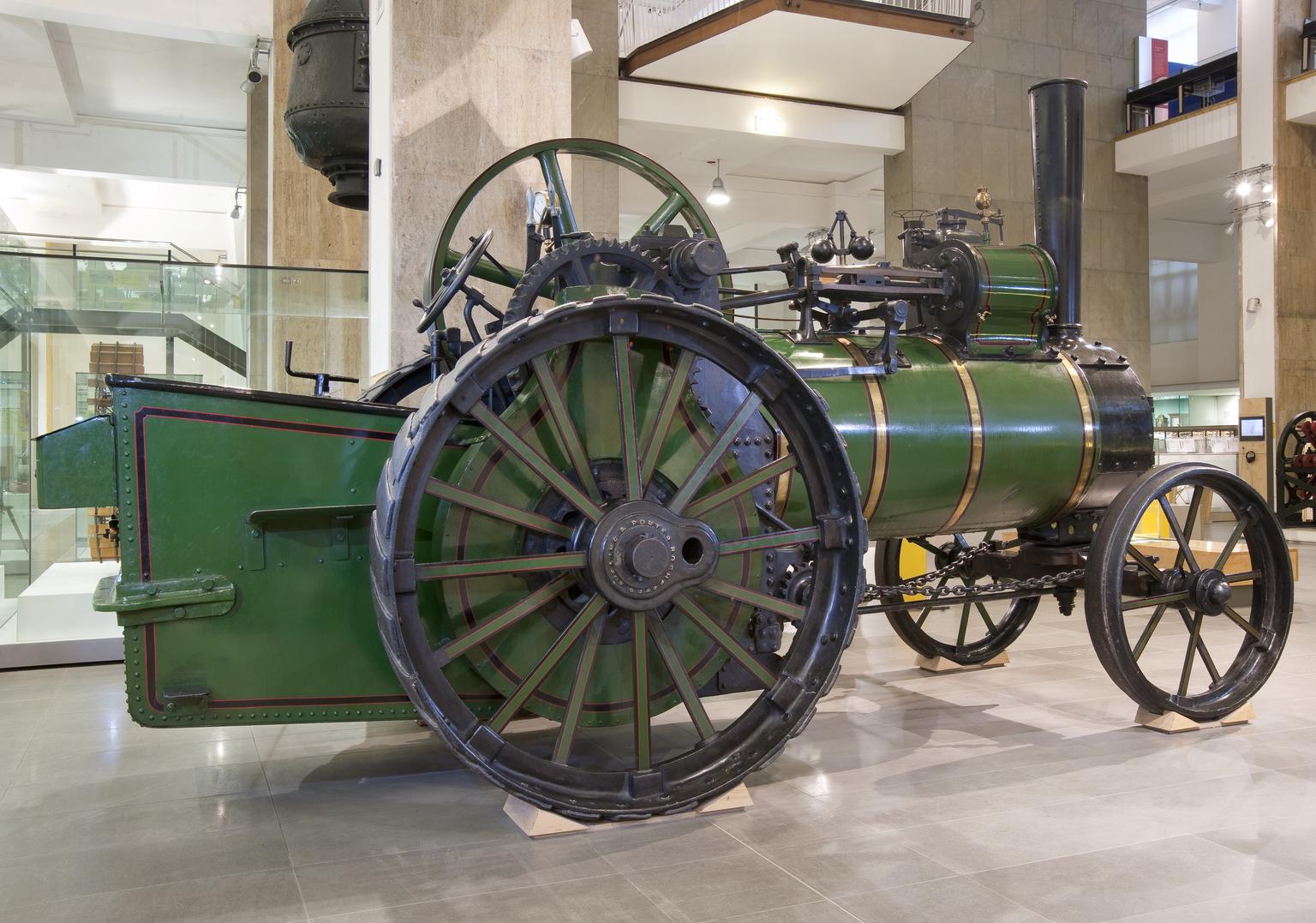
The Aveling and Porter engine in the photograph helps restore the scale of the question. Made in Rochester around 1871, it is a steam traction engine, with a tall chimney, exposed working parts and broad wheels. The Science Museum Group records its approximate dimensions as 4.8 metres long and 2.44 metres wide.[2] Meeting that bulk on a narrow road required room to pass, as well as confidence that the horse would keep moving.
The legislation received royal assent on 5 July 1865 and came into operation on 1 September. Its title specified agricultural and other uses. Section 3 covered road locomotives propelled by steam or other non-animal power; section 4 set ceilings of four miles an hour on public roads and two through cities, towns and villages.[1] The text regulated the encounter between mechanical power and an already occupied highway.
The freedom hidden in a repeal
The most revealing provision comes before the flag. Section 2 repealed specified parts of the 1861 act, including section 5 and the orders issued under it.[1] To understand the importance of that deletion, the reader has to leave the statute and enter Parliament.
At the Lords' second reading on 26 May 1865, the Earl of Hardwicke explained that the earlier law let the Secretary of State prohibit or restrict road engines where they posed danger. Repeated applications, he argued, had brought a valuable means of haulage almost to a standstill. The new bill was intended to remedy that situation.[3]
Lord Kinnaird supplied the practical difficulty. He owned two machines and had farms five miles apart. A restriction limiting travel to the hours between midnight and six in the morning made getting engines into fields exceedingly difficult. He feared having to abandon their use.[3] His problem was the journey between jobs: a machine useful inside a field could become unusable if it could not reach the next one.
Opponents understood the repeal as a substantial concession. The Earl of Carnarvon objected that the bill removed valuable safeguards. He questioned whether an approaching vehicle could pass an engine nine feet wide on a narrow road.[3] These were competing claims on the same space. The farmers' interest in access did not make other road users' fears disappear.
The walker had more than a flag to carry
Section 3 required at least three people to conduct the locomotive. One had to walk at least sixty yards ahead, keep the flag displayed, warn riders and drivers, signal when the engine should stop, and help horses and carriages pass. The driver also had to leave as much room as possible and obey a raised-hand stop signal.[1]
The sequence of duties matters. A warning announced the engine; a signal could halt it; assistance helped another traveller get past. My reading is that the walker served as an intermediary between two kinds of traffic. The law placed part of the work of making the encounter manageable on the engine's crew.
Yet even the distance was contested. In the Commons on 26 April, Mr. Fellowes proposed a hundred yards. Sir William Miles replied that a person that far ahead could disappear from the driver's view, especially near towns. Sir Edward Dering distinguished straight country roads from towns and lanes with bends.[4]
That debate exposes a genuine design problem. More separation could give an approaching rider earlier warning while making communication with the engine harder. No single distance answered both concerns equally well.
It also supplies a warning about reading legislative evidence. The Commons voted to replace “less” with “more,” making sixty yards a maximum at that stage. The enacted text says “not less than Sixty Yards.”[1][4] A speech or committee vote records an argument at a particular moment. The final act establishes which wording became law.
Permission reached the edge of a field
The bargain extended beyond engines travelling along the road. Section 6 relaxed an existing restriction on steam machinery working within twenty-five yards of a highway, allowing locomotive engines to plough there if someone stood in the road to signal the driver and assist passing horses. The driver had to stop in time.[1]
During the Commons debate, Sir Edward Dering argued that removing this concession would deprive farmers of steam ploughing. The eventual arrangement tied permission to a person stationed where field work met public traffic.[4] Again, the act made human attention part of the conditions under which machinery could operate.
The flag and the walker had different afterlives
The later amendments are equally precise. Section 29 of the Highways and Locomotives (Amendment) Act 1878, expressly applying this change to England, replaced the paragraph about the advance walker. The new wording retained a person on foot at least twenty yards ahead, available to help horses and carriages. It omitted the red flag.[5] The warning object disappeared before the attendant did.
The 1896 legislation made a different change. It exempted a class of light locomotives from earlier restrictions: vehicles under three tons unladen, subject to conditions on towing and visible smoke or vapour. It also required an audible warning instrument.[6] Parliament was distinguishing kinds of machine and changing how they announced their presence.
None of these documents alone measures the act's full economic effects. Establishing how much it delayed particular inventions would require evidence about manufacturers, costs, enforcement and demand. What the text and debates do show is a negotiated permission to use the road. For an owner whose engine otherwise moved between farms in darkness, the person walking ahead could be part of the price of working by day.
Sources
- UK Parliament, Locomotives Act 1865, 28 & 29 Vict. c. 83, original enacted text, especially sections 1–4 and 6; scan hosted by The National Archives.
- Science Museum Group, “Aveling and Porter steam traction engine,” object 1953-1/1; manufacture date, dimensions and museum photographs.
- Hansard, House of Lords, “Locomotives on Roads Bill—(No 108),” second reading, 26 May 1865; Hardwicke, Kinnaird and Carnarvon on road access and safeguards.
- Hansard, House of Commons, “Locomotives on Roads Bill: [Bill 63.] Committee,” 26 April 1865, vol. 178, columns 1060–71; the attendant's distance and steam ploughing beside roads.
- UK Parliament, Highways and Locomotives (Amendment) Act 1878, 41 & 42 Vict. c. 77, section 29; replacement of the advance-walker provision in England.
- UK Parliament, Locomotives on Highways Act 1896, 59 & 60 Vict. c. 36, sections 1 and 3; exemption for light locomotives and audible warning requirement.