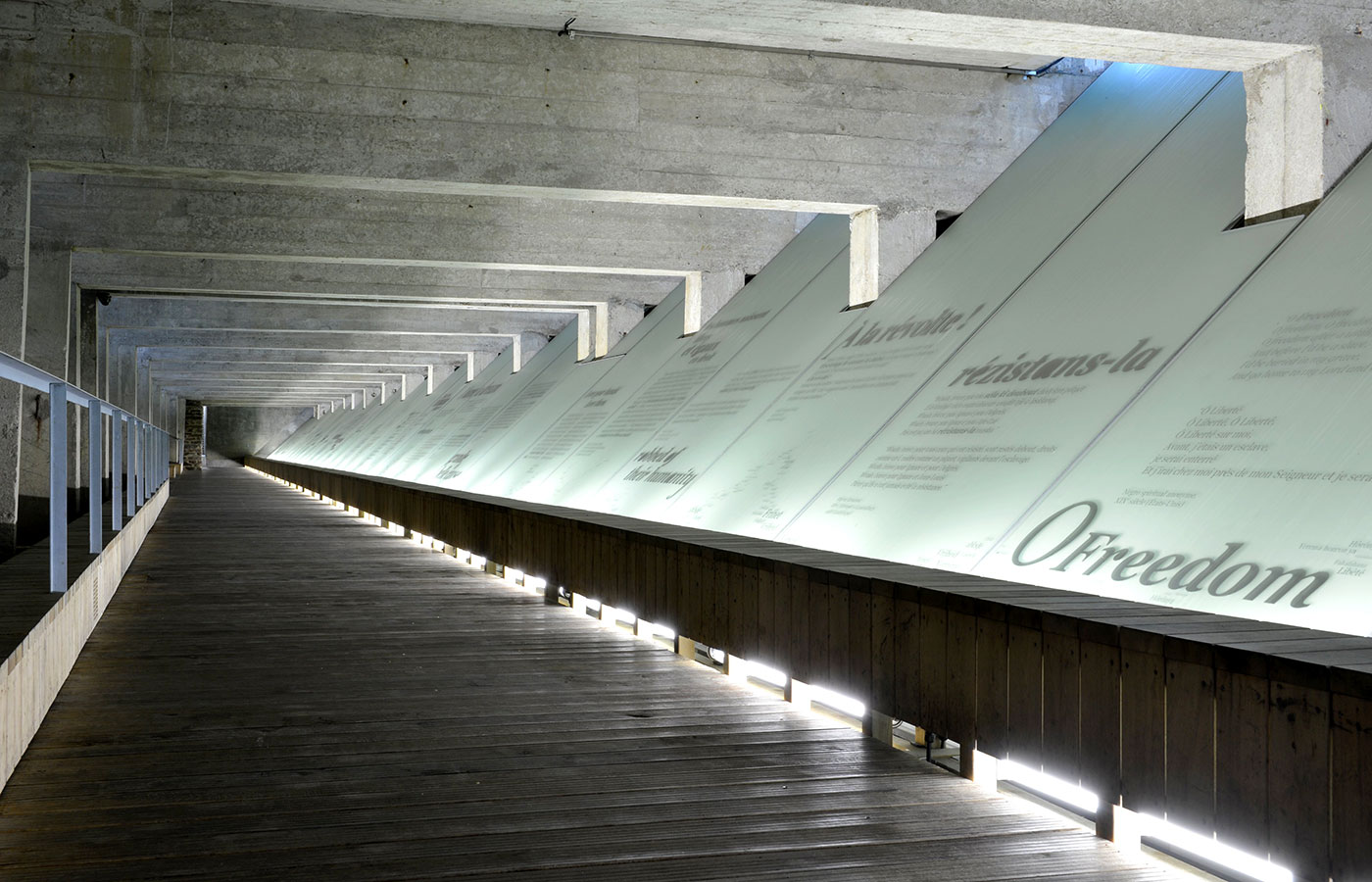
A ship's name, a departure date, another ship's name: on Nantes's riverfront, glass inserts turn a walk into an encounter with the port's slave-trading record. Below the pavement, a passage places the visitor beside the Loire and a wall of texts about freedom. The Memorial to the Abolition of Slavery, opened on 25 March 2012, asks people to move between those two registers: the business of captivity and the struggle against it.[1]
That movement raises a difficult question for a city enriched by the trade. How can a monument honour emancipation while keeping responsibility for enslavement in view?
Before the descent, a struggle for a place
The memorial's official chronology begins well before construction. In 1985, an international symposium took place in Nantes, but the municipality declined to fund the accompanying research and cultural programme. Historians and associations continued the work. In 1992, the exhibition Les Anneaux de la Mémoire brought the Atlantic slave trade and Nantes's participation before a large public.[2]
In April 1998, eleven associations came together around the 150th anniversary of abolition. A commemorative sculpture commissioned by Mémoire de l'Outre-mer was unveiled on the Quai de la Fosse and vandalized days later. That June, the municipality decided to create a commemorative work. The eventual memorial therefore followed both a campaign for recognition and a physical attack on an earlier attempt to secure it.[2]
This sequence changes how the finished site should be read. Municipal recognition was an outcome of public pressure. The completed monument gives that recognition permanence, but its foundations include people insisting that the city make room for a history it had been reluctant to display.
The quay becomes part of the evidence
Krzysztof Wodiczko and Julian Bonder's design uses two levels. Above, 2,000 glass inserts record slave-trading voyages and places connected with the trade. Below, visitors encounter the river through openings between structural supports, alongside a long glass wall bearing laws, testimony, literature and abolitionist texts.[1]
The physical conversion matters. The European Prize for Urban Public Space's project record describes a car park replaced by a riverside promenade. Underneath, the designers adapted existing embankment structures; a waterproof concrete basin protected the new passage against rising water. The low, confined gallery evokes a ship's hold through the reuse of a space already embedded in the city.[3]
It is a designed evocation, rather than a surviving slave-ship interior. Reading it as a reconstruction would mistake an architectural analogy for an archaeological object. Its force comes from where the visitor stands: below a familiar urban surface, close to the water that connected the port to a much larger system.
The project record also makes the intervention's ordinary civic purpose visible. Removing parked cars returned riverfront space to public use.[3] Remembrance acquired a place in daily movement. That can make an encounter possible without a planned museum visit, although accessibility alone cannot tell us what a passer-by understands.
What the word “abolition” leaves open
In a 2021 study, researcher Rossila Goussanou documented objections that persisted after the opening. Critics questioned the memorial's low visibility underground and its limited explanation of the structures that sustained slavery. On 10 May 2016, protesters covered exterior plaques with a banner attacking the absence of the Code Noir, the French colonial slave code. Their objection concerned the balance of the story: celebrating abolition could allow Nantes to appear primarily as a city of emancipation.[5]
Goussanou also recorded a different intervention in April 2019. An anonymous collective placed hundreds of plaques on the esplanade naming people who had died while migrating from Africa. The additions brought another history of dangerous journeys into the memorial's space.[5]
These acts reveal different demands on the same site. One asks for a fuller account of the historical system; the other uses commemoration to address present suffering. Neither is answered simply by pointing to the monument's existence. Goussanou's evidence establishes that people contested its message, without establishing that every visitor read it in the same way.[5]
The museum has work the monument cannot finish
The memorial itself includes historical and geographical information at one end of the passage.[1] Its educational guidance nevertheless makes a useful distinction. It advises teachers to separate the historical visit at the Nantes History Museum from the commemorative visit at the memorial, so pupils do not confuse history with remembrance. Its school itinerary moves through museum rooms, the city, and finally the memorial.[4]
That division gives the strongest answer to the charge of omission. The museum's collection includes a copy of the Code Noir. Its account addresses the organization of slave-trading expeditions, the actors involved, and life under plantation slavery. Fourteen information panels link museum and memorial through the city.[6] The code is therefore present within Nantes's wider interpretation, even though critics wanted its role confronted at the memorial itself.
The distinction also exposes a practical weakness. A visitor who reaches only the quay may never encounter the explanation supplied elsewhere. Assessing the arrangement would require evidence about how people use those linked sites and what they learn from them. A list of available resources cannot establish that connection by itself.
The educational sequence suggests a demanding way to make the memorial work: understand the system, recognize its traces in the city, then enter a space of commemoration. The descent gains meaning from the history carried into it.[4]
Nantes's achievement is a durable public place where the riverfront can be read through slavery's history. Its unfinished task is to keep the links legible: between a ship's name and the people it carried, between a declaration of freedom and the institutions that denied it, between the quiet passage below and the city continuing overhead.
Sources
- Memorial to the Abolition of Slavery, “Discovery” — opening date, designers, glass inserts, historical information and passage; source of the photograph.
- Memorial to the Abolition of Slavery, “Nantes and its memorial policy” — civic campaigning, the 1985 symposium, 1992 exhibition and 1998 sculpture and municipal decision.
- European Prize for Urban Public Space, “Memorial to the abolition of slavery,” Special Mention 2012 — the former car park, existing embankment structures and conversion of the lower gallery.
- Memorial to the Abolition of Slavery, “Pro/presse/edu,” Education — the museum–city–memorial itinerary and distinction between historical explanation and commemoration.
- Rossila Goussanou, “Sur les traces du mémorial,” Atlas Social de la métropole nantaise (1 October 2021), especially sections 3–4 — criticism of the memorial's framing and the 2016 and 2019 interventions.
- Memorial to the Abolition of Slavery, “The history museum” — the Code Noir, interpretation of Nantes's colonial slave system and connecting information panels.