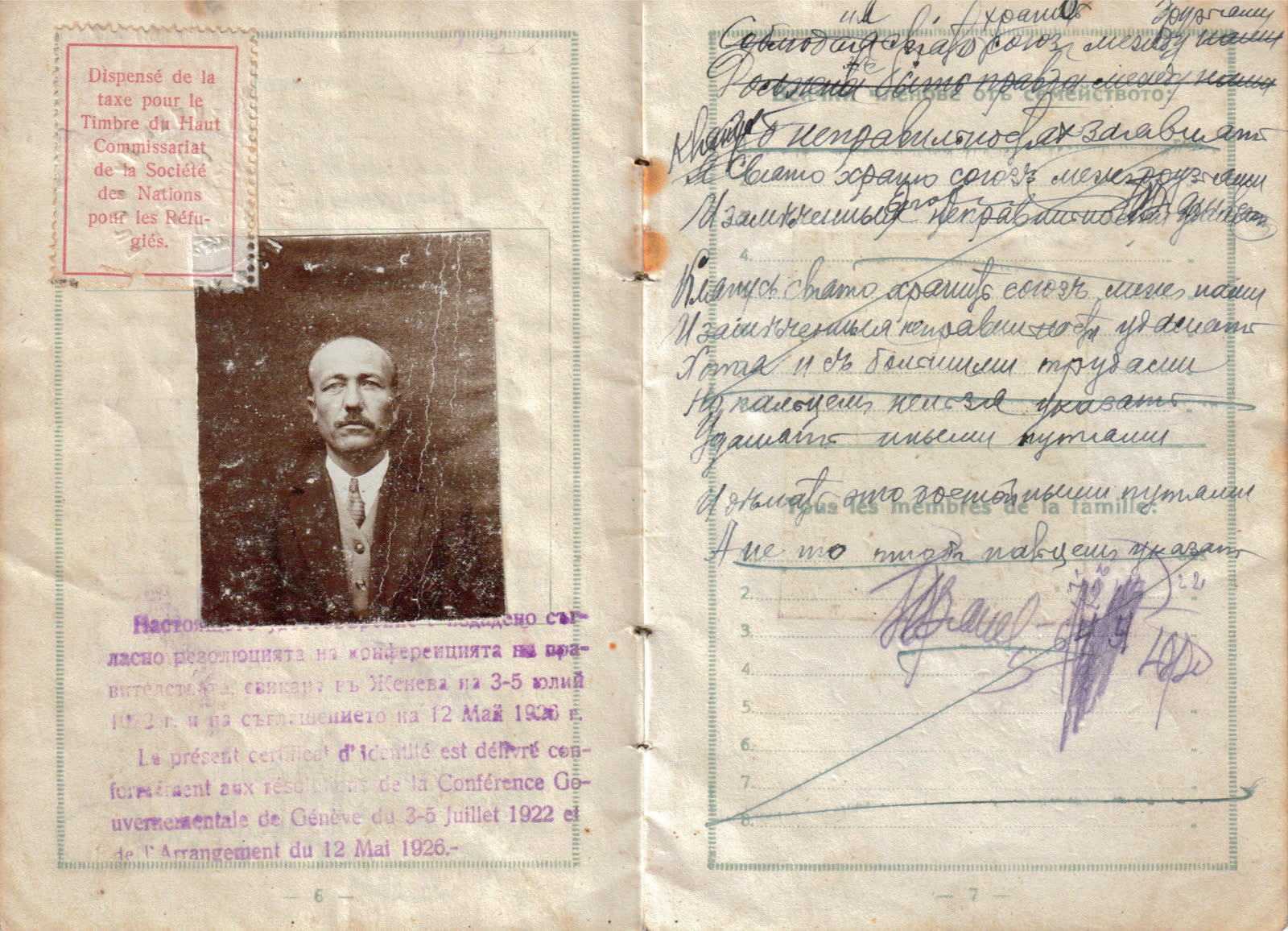
The Nansen passport is often remembered as a humane invention, which it was, but that description is thinner than the historical mechanism. Its real importance was administrative. In the interwar years, large numbers of displaced people had a problem that charity alone could not solve: they were outside their home states and no longer held papers that other states were prepared to recognize. Without a valid passport, movement, residence, employment, and family reunification all became harder at once.[1][2][3]
That is why the Nansen passport matters in history. It did not end statelessness. It made stateless people legible to the institutions that controlled everyday life: consulates, police offices, shipping lines, and border posts. The breakthrough was not sovereignty in the full sense. It was the creation of a shared file format for people whose state had disappeared, rejected them, or become inaccessible.[1][2][3]
The lead image shows that mechanism in object form. A Nansen passport covered in entries and stamps is not just memorabilia. It shows the document doing its actual work: carrying identity, movement permission, and bureaucratic recognition from one office to the next.[4][5]
Timeline anchors
- 1921: the League of Nations appoints Fridtjof Nansen as High Commissioner for Refugees.[1]
- July 5, 1922: an arrangement creates identity certificates for Russian refugees.[2]
- May 31, 1924: a second arrangement extends that document logic to Armenian refugees made stateless after the postwar settlement.[2]
- After 1922: the League of Nations provides "Nansen passports" to stateless refugees for cross-border movement.[1]
- 1930: Nansen dies, ending the first phase of the system built around his personal authority.[1][3]
- 1931: the Nansen International Office for Refugees is created in Geneva to continue refugee protection work after his death.[3]
The sequence matters because it shows that the passport was not a one-day invention. It was a staged answer to a recurring administrative failure.
The problem was not only exile. It was document collapse.
After the First World War and the Russian Revolution, refugee displacement in Europe did not merely produce people in need. It produced people whose legal paperwork no longer worked. The Nobel Prize's institutional summary of Nansen's work places him inside the League of Nations refugee regime from 1921, and notes that after 1922 the League provided "Nansen passports" to stateless refugees so they could cross national borders.[1]
That short description is enough to reveal the underlying problem. Borders were still there. Shipping companies still checked documents. Police still registered foreigners. Consuls still issued visas. If a refugee had no recognized national passport, every one of those checkpoints could stop movement.
The Nansen passport mattered because it addressed that choke point directly. Instead of waiting for universal naturalization, repatriation, or a full redesign of international law, the League and participating states built a narrower instrument: an identity-and-travel certificate that governments could accept even when the holder no longer possessed a functioning nationality document.[1][2][3]
This is the first mechanism in the story: the refugee question was converted from a purely political deadlock into an administrative category.
July 1922: Russian refugees first
The OFPRA timeline is particularly useful because it anchors the system in specific legal acts rather than in retrospective legend. It identifies the Arrangement of 5 July 1922 concerning the granting of identity certificates to Russian refugees.[2]
That wording matters. The first move was not the conferral of citizenship. It was the conferral of an identity certificate. In practical terms, the League refugee regime began by asking a smaller question: how can officials verify, classify, and permit movement for a person who no longer holds a nationally trusted passport?
Seen this way, the Nansen passport was a document of managed incompleteness. It did not claim that the Russian refugee problem had been solved. It claimed that a refugee without a state could still be processed through border and residency systems without pretending the person had ceased to exist in law.
This is why the passport was stronger than a humanitarian letter and weaker than full nationality. A letter might inspire sympathy, but it would not necessarily survive a border counter. A national passport implied a state standing behind the bearer. The Nansen passport sat in between: an internationally recognized workaround for people stranded between those two conditions.[1][2][3]
1924 and after: the category widened
The same OFPRA timeline records a second key step: the Arrangement of 31 May 1924 concerning the granting of identity certificates to Armenian refugees.[2] The page connects that decision to the post-Lausanne settlement, which made return impossible for many Armenian exiles and left them needing host-country solutions.[2]
This extension is the second mechanism in the story. Once officials had a reusable documentary form, they could expand it beyond one refugee population. The passport was no longer an ad hoc favor to one displaced group. It was becoming a transnational template.
Britannica's summary of the League of Nations Passport sharpens that point further. It describes the Nansen passport as a travel document that allowed the holder to move more freely across national boundaries, then notes that after Nansen's death in 1930, the Nansen International Office for Refugees in Geneva carried the work forward from 1931, caring mainly for White Russians, Armenians from Turkey, and later Jews from Nazi Germany.[3]
That institutional continuity is historically important. It shows that the passport's value did not depend solely on Nansen's prestige. The format had become useful enough that states and refugee agencies kept it alive after the individual who gave it his name was gone.
Why it worked: not because it made refugees equal, but because it made them readable
The strongest way to read the Nansen passport is not as moral symbolism but as a low-level interoperability layer.
A refugee carrying one of these documents could present something standardizable. A visa office could stamp it. A border guard could inspect it. A local administration could file it. The Library of Congress item for a surviving Nansen passport with stamps makes that visible in the most concrete way possible: the document is crowded with the marks of repeated official use.[4] The Wikimedia Commons file used for the article image shows the same thing.[5]
That is the third mechanism. Human mobility depends on small acts of recognition repeated by many offices. The Nansen passport did not need to solve every problem at once. It only had to solve enough of them that displaced people could board ships, rent rooms, register their presence, apply for onward travel, and remain inside administrative sight rather than outside it.
In that sense, the passport turned a refugee from a legal void into a governed exception. That is not the same as equality. It is closer to a conditional corridor through a border-heavy world.
What the passport could not do
A history like this becomes misleading if it turns the document into a miracle.
The sources point to limits as well as gains. Britannica describes the Nansen passport as a travel document, not a substitute nationality.[3] OFPRA's legal framing is likewise about identity certificates for specified refugee populations, not universal membership in a new political community.[2] The system could ease movement and recognition, but it still depended on states deciding to honor the document, issue visas, and permit residence.
That means the Nansen passport should be read as a partial technology. It reduced friction. It did not erase vulnerability. It helped refugees cross borders more freely; it did not guarantee equal rights once they arrived. It created a standard file for stateless people; it did not dissolve the hierarchy between citizens and noncitizens.
This limitation is exactly what makes the passport historically interesting. The document sits at the boundary between humanitarianism and governance. It shows how international institutions often work when they cannot deliver full political solutions: they standardize paperwork, narrow discretion, and create procedures that make life less impossible even when it is far from secure.[1][2][3]
Why this history still matters
The Nansen passport deserves to be remembered not only because it helped refugees, but because it reveals a durable pattern in modern governance. When institutions cannot quickly settle the largest political question, they often start by building a smaller documentary bridge that lets everyday life continue.
That is the lasting lesson here. Nansen and the League did not abolish the border state. They gave the border state a document it could recognize for people who otherwise risked being unreadable everywhere. The result was modest in theory and immense in practice.
History often celebrates grand settlements. The Nansen passport points to another route: one sheet of paper, accepted widely enough, can change the operational meaning of exile. It can turn statelessness from a condition of pure blockage into a condition that institutions, however imperfectly, know how to handle.[1][2][3][4]
Sources
- Nobel Prize, "Fridtjof Nansen - Facts" - League of Nations refugee role from 1921, post-1922 Nansen passports, and the 1930 endpoint of Nansen's own career.
- OFPRA, "1920" timeline - July 5, 1922 arrangement for Russian refugees and May 31, 1924 arrangement for Armenian refugees.
- Encyclopaedia Britannica, "League of Nations Passport" - cross-border function of the Nansen passport and the 1931 Nansen International Office for Refugees.
- Library of Congress, "Nansen Passport with Stamps" - surviving stamped travel document showing the passport in interwar administrative use.
- Wikimedia Commons, "File:Nansenpass.jpg" - archival image source for the passport photograph used as the article hero image.