
On paper, the Little Rock crisis was about constitutional hierarchy. The Supreme Court had already declared segregated public schooling unconstitutional in Brown v. Board of Education. A federal court had approved a desegregation plan for Little Rock Central High School. Nine Black students were scheduled to enter the school in September 1957. Then Governor Orval Faubus used the Arkansas National Guard to block them, and the entrance to one high school became a test of whether federal court orders could be obeyed in public view.[2][3][4]
That broad constitutional story is well known. What the silent Army footage adds is the physical grammar of enforcement. It shows desegregation not as an abstract principle and not even primarily as a speech, but as a repeated problem of vehicles, sidewalks, crowd edges, stairways, and doorways. The state had to decide who could stand where, who could move when, and who would occupy the space between nine students and a hostile public.
The reels matter for that reason. The best-known images from Little Rock tend to freeze the crisis into one face, one glare, one afternoon. Those still photographs deserve their place.[5] But the moving images preserved through the Army and National Archives show something slightly different and, in historical terms, just as important: federal authority arriving as procedure. The school entrance becomes a corridor, and the corridor has to be maintained.
Historical context: a constitutional conflict had to become a daily route
The chronology tightened fast. On September 2, 1957, Faubus announced that he had called out the Arkansas National Guard. On September 4, the guard prevented the Black students from entering Central High. On September 23, after one attempt at admission, a white mob gathered outside the school and the students had to be removed. That same day Eisenhower signed Executive Order 10730, authorizing federal troops to restore order and aid the execution of federal law in Little Rock.[2][3]
Eisenhower's public explanation is crucial to the footage embedded below. In his September 24 radio and television address, he framed the issue less as a local education dispute than as a basic question of constitutional government. Federal troops, he said, were being used because "mob rule cannot be allowed to override the decisions of our courts" and because the federal government had to uphold federal law when obstruction of justice continued.[4] In other words, the President was not narrating heroism. He was narrating enforceability.
That emphasis is why the Army's visual record feels so exact. Once paratroopers from the 101st Airborne Division arrived in Little Rock on September 24, the crisis shifted from symbolic defiance to controlled access. Army reporting later described the deployment as the move that ended a three-week standoff and ensured the nine students could attend the previously all-white school.[2] What had been a confrontation over state resistance now became a logistical obligation that had to be carried out in full public view.
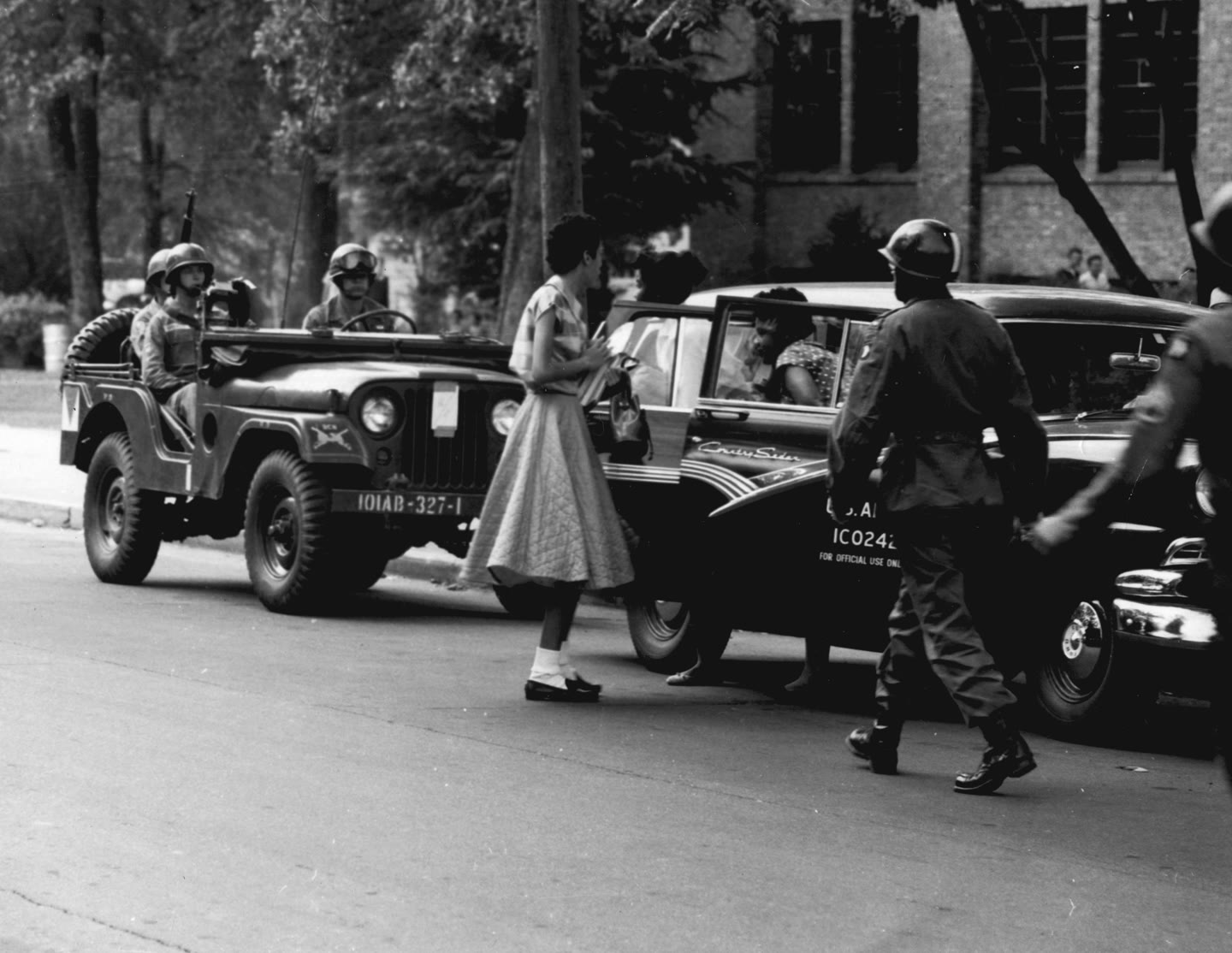
The footage makes that obligation concrete. Little Rock does not appear here as a debating chamber. It appears as a place of guarded approaches and managed crossings. That is what gives the film its historical force. The Constitution enters the frame through boots on pavement, officers consulting papers, and cars delivering students to a doorway that had become nationally contested.
Image context: the cover image uses the Wikimedia Commons file "Operation Arkansas, Little Rock Nine," a U.S. Army photograph showing the 101st Airborne escort during the September 1957 crisis. It works for this article because the image compresses the whole argument into one scene: school integration had to be made physically possible through escort, spacing, and visible armed protection.[6]
Video provenance
The embedded video is the official YouTube upload from U.S. Army Website Videos. Its description identifies the material as two reels from the National Archives covering the Army's involvement at Little Rock Central High School in 1957, and it notes that no audio survives on the reels.[1] That provenance matters. What we are watching is not a retrospective documentary with voice-of-God explanation layered on top. It is institutional record material: partial, procedural, and silent.
Close reading: what the reels show that the famous stills do not
The first thing the footage establishes is preparation. Before Central High fully comes into view, the camera keeps returning to officers, vehicles, briefing materials, and soldiers organizing themselves for movement.[1] That sequence changes the meaning of the crisis. Desegregation is not presented as a single moral tableau but as an operation with routes, instructions, and timing. The school day had to be assembled before it could be protected.
As the reel moves outward into the city and toward the school, the frame repeatedly catches thresholds rather than interiors. We see curbs, entrances, exterior walls, and human bottlenecks. Even when the students themselves are not held in close-up for long, the film makes clear that the decisive historical fact was passage.[1] Could they get from car to doorway? Could the space around them be kept open? Could a public school entrance still function once it had become a national theater of resistance? The camera's answer is procedural rather than dramatic: only by filling the gap with military order.
That visual emphasis is one reason the reels remain valuable alongside better-known photographs. Still images from Little Rock isolate individual courage and hostility with unforgettable sharpness.[5] The moving footage reveals a second layer of truth. It shows that the crisis was also administrative and spatial. Federal power had to be exercised as spacing, pacing, and escort. That is harder to compress into a single famous image, but the reel makes it impossible to miss.
The silence intensifies this effect. Without narration, the viewer's eye moves toward paper in officers' hands, lines of soldiers moving through the frame, the intervals between bodies, and the narrowness of safe passage.[1] The lack of sound removes the temptation to treat the event as a speech-driven climax. What remains is the labor of keeping an order alive on the ground. The Constitution, in this footage, is not eloquent. It is repetitive.
Around the middle and later stretches, the film also shows why the federal presence had to be legible. Crowds gather at the edges. Soldiers occupy the visible middle. The school facade appears less as an educational institution than as contested civic architecture, a building whose doors had become politically charged objects.[1] That matters because the whole confrontation turned on public visibility. A court order enforced in secret would not have answered Faubus's spectacle of resistance. The escort had to be seen.
This is where Eisenhower's address and the film fit tightly together. His speech argued that federal law had to prevail over mob obstruction.[4] The reels show what that argument looked like when translated into a city street. The troops are not performing conquest. They are maintaining a narrow channel of lawful movement. That distinction is historical, not cosmetic. The Army is present so that schooling can resume under court order; the footage keeps reminding the viewer that the task is access.
Why this footage still matters
Little Rock survives in public memory as one of the central dramas of post-Brown desegregation, and it should. But memory often flattens the event into a confrontation of symbols: governor against president, segregationist crowd against brave students, state resistance against constitutional law. All of that is true. The archival footage adds the operational layer that the symbolic summary leaves out. It shows how a crisis of law became a problem of route management, guarded intervals, and publicly maintained passage.[1][2][3][4]
That is also why the film belongs in a history feed built around archival spotlight rather than mere commemoration. The footage does not only illustrate what happened. It preserves the feel of enforcement as an everyday discipline. Students had to arrive. Troops had to position themselves. A building had to keep functioning while the nation watched. The camera records that conversion of constitutional principle into daily choreography.
Seen now, the reels make a hard point with unusual clarity. Desegregation was never only a moral argument won in court and then accepted by institutions. In Little Rock, it had to be walked through a doorway under guard. The silent Army footage keeps that fact in motion.
Sources
- U.S. Army Website Videos, "Original archival footage - 1957," official YouTube upload of silent National Archives reels on Operation Arkansas.
- U.S. Army, "Operation Arkansas: a different kind of deployment" - retrospective overview of the 101st Airborne mission at Little Rock Central High.
- National Archives, "Executive Order 10730: Desegregation of Central High School (1957)" - milestone document and historical context.
- The American Presidency Project, Dwight D. Eisenhower, "Radio and Television Address to the American People on the Situation in Little Rock" (September 24, 1957).
- Library of Congress, "The Aftermath" in the Brown v. Board of Education exhibition - on the Little Rock Nine and the October 3, 1957 troop-escort photograph.
- Wikimedia Commons file page for "Operation Arkansas, Little Rock Nine," the archival U.S. Army photograph used as this article's lead image.