The 1936 Berlin Olympics were designed to be read as a pageant before they were read as a scoreboard. The stadium, flags, torch relay, mass choreography, and film cameras all served a regime that wanted modern sport to look like proof of national and racial order. That is why Jesse Owens's four gold medals still carry more historical weight than a list of events can hold. They were athletic results, but they also interrupted the visual argument that the host state had built around the Games.[2][3]
Owens arrived in Berlin as a Black American athlete from a country that still denied equal citizenship at home. That double setting matters. The story is often flattened into a simple morality play in which Owens defeats Hitler's ideology in one afternoon. The reality is sharper and less tidy: the Nazi state used the Games as international display; American sports officials debated participation despite discrimination in Germany; Black athletes competed under the U.S. flag while segregation and racial exclusion remained ordinary in the United States; and Owens's victories were celebrated abroad even as official recognition at home remained painfully limited.[2][3][5]
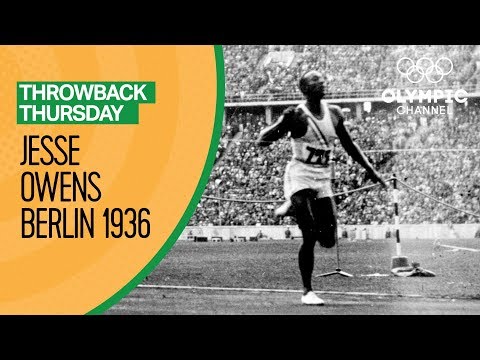
The archival video embedded below is useful because it does not lecture that complexity. It shows the contradiction in motion. The clip, posted by the official Olympics YouTube channel as "Jesse Owens' Historic Wins at the Berlin 1936 Olympics," compiles surviving footage from Owens's Berlin performances: the start line, the sprint lanes, the long-jump runway, the crowd, the stadium framing, and the repeated conversion of expectation into timed fact.[1] Its provenance is important. This is not a full film and not a neutral window onto 1936; it is a later Olympic-channel presentation of archival footage. Still, the underlying images preserve the thing that prose alone cannot: the bodily speed with which Owens made a vast ideological stage answer to inches and tenths of seconds.
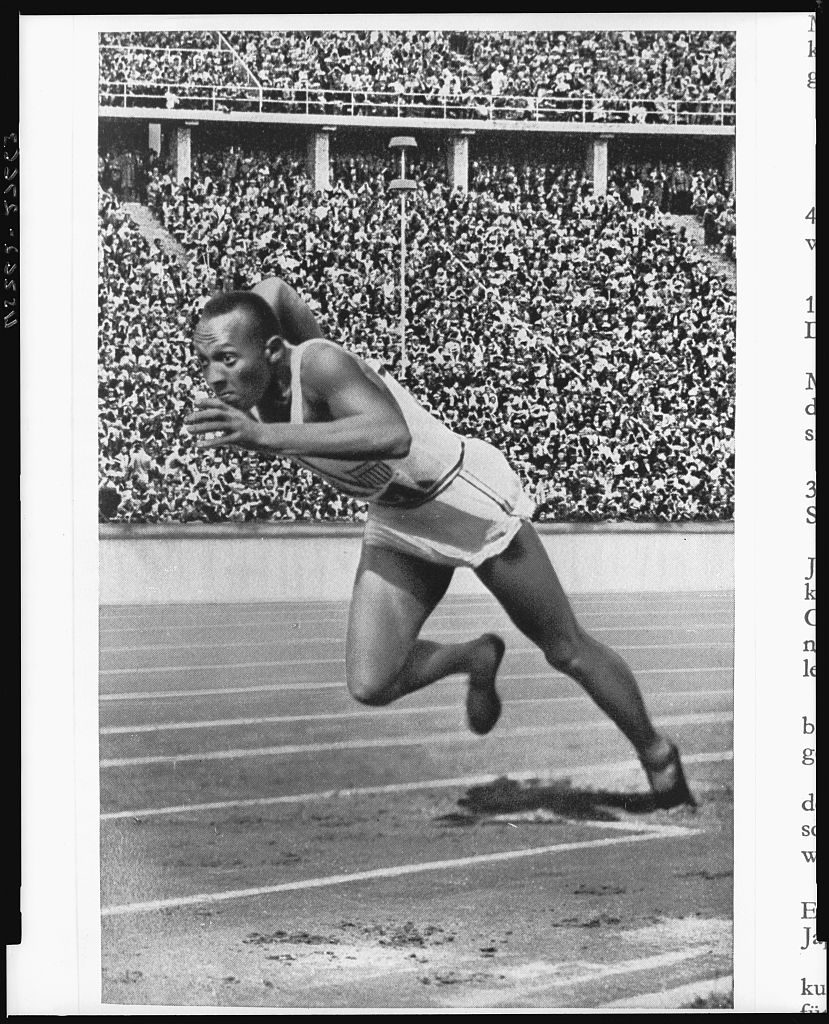
Image context: the lead image is a real archival photograph from the Library of Congress, described as Jesse Owens at the start of his record-breaking 200-meter race in 1936. It is not a diagram, chart, or generated visual.[4]
The Archival Video
What The Footage Lets Us See
Around the opening seconds, the film's strongest historical detail is not a speech or a banner. It is the wait before motion. Owens stands inside a system built to classify, rank, and display bodies. Then the gun turns politics into biomechanics. In the 100 meters and 200 meters, the lanes become a temporary court of evidence. No viewer needs a caption to understand what the finish line does: it narrows a propaganda pageant into a measurable result.[1][2]
That is why the camera matters. Berlin 1936 was one of the first Olympics to understand itself as a modern media event. The footage does not merely record sport; it records a regime trying to master the optics of sport. The paradox is that the same visual machinery also preserved Owens's contradiction of the story the host wanted to tell. Every slow look at the stadium gives the race more pressure. Every cut back to Owens gives the spectacle less control over its own meaning.
The long-jump material adds a different kind of evidence. Sprinting is over almost before historical interpretation can catch up. The long jump stretches attention across approach, takeoff, flight, landing, measurement, and acknowledgment. The Abraham Lincoln Presidential Library and Museum's teaching guide summarizes Owens's Berlin results across the long jump, 100 meters, 200 meters, and relay, while the Holocaust Encyclopedia places the Games inside Nazi propaganda and display.[2][3] In the footage, the jump works because it is so plain. A body runs, lifts, lands, and waits for the mark. The result is less rhetorical than a podium photograph and more difficult to absorb into ideology.
The 4x100-meter relay sequence is also worth reading carefully. Owens is often remembered alone, but one of his four gold medals came through a team exchange. The relay turns individual speed into sequencing: first leg, handoff, curve, straightaway, finish. That matters historically because the relay resists the lone-hero version of the story. Owens was singular, but he was also part of a U.S. Olympic team that included other Black athletes whose performances were framed by both international propaganda and domestic inequality.[3]
The Pageant And The Clock
The durable headline is simple: Owens won four gold medals in Berlin, in the 100 meters, 200 meters, long jump, and 4x100-meter relay.[2] The historical force comes from where those facts landed. Berlin had been prepared as a demonstration of national rebirth under Nazism. Foreign visitors encountered a cleaned-up public face, while the regime's antisemitic and racial policies did not disappear; they were managed for display.[3] The Games asked spectators to confuse order with legitimacy.
Owens's wins did not defeat Nazism. No race could do that. They did, however, puncture a specific claim in a specific public setting. The clock and measuring tape forced the host pageant to register a Black American athlete as the most successful track-and-field competitor of the Games. That is the narrow but real historical claim worth keeping. The film shows a propaganda environment losing control of part of its own evidence.
This is also why the famous "Owens humiliated Hitler" shorthand should be handled carefully. It captures the symbolic reversal, but it can make the history too easy. Owens did not return to an egalitarian America. A National Archives essay on Owens directly addresses the "snub" myth and notes that Owens and other medal-winning athletes of color were not invited to the White House to be received by President Roosevelt.[5] If the Berlin footage is read only as a foreign-racism morality tale, it lets American segregation sit outside the frame. A better reading keeps both systems in view: Nazi racial ideology staged the Olympics; U.S. racism shaped the life of the athlete who made that staging fail on the track.
Why This Video Still Has Archival Force
The clip's value is not completeness. It is compression. In a few minutes, it gathers a stadium, a camera language, a racial ideology, a set of Olympic events, and a body moving too quickly for the host narrative to contain.[1] Written sources can explain the boycott debate, the Nazi Olympic display, the medal record, and Owens's later treatment. The moving image supplies the pressure of sequence: stand, wait, run; approach, jump, land; pass, receive, finish.
That sequence is what later memory often loses. Memory wants the whole episode to resolve cleanly into triumph. The footage is more interesting because it keeps the contest material. Owens's victories are not abstractions. They depend on starts, strides, landings, relay exchanges, and official marks. The regime wanted the Games to make politics look natural. Owens's performances made measurement expose politics as wishful theater.
The still photograph used for this article holds the same tension in one frame. The Library of Congress describes it as Owens at the start of his record-breaking 200-meter race.[4] Before the race, everything is still undecided. The line, the posture, and the waiting crowd belong to the host's carefully arranged event. What follows belongs to the clock. The photograph and the video therefore belong together: one preserves the loaded pause, the other preserves the release.
Owens's Berlin story remains powerful because it refuses a single moral. It is not simply "sport beats politics," because politics built the stage. It is not simply "America beats Germany," because Owens came from a segregated America. It is not simply "the camera tells the truth," because cameras can serve power. The better lesson is more exact: sometimes a system of display records evidence against itself. Berlin built the frame; Owens made the frame betray the pageant.[1][3][5]
Sources
- Olympics, "Jesse Owens' Historic Wins at the Berlin 1936 Olympics," YouTube archival-footage compilation.
- Abraham Lincoln Presidential Library and Museum, "Exposing the Hypocrisy of the 1936 Berlin Olympics" - teaching guide with Owens's Berlin events, results, and historical framing.
- United States Holocaust Memorial Museum Holocaust Encyclopedia, "1936 Olympics: Berlin Games and the Nazi Regime" - context on the Berlin Games as Nazi propaganda.
- Library of Congress image service, archival JPEG of "Jesse Owens" at the start of the record-breaking 200-meter race.
- U.S. National Archives, Rediscovering Black History, "Jesse Owens, American Hero" - essay on Owens, the Hitler/Roosevelt snub story, and White House recognition.