The Moscow-Washington hotline is remembered as a red telephone. That memory is vivid, cinematic, and wrong. The first hotline was a written communications system built around teleprinters, encoding equipment, fixed terminal points, redundant circuits, operating procedures, and people who had to receive, decode, translate, deliver, and answer a message under pressure.[2][3][5] Its historical importance lies in that less glamorous design. After the Cuban Missile Crisis, the problem was not that John F. Kennedy and Nikita Khrushchev lacked drama. The problem was that drama had outpaced dependable communication.
In October 1962, the two governments came closest to nuclear war amid surveillance discoveries, naval quarantine orders, back-channel hints, public threats, emotional letters, and overlapping signals. The State Department's later milestone account stresses that the crisis involved direct and indirect communications as well as miscommunications, and that Kennedy, Khrushchev, and their advisers struggled to understand each other's intentions while the world approached possible nuclear conflict.[4] The hotline was one concrete answer to that failure. It did not promise trust. It built a narrower thing: a verified path for messages when ordinary diplomacy, public broadcasting, embassy channels, and improvised intermediaries were too slow or too ambiguous.
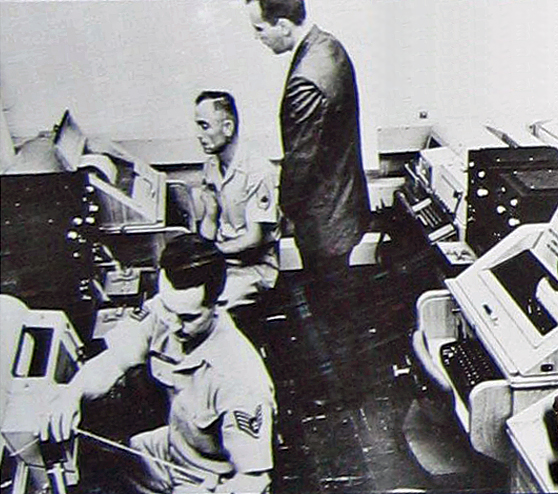
Image context: the photograph matters because the hotline was not a magic handset. It was equipment, routing, staffing, language procedure, and maintenance discipline. Its physical form helps recover the mechanism that the red-phone myth hides.[1][5]
The failure was timing plus ambiguity
The Cuban Missile Crisis did not suffer from a total absence of communication. It suffered from too many uncertain paths carrying different kinds of authority. On October 22, 1962, Kennedy wrote to Khrushchev and then addressed the public, demanding removal of Soviet missiles from Cuba.[4] Khrushchev answered on October 24, while ships, reconnaissance flights, military readiness levels, and diplomatic feelers were already changing the operating environment.[4] On October 26, a long message from Khrushchev appeared to open a settlement around Soviet withdrawal and a U.S. pledge not to invade Cuba; on October 27, a second message introduced the Turkey missile issue, while an American U-2 was shot down over Cuba.[4]
That sequence exposed a crisis-management defect. Leaders could speak, but the recipient had to decide whether a message was personal, public, tactical, exploratory, or binding. The message might arrive after the military situation had moved. A back-channel hint might resemble a formal offer without becoming one. A public broadcast could outrun private clarification. In a nuclear crisis, delay and ambiguity were not separate hazards; each made the other worse. A late message could be read through the fear created by events that had occurred while it was in transit.
The hotline addressed that specific defect. It was not a peace treaty and not an arms-control limit. It was a device for preserving authoritative communication when both governments were already frightened. The mechanism was humble: reduce uncertainty about where a message came from, where it went, how it moved, which language it used, who maintained the circuit, and who had responsibility for delivery to the head of government.[2][3]
Geneva turned crisis memory into operating rules
The diplomatic path moved quickly in 1963. According to the Office of the Historian's FRUS editorial note, U.S. representative Charles C. Stelle proposed a special Washington-Moscow communications link on March 29; Soviet representative Semen K. Tsarapkin said on April 5 that the Soviet Union was prepared to consider a direct link; technical discussions began in Geneva on May 6; and negotiation continued until the agreement was signed on June 20.[2] The speed is important. The hotline came out of a recent scare while the memory of October 1962 still had administrative force.
The June 20 memorandum framed the link for "time of emergency" and assigned each government responsibility for arrangements on its own territory.[3] It also required each side to ensure continuous functioning and prompt delivery to its head of government of messages received from the other side.[3] That delivery clause is the center of the mechanism. A communications link is only partly a wire or radio path. It is also a promise that a message will enter the political chain without disappearing into bureaucracy.
The annex made the design concrete. It specified two terminal points with telegraph-teleprinter equipment, a full-time duplex wire telegraph circuit routed from Washington through London, Copenhagen, Stockholm, and Helsinki to Moscow, and a full-time duplex radiotelegraph circuit routed through Tangier for service communications and coordination.[3] If the wire circuit failed, messages could move by radio circuit.[3] The system was built around redundancy because the very moment one needed the line was the moment ordinary infrastructure could be stressed, damaged, or mistrusted.
Writing was a safety feature
The most useful correction to the red-phone myth is not pedantry. It changes the interpretation. A telephone would have delivered voice, speed, accent, emotion, and translation pressure all at once. The first hotline used written messages. Arms Control Association's fact sheet notes that the first generation had no voice element and resided in the National Military Command Center at the Pentagon rather than on the president's desk in the Oval Office.[5] That institutional placement mattered. The line was closer to command-and-control discipline than to personal theater.
The written format slowed crisis talk down in a controlled way. Messages from Washington to Moscow were sent in English, and messages from Moscow to Washington were sent in Russian; each side installed equipment to receive the other's language and exchanged encoding devices.[3][5] This meant a leader could not simply blurt a sentence into a handset and hope tone would carry across ideology, language, and fear. The message had to be composed, transmitted, decoded, translated, read, and answered. In normal conversation that would be cumbersome. In nuclear crisis communication, the friction could be protective.
The system therefore balanced two needs that pull against each other. It reduced transit time from the old diplomatic rhythms, but it preserved enough formality to avoid the improvisational risk of live voice. That balance was the causal mechanism: faster than embassies and public statements, slower and more deliberate than a phone call. It gave leaders a way to clarify intentions without turning every pause, mistranslation, or vocal stress into a new signal.
Maintenance made credibility
A hotline that works only in theory is another source of false confidence. The 1963 agreement therefore assigned agencies responsible for technical maintenance, continuity, reliability, and timely transmission.[3] The annex also required terminal equipment, spare parts, tools, test equipment, operating instructions, blank tape, and keying tapes.[3] Those details can read like procurement trivia, but they are where credibility lived. Crisis communication depends on the mundane ability to know the circuit still functions.
The later public history reinforces that point. Arms Control Association notes that the system was ready to test in August 1963; on August 30, the United States sent the well-known pangram testing every letter and number key, and after becoming operational the link was tested every day.[5] Daily testing was more than technical housekeeping. It kept the channel from becoming a ceremonial artifact. It turned the hotline into a routine, and routine is what allows an emergency procedure to be trusted before the emergency arrives.
The line's later upgrades followed the same logic. In 1971, the two sides signed an agreement to add satellite communications circuits; the satellite circuits became operational in January 1978; facsimile capability was agreed in 1984 and became operational in 1986.[5] These changes did not erase the original mechanism. They extended it. The question remained the same: how can two adversarial command systems send authoritative messages quickly enough to prevent miscalculation, while preserving enough structure that the message can be read as deliberate?
What the hotline could not do
The hotline reduced one class of danger, not every class of danger. It could not make intelligence accurate. It could not stop leaders from bargaining hard. It could not prevent a state from taking risky military action. It could not guarantee that a message sent through the line would be believed. The Six-Day War in June 1967, one of the early crises in which the line was used, shows the narrower function: the channel helped clarify intentions around fleet movements and escalation risk, but it did not solve the war itself.[5]
That boundary is what makes the hotline historically interesting. It was not a cure for conflict. It was infrastructure for avoiding the accidental enlargement of conflict. In the Cold War, that distinction mattered. A crisis could become more dangerous because one side misread a military movement, a public statement, a delayed letter, or an informal probe. The hotline did not remove hostility. It gave hostility a less chaotic route for urgent explanation.
The causal chain is therefore precise. The Cuban Missile Crisis exposed the danger of slow, mixed, and ambiguous communication in a nuclear confrontation.[4] The 1963 Geneva process turned that lesson into a signed link with assigned responsibility, fixed terminals, redundant circuits, language rules, encoding equipment, and maintenance obligations.[2][3] Daily tests and later upgrades made the line operational rather than symbolic.[5] The result was not intimacy between rivals. It was a disciplined corridor through which adversaries could say, in writing and with authority, what they were doing before the other side filled the silence with fear.
That is why the red telephone myth misses the point. A red phone suggests instant access and personal rapport. The actual hotline suggests something wiser: in a crisis, communication can become safer when it is engineered, staffed, slowed just enough, and tested every day.
Sources
- Wikimedia Commons, "File:Hotlineroom.jpg" - source page for the White House / NSA photograph of Washington-Moscow hotline terminal equipment used as the article image.
- Office of the Historian, Foreign Relations of the United States, 1961-1963, Volume V, Soviet Union, Document 333 - editorial note on the proposal, negotiation, June 20 signing, and NSAM 255 implementation instructions for the hotline.
- University of Minnesota Human Rights Library, "Memorandum of Understanding Between the United States of America and the Union of Soviet Socialist Republics Regarding the Establishment of a Direct Communications Link" - treaty text and technical annex signed June 20, 1963.
- Office of the Historian, "The Cuban Missile Crisis, October 1962" - overview of the crisis, the sequence of Kennedy-Khrushchev communications, and the post-crisis rationale for a direct link.
- Arms Control Association, "Hotline Agreements" - fact sheet on the 1963 hotline agreement, first testing, non-telephone design, early uses, and later upgrades.