Armistices are often described as pauses between war and peace, as if every ceasefire were the same legal shelf with different dates stamped on it. The record is rougher than that. Some armistices are written as short bridges to occupation, disarmament, and a victor's settlement. Others are written to freeze a battlefield that neither side can politically finish. Put the 11 November 1918 armistice at Compiègne beside the 27 July 1953 armistice at Panmunjom and the difference becomes hard to miss.[1][2][4]
The first document behaved like a countdown. Germany's delegation was given 72 hours to accept terms that required evacuation, surrender of matériel, continuation of the Allied blockade, and compliance under threat that the armistice could be repudiated on 48 hours' notice if key clauses were not carried out.[1][2] The second document behaved like an operating manual. It fixed a Military Demarcation Line, required each side to withdraw 2 kilometers to create a Demilitarized Zone, and established commissions, observer teams, and inspection machinery meant to keep a military stop from collapsing back into battle.[4]
That difference matters because it explains why one armistice still feels, in popular memory, like the end of a war, while the other still feels like the management system of an unfinished one. The sharpest contrast is not simply that World War I led to the Treaty of Versailles while the Korean War never produced a final peace treaty. The deeper contrast is structural. Compiègne assumed movement after signature; Panmunjom assumed continued separation after signature.[1][4][5]
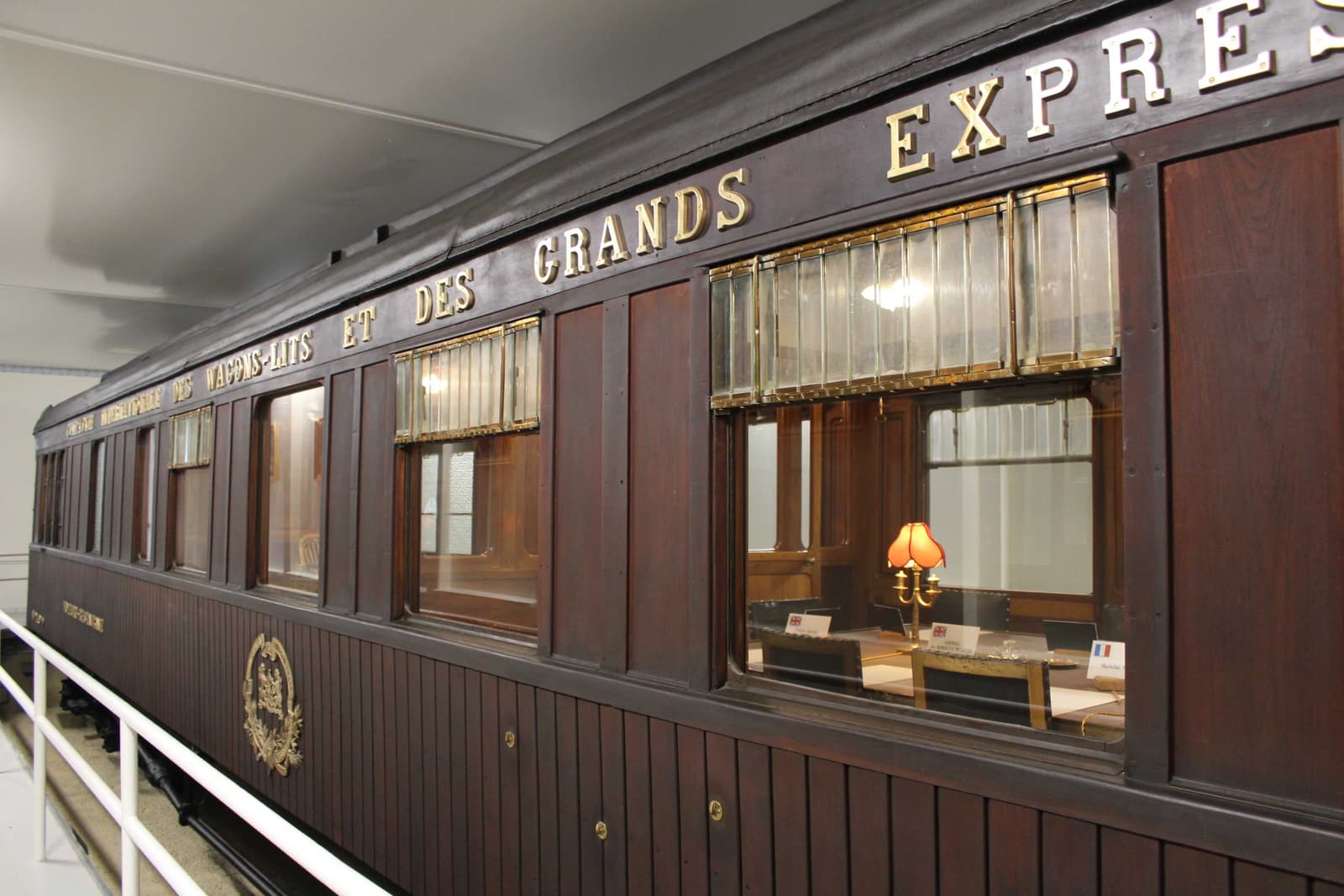
Image context: the cover uses the Armistice Museum's photograph of the restored carriage displayed at Compiègne.[3] It fits this comparison because the 1918 armistice quickly became a memorial of concluded defeat, while the 1953 armistice remained an administrative framework that still governs a live frontier.
Compiègne treated ceasefire as enforced movement
The battlefield setting of November 1918 shaped everything that followed. The National WWI Museum notes that by the time the German delegation reached Marshal Foch's railway carriage in the Forest of Compiègne, the German army was near collapse and the Allied side left little room for bargaining.[2] The armistice was agreed at 5 a.m. and took effect at 11 a.m., which already tells you something about its logic: not a shared political opening, but a fixed clock after which compliance would be measured against a defeated army.[1][2]
The clauses reinforce that reading. Germany had to evacuate occupied territories west of the Rhine, release Allied prisoners without reciprocity, surrender submarines and major surface warships, and accept that the existing blockade would remain in place during the armistice.[1] Even the duration clause shows how provisional the document was meant to be. The armistice was set for 36 days, extendable, with a permanent International Armistice Commission recognized only in order to supervise execution under Allied high command.[1] In other words, the document did not build a durable neutral zone between two still-balanced military systems. It managed the mechanics of German retreat while the victors held decisive leverage.
Compiègne's later memorial history makes that function easier to see. The Armistice Museum explains that the original railway carriage was requisitioned in 1918, displayed at Les Invalides from 1922 to 1927, and moved to the forest clearing as a commemorative object before Hitler reused the site in 1940 for France's humiliation.[3] That afterlife mattered because it turned the armistice into a symbol of closure and reversal. A carriage that first hosted the end of one war then became a trophy in the opening chapter of another. The key point is that the memorial could exist precisely because the 1918 armistice had not been designed to preserve a long-term shared frontier. It had been designed to move power in one direction.
Panmunjom treated ceasefire as managed separation
Panmunjom came out of a different military geometry. By the early 1950s, the Korean War had hardened into a costly stalemate near the line that roughly tracked the prewar division.[6] The Foreign Relations of the United States introduction stresses that casualties continued during 19 months of armistice negotiations and that talks supposedly limited to military issues repeatedly became political because prisoner repatriation, future settlement, and South Korean resistance could not be kept outside the tent.[6] That is already a very different condition from Compiègne. No equivalent of German collapse existed. No side could dictate a unilateral disarmament script to the other.
The text signed on 27 July 1953 therefore solved a different problem.[4] Its preamble says the objective is a military armistice that ensures a complete cessation of hostilities "until a final peaceful settlement is achieved."[4] The next clauses do the real work. A Military Demarcation Line is fixed. Both sides withdraw 2 kilometers from it to establish the DMZ.[4] Markers are to be erected and supervised. The Military Armistice Commission is created with 10 senior officers, five from each side.[4] The Neutral Nations Supervisory Commission is created with officers from Sweden, Switzerland, Poland, and Czechoslovakia.[4] This is not countdown language. It is border language.
The post-signature politics show why that machinery mattered. A July 7, 1953 National Security Council report in the FRUS volume noted that the armistice terms called for a political conference within 90 days, but also admitted that accepting the armistice effectively meant accepting the practical possibility of Korea remaining divided for an indefinite period on the present demarcation line.[5] The contradiction sits at the center of Panmunjom's afterlife. The agreement promised that military stillness would open onto politics, yet its most durable accomplishment was to build a governed buffer that could survive even after political settlement failed to arrive.[4][5][6]
That is why Panmunjom never entered memory as a carriage in a clearing. It entered memory as procedure, post, marker, and meeting regime. The FRUS introduction makes clear that even after signature the Korean question kept sliding from Panmunjom to broader diplomatic conferences, while the armistice itself remained the framework inside which renewed war was to be prevented.[6] The ceasefire became a system for living with unresolved sovereignty, not a bridge that quickly disappeared once peace took over.
Why the documents had different jobs
The simplest comparison is also the strongest one: the two armistices were written for different balances of force. Compiègne followed battlefield collapse and assumed that Germany would move backward while the Allies supervised terms that looked, in practice, close to imposed surrender.[1][2] Panmunjom followed stalemate and assumed that both sides would remain armed, suspicious, and politically unreconciled on either side of a line that had to be watched every day.[4][6]
Once that difference is clear, several other contrasts fall into place. Compiègne kept the blockade, demanded matériel, and treated territorial evacuation as immediate proof of compliance.[1] Panmunjom spent more paper on zones, markers, commissions, inspection teams, coastal islands, civilian crossings, and repatriation procedures because the central task was to prevent accidental or deliberate re-opening of war along a continuing front.[4] Compiègne's commission lived under Allied authority because the direction of force was settled. Panmunjom's commissions had to preserve a balance that none of the signatories trusted but none could overturn cheaply.[1][4]
This is also why the later political histories diverged. In 1918, the armistice was a short document with enormous consequences because everyone understood that the larger settlement would be written under conditions of Allied advantage.[1][2] In 1953, the armistice had to be institutionally dense because the larger settlement was exactly what could not yet be secured. The line, the buffer, and the inspectors were not temporary decorations on the way to peace. They were the practical substitute for peace.[4][5][6]
Why one still feels like an ending and the other still feels provisional
Compiègne and Panmunjom both show that an armistice is never just a pause. It is a design for what the day after the guns fall silent will look like. At Compiègne, the day after signature meant evacuation schedules, surrender lists, and Allied enforcement against a beaten state.[1][2] At Panmunjom, the day after signature meant guards, boundary markers, supervision teams, and an unresolved political future pushed into the background but never removed.[4][5]
That is why the memory of 11 November 1918 leans toward bells, relief, and endings even though peace terms still had to be negotiated.[2] The military outcome already pointed forward in one direction. The memory of 27 July 1953 leans toward truce, line, and suspension because the agreement's strongest achievement was precisely to freeze history in place long enough to stop more killing.[4][6] One armistice closed a campaign by pushing its consequences onward. The other closed a campaign by making continuation impossible without making resolution available.
Read together, the two documents correct a lazy habit of treating all ceasefires as temporary versions of the same thing. Compiègne was a countdown because one side had lost the power to bargain on equal terms.[1][2] Panmunjom became a border machine because neither side had won enough to decide Korea's political future.[4][5][6] That is the real comparison. An armistice takes the shape of the war that produces it, and sometimes the shape lasts longer than the peace that never comes.
Sources
- German History in Documents and Images, "Conditions of the Armistice with Germany (November 11, 1918)" - full text of the 1918 armistice, including duration, evacuation, blockade, surrender, and commission clauses.
- National WWI Museum and Memorial, "Nov. 11, 1918" - overview of the signing context, the 72-hour German deadline, the 5 a.m. agreement, and the 11 a.m. ceasefire.
- The Armistice Museum, "The Armistice Carriage" - official museum history of the Compiègne carriage, its memorialization, and its reuse in 1940.
- U.S. National Archives, "Armistice Agreement for the Restoration of the South Korean State (1953)" - transcript of the Korean Armistice Agreement, including the DMZ, demarcation line, commissions, and neutral-nation supervision clauses.
- Office of the Historian, U.S. Department of State, FRUS 1952-1954 Korea Volume XV Part 2, Document 674 - July 7, 1953 NSC report on post-armistice objectives, the planned political conference, and the practical possibility of indefinite division.
- Office of the Historian, U.S. Department of State, FRUS 1952-1954 Korea Volume XV Part 1, Introduction - overview of the Panmunjom negotiations, their political entanglements, and the unresolved post-armistice settlement problem.