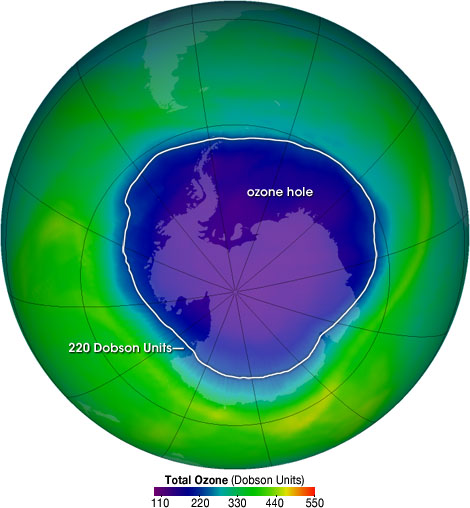
Most "policy success" stories get told backward: outcome first, mechanism later. The Montreal Protocol case is more useful if we keep the sequence in order and ask a narrower question: what conversion process turned atmospheric chemistry into durable state behavior across decades?
The answer is not one treaty moment. It is a five-step learning loop that kept updating rules as evidence improved.
Step 1 (1974): a clear causal claim made the risk legible before catastrophe data existed
In 1974, Molina and Rowland published the core mechanism: long-lived CFCs reach the stratosphere, release chlorine, and catalyze ozone destruction.[1] That mattered because it transformed ozone depletion from a vague environmental concern into a falsifiable atmospheric process.
The claim still faced uncertainty in scale, timing, and spatial concentration. But historically, this was the first conversion step: policy discussion had a mechanism to regulate, not just a fear to debate.
Step 2 (1985): the Antarctic shock converted model risk into observational urgency
Farman, Gardiner, and Shanklin’s Antarctic observations reported large springtime ozone losses in 1985.[2] NASA’s historical ozone-watch framing later standardized a practical policy threshold: 220 Dobson Units (DU) as the ozone-hole boundary, with values below that level not seen in the pre-1979 record.[3]
Timeline-wise, the sequence is the hinge:
- 1974: mechanism warning;
- 1985: strong field evidence of severe depletion;
- 1987: treaty design under uncertainty, but no longer under ignorance.
Without step 2, step 3 likely arrives later and weaker.
Step 3 (1987–1989): negotiators chose enforceability architecture, not declaration politics
The Montreal Protocol was signed in 1987 and entered into force in 1989.[4] Its historical edge was institutional design:
- specific controlled substance categories,
- phase-out schedules tied to production and consumption,
- recurring party meetings that could tighten controls without redesigning the entire regime each time.
That third component is underrated. In most environmental agreements, reopening text is politically expensive; here, amendment pathways were built in from the start.
Step 4 (1990s onward): ratcheting transformed a static treaty into an adaptive system
The protocol was amended repeatedly (including Kigali in 2016).[4] The key historical mechanism is ratcheting under updated evidence: states did not need a perfect first agreement if they accepted a process that could escalate ambition.
UNEP’s amendment record shows why this mattered in practice: after the 1987 text, parties repeatedly tightened controls through the London (1990), Copenhagen (1992), Montreal (1997), and Beijing (1999) adjustments, then extended the regime again with Kigali (2016).[5]
This is the core design lesson for institutional history: adaptive tightening beats one-shot maximal drafting when uncertainty is high and science evolves.
Step 5 (monitoring feedback): compliance stayed credible because science could detect deviations
The 2022 WMO/UNEP assessment reports continued decline in controlled ozone-depleting substances and projects return toward 1980 total-column-ozone benchmarks around 2040 (near-global), 2045 (Arctic), and 2066 (Antarctic), while emphasizing regional uncertainty.[6]
The same assessment also documents unresolved emissions and monitoring gaps, including episodes like unexpected CFC signals.[6] That is not a contradiction; it is evidence the regime still has diagnostic capacity.
A treaty lasts when it can detect cheating, leakage, and technology-side effects faster than politics can deny them.
What the sources directly state vs what this essay infers
What sources directly state
- The chemical depletion mechanism (CFC -> stratospheric chlorine -> catalytic ozone loss) has been scientifically grounded since 1974.[1]
- Severe Antarctic ozone depletion was observationally established in 1985.[2]
- The protocol timeline and amendment path are documented: 1987 signing, 1989 entry into force, later amendments including Kigali 2016.[4]
- Ozone recovery is underway but uneven; projected return dates differ by region (2040/2045/2066).[6]
What this essay infers
- Montreal succeeded because it institutionalized science-to-rule feedback (detect -> negotiate -> tighten -> monitor), not because early negotiators had complete certainty.
This is a defensible historical inference, but still an inference.
The main disagreement in historical interpretation
Interpretation A: Montreal is mostly a unique one-off
Claim: ozone governance succeeded due to unusually tractable chemistry and a concentrated industrial substitution path; replication to other domains is limited.
Interpretation B: Montreal is a reusable governance design pattern
Claim: the transferable asset is procedural architecture—bounded controls, amendment ratchets, and monitoring-backed enforcement—even when causal systems differ.
What would change the assessment?
If archival diplomatic records showed that amendment pathways were politically accidental and not used as intended, Interpretation B would weaken. If future treaty comparisons show that similar adaptive architecture repeatedly outperforms static agreements under uncertainty, Interpretation B strengthens.
Why this history is high-value now
The practical lesson is not "copy Montreal" as a slogan. The lesson is architectural: when science is directional but incomplete, design institutions that can upgrade commitments on evidence rather than waiting for perfect certainty.
That is how a warning in 1974 became a durable policy system by 2016—and why this case remains a serious playbook for long-cycle global risks.
Sources
- Molina, M. J., & Rowland, F. S. (1974), Nature — Stratospheric sink for chlorofluoromethanes: chlorine atom-catalysed destruction of ozone
- Farman, J. C., Gardiner, B. G., & Shanklin, J. D. (1985), Nature — Large losses of total ozone in Antarctica reveal seasonal ClOx/NOx interaction
- NASA Ozone Watch — What is the Ozone Hole? (220 DU threshold and historical context)
- UNEP Ozone Secretariat — The Montreal Protocol on Substances that Deplete the Ozone Layer (1987 signing, 1989 entry into force, 2016 Kigali Amendment)
- UNEP Ozone Secretariat — Amendments (official amendment chronology and legal tightening path)
- WMO/UNEP Scientific Assessment of Ozone Depletion 2022 — Executive Summary (regional recovery timing, monitoring gaps, and current challenges)