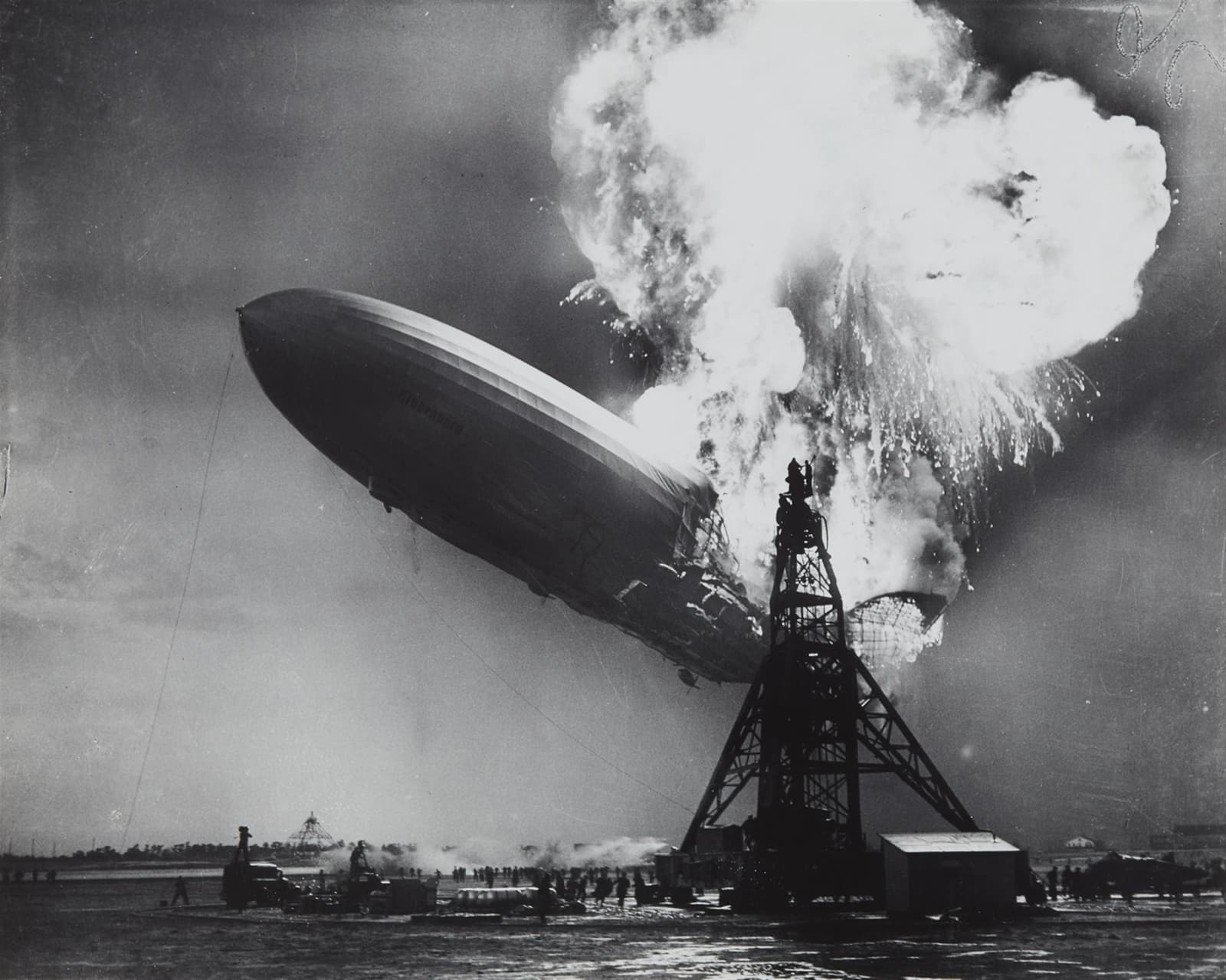

On the evening of May 6, 1937, a crowd of journalists, newsreel cameramen, Navy personnel, and waiting family members stood at Naval Air Station Lakehurst in New Jersey. The LZ 129 Hindenburg — 245 meters long, the largest aircraft ever built to that point — was arriving from Frankfurt after a crossing that had been delayed a day by unfavorable weather. It was the ship's first North American flight of its second commercial season. The approach to the mooring mast was routine. The lines had been dropped. And then, at 7:25 p.m. Eastern Time, a fire appeared at the stern.
What followed lasted 34 seconds. By the time the wreckage had settled to the ground, 13 of the 36 passengers and 22 of the 61 crew were dead, along with one ground worker. Thirty-two years of commercial passenger airship travel — a technology that had crossed oceans, carried heads of state, and represented the most ambitious engineering of the interwar period — ended in a third of a minute.
The Hindenburg disaster was the first major transportation catastrophe to occur in front of rolling newsreel cameras and a radio correspondent broadcasting live. That convergence of record-keeping technologies made it unlike any previous accident in history. Pathé newsreel cameramen were on the field, their cameras already running as the ship made its final approach. What they captured in those 34 seconds would be screened in movie theaters across the United States and Britain within days, and would become the most-viewed archival footage of the entire interwar period.
The airship age and what it produced
The era of commercial rigid airships was, in retrospect, narrow: roughly from the early 1900s through May 6, 1937. The underlying physics — a rigid aluminum frame enclosing gas cells, with gondolas hung below — dated from Count Ferdinand von Zeppelin's first flight in 1900. By the early 1930s, the technology had matured enough to support scheduled transatlantic passenger service.[1]
The LZ 129 Hindenburg, named after the former German president Paul von Hindenburg, entered commercial service in 1936 under the Deutsche Zeppelin-Reederei. It flew ten round trips between Germany and the United States that year without incident, carrying roughly 1,000 passengers and several thousand pounds of mail.[2] The crossing took between 59 and 78 hours depending on winds — slower than an airplane, but at the time no airplane could cross the Atlantic with paying passengers at all. The Hindenburg traveled in comfort: a dining room, a reading lounge, a promenade deck with slanted observation windows, private passenger cabins.
The ship was also unmistakably a vehicle of the Nazi state. The swastika appeared on both tail fins. Goebbels's Propaganda Ministry had pushed for the design and understood the ship's value as a symbol of German technological superiority. On its transatlantic routes, the Hindenburg flew over cities specifically to be seen.[2][3]
By May 1937, the ship's second season was opening with heightened security concerns. A wave of anonymous letters to German authorities had warned of a sabotage attempt, and the passenger list and crew manifest had been reviewed by the Gestapo before departure. The ship's commander, Captain Max Pruss, was one of Germany's most experienced airship pilots. The flight itself had been uneventful.[3]
The approach and the fire
The Hindenburg arrived over Lakehurst in the early evening after circling the New Jersey shore for nearly an hour while waiting for a thunderstorm to pass. At 6:22 p.m., ground commander Charles Rosendahl sent the message "conditions now suitable for landing." Captain Pruss began the final approach at medium altitude, dropping water ballast and slowing the ship.[3]
The first mooring lines touched the ground at approximately 7:21 p.m. The newsreel cameras were already running. Radio reporter Herbert Morrison of WLS Chicago was broadcasting a live description — an unusual arrangement; most radio journalism still did not cover arrivals live. His recorded voice would be paired with the Pathé footage in cinema newsreels and, eventually, in every documentary about the disaster made since.
At 7:25 p.m., a flame appeared near cell four or five toward the stern. Within three seconds it had expanded into a visible jet. Within seven seconds the entire aft portion of the ship was burning. The hydrogen — 200,000 cubic meters of it — did not explode in the technical sense; it burned, intensely and rapidly, producing the characteristic orange-and-white fire visible in the footage. The stern fell first, the nose rising as the still-buoyant forward cells held aloft briefly, then the entire structure collapsed onto the mooring field.[3][4]
British Pathé footage: provenance and what it captures
The footage below was shot by Pathé news cameramen stationed at Lakehurst for the arrival. It was among the earliest footage screened; British Pathé's newsreel reached British cinemas within days of the disaster. The film has been held in the Pathé archive and was digitized and uploaded to their YouTube channel in 2016 as part of their institutional archive release. It is one of the clearest surviving continuous-shot records of the event.
Watch the footage with the ship's structural sequence in mind. The fire originates at the upper stern — near the trailing edge of the upper fin — and within the first two seconds is already large enough to illuminate the fabric skin from behind. The skin burns away almost instantaneously, exposing the aluminum framework. What the camera shows for the next several seconds is not a uniform fireball but a structured collapse: the stern dropping, the framework visible as a glowing lattice before it too disintegrates, while the nose remains elevated at roughly 30 to 40 degrees.
That forward elevation is one of the footage's most striking features. The hydrogen in the forward cells kept the nose buoyant for nearly 15 seconds after ignition — long enough for some crew members to survive by riding the nose down as it settled. The ground crew are visible in the lower frame, first running toward the ship on instinct, then reversing as the scale of the fire becomes clear. Some crew members can be seen dropping or sliding from the gondola area as the stern impacts the ground.
The audio that most audiences associate with this footage — Morrison's "Oh, the humanity and all the passengers!" — was not recorded at the scene. Morrison's broadcast was made on a portable recording device, unusual for 1937, and his recording was later synchronized with the film for theatrical release. His voice had broken; he had been narrating a routine landing and was caught entirely unprepared. The combination of his fractured delivery and the visual record created one of the most emotionally legible documents of the 1930s.[4]
What moving images captured that text could not
No written account of the 34-second fire conveys what the footage conveys: the pace. Contemporary newspaper descriptions of the disaster, even by eyewitnesses, tend to read as sequential and deliberate — as if there were moments to observe and register and react. The footage makes clear there were not. The fire moved faster than perception could organize. The accounts written hours later by survivors show people mid-action — adjusting a line, turning to speak — and then suddenly in motion with no decision point in between.
The footage also resolves a point of debate that persisted for decades: the fire's directionality. Early accounts disagreed about whether the fire began at the bow, the stern, or the upper hull. The Pathé film shows clearly that the stern ignited first and that the fire moved forward and upward along the upper fin structure before expanding into the main body. This visual evidence eventually shaped the accident investigation — though the cause of ignition itself, whether hydrogen leak, electrostatic discharge, or incendiary paint, has never been definitively settled.[3][4]
The end of the passenger airship and the beginning of something else
The Hindenburg disaster did not end the airship program immediately — there were inquiries, investigations, and proposals for hydrogen replacement — but the commercial passenger airship never recovered. No transatlantic scheduled airship service operated after 1937. The Graf Zeppelin II flew on for two more years on European routes before being scrapped at the start of the Second World War. The age of lighter-than-air passenger transport was over.[1][2]
What the footage created, beyond the historical record, was a template. The combination of live radio and motion pictures at a major disaster was new in 1937. The question of how journalism covers catastrophe — with what technologies, at what distance, with what emotional register — was opened by this footage in a way it had not been before. Morrison's broadcast became one of the first examples studied in American journalism schools. The Pathé film became one of the first examples of what we would now call breaking-news visual documentation: unedited, continuous, shot by people who did not know what they were going to see.
The 34 seconds have been watched by more people than witnessed the disaster itself by several orders of magnitude. The footage is now older than most living people. It remains the clearest record of a specific, irreversible moment — and of the airship age that ended when the stern began to glow.
Sources
- Smithsonian National Air and Space Museum, "Airships: The Golden Age," exhibition overview.
- Harold G. Dick and Douglas H. Robinson, The Golden Age of the Great Passenger Airships: Graf Zeppelin and Hindenburg (Washington: Smithsonian Institution Press, 1985). WorldCat record.
- Michael D. Lemonick, "What Really Happened to the Hindenburg?" Time, May 6, 2012.
- National Archives and Records Administration, Herbert Morrison Hindenburg broadcast recording, "Eyewitness to History" series.
- British Pathé, "Hindenburg Disaster – Real Footage (1937)," YouTube, published March 24, 2016.