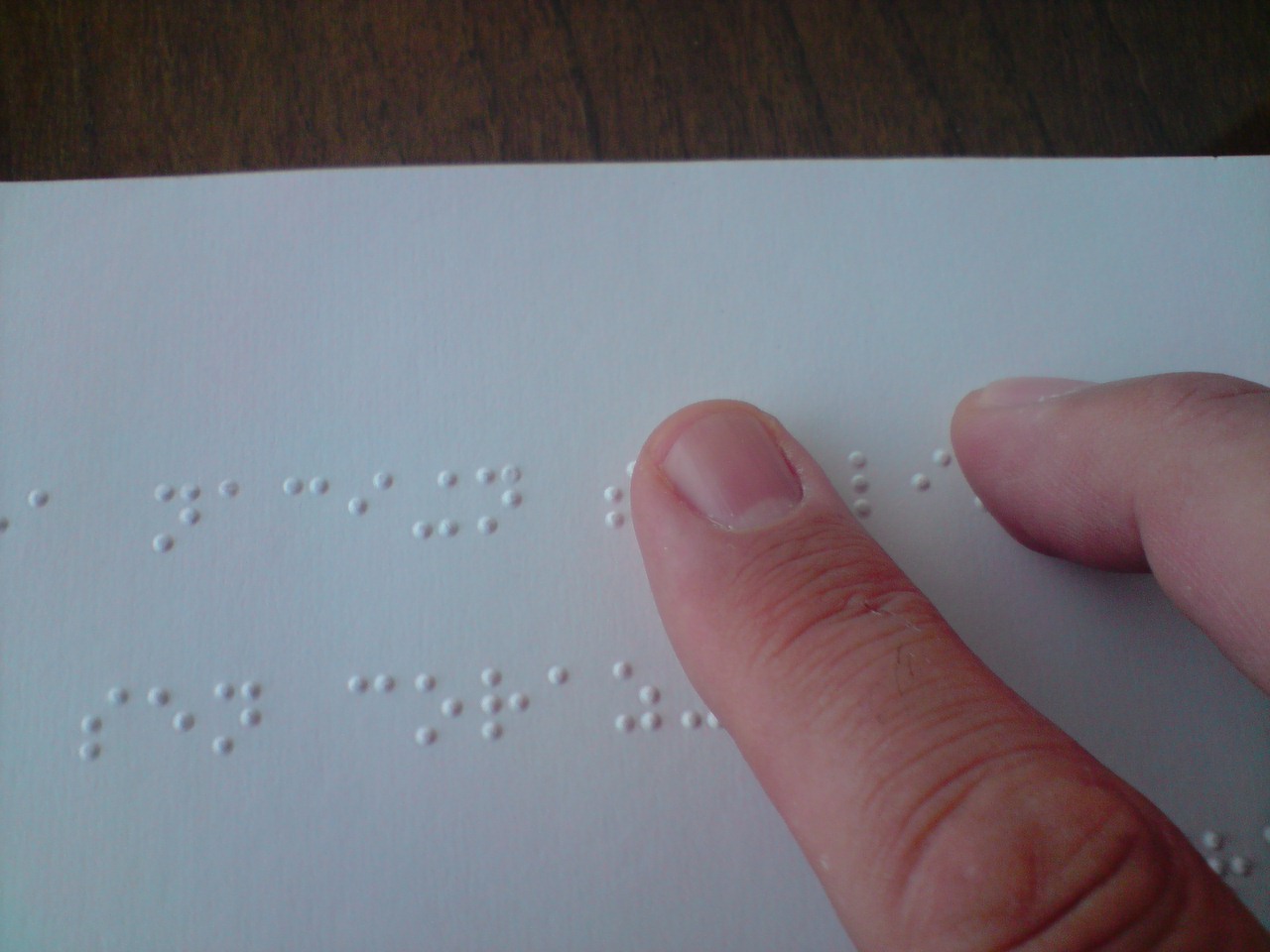
The easy version of Louis Braille's story says that a blind French teenager took a military code called night writing and made it useful for blind readers. That version is not useless. It keeps two important facts in view: Charles Barbier's raised-dot system reached the Paris school where Braille studied, and Braille acknowledged that Barbier's method gave him the first idea for his own.[3][4]
But as history, the shortcut makes Braille's invention too passive. It turns design into inheritance. The stronger reading is this: between the early 1820s and the publication of Braille's first method in 1829, Braille did not merely simplify someone else's code. He changed the unit of reading. He made literacy fit a fingertip, a stylus, a page, and the working needs of blind students who needed to write as well as read.
Myth: Braille was mainly a military-code adaptation
Barbier matters, but the military-origin story needs tightening. Perkins historian Philippa Campsie points out that Barbier had indeed served in the artillery, yet the later claim that his raised-dot method was meant for or used by the army is much shakier than the familiar story suggests.[4] The durable evidence is narrower and more useful: Barbier devised a raised-point writing method, brought it into the world of blind education, and gave Braille something concrete to test against the daily limits of existing systems.[4]
That distinction matters because it changes the question. If the story is simply military code becoming school alphabet, then Braille looks like a clever adapter. If the story is a blind student assessing the physical affordances of competing tactile systems, Braille becomes the designer of a new reading interface. The central problem was not secrecy in the dark. It was whether a person without sight could read, write, correct, practice music, and share text at a usable speed.
Braille's own 1829 preface makes that logic clear. In the Internet Archive facsimile and translation of Procede pour ecrire les Paroles, la Musique et le Plain-chant au Moyen de Points, he credits Barbier while explaining why a new method was needed: smaller signs, enough characters for ordinary writing, and applicability to music and plainsong.[3] That is not the language of a borrowed code looking for a classroom. It is the language of a user finding a system too large, too limited, and too narrow for the work it had to do.
Evidence: the six-dot cell solved a body problem
The decisive move was scale. Britannica summarizes the familiar life arc: Braille was born in 1809 near Paris, was blinded after a childhood accident, entered the National Institute for Blind Children in 1819, and later taught there.[2] Those facts place him inside the institution where embossed reading systems were not abstractions. They were tools that either worked under a student's hands or did not.
The older raised-letter approach tried to make touch imitate sight. Raised Roman letters preserved the look of print, but the fingertip had to trace shapes that were designed for eyes. Braille's dot cell worked differently. It accepted that tactile reading has its own grammar: compact repeated positions, quick recognition, and marks that a blind person could produce with simple tools.
That is why the six-dot cell mattered. A cell two dots wide and three dots high could hold many combinations while staying small enough to be recognized as one unit. It also created a writing system that was not only consumed by blind readers but made by them. The Library of Congress NLS music note essay states the practical advantage directly: raised dots were easier for blind people to recognize than raised letters, and dots could be written accurately by blind people themselves.[6] The reader was no longer merely the recipient of embossed material prepared elsewhere. The reader could become a writer.
Myth: the alphabet was the whole invention
Braille's system is often remembered as an alphabet, but his ambition was broader from the start. The American Printing House notes that the 1829 book was the first explanation of the system Braille created for blind and low-vision readers to read and write, and that it covered literary code, music code, and instructions for writing it.[5] The Musee Louis Braille likewise identifies the method as a system for words, music, and plainsong, published in 1829 and again in 1837.[7]
Music is not a side detail. Braille was a musician, and the Paris school trained students for practical musical work. A system that only represented prose would still leave a major part of blind education dependent on sighted mediation. The NLS music history essay emphasizes that music was central at the institute and that Braille developed music notation alongside the alphabetic code.[6] In other words, Braille's design brief was literacy in the fuller sense: schoolwork, correspondence, musical study, and professional possibility.
That breadth also explains why early Braille was not instantly identical to the modern system. The 1829 method still included dashes as well as dots.[3][6] The later refinement matters because it shows the system developing through tactile evidence. The problem with dashes was not philosophical. It was practical: dots were cleaner to perceive and write. By 1837, the system had moved closer to the dot-only form that made Braille durable.[6][7]
Evidence: adoption lag does not mean weak design
Another myth hides inside the invention story: because Braille's system now feels inevitable, it is easy to imagine that educators recognized its superiority immediately. They did not. The Library of Congress NLS bibliography notes that Braille's innovation remained unrecognized during his lifetime in some accounts, even though it later became global.[8] The NFB introduction to the 1829 publication places official French educational adoption in 1854, two years after Braille's death.[3]
That lag is historically revealing. Institutions often prefer systems that are legible to existing authority. Raised print made sense to sighted teachers because it resembled print. Braille made sense under blind fingers because it privileged touch over visual resemblance. The delay was not only technical conservatism. It was a conflict over whose experience counted as design evidence.
The strongest proof of Braille's invention is therefore not a heroic origin scene. It is the way the system kept answering practical questions. Can a character be recognized quickly? Can a learner write it without sight? Can the same grammar extend to numbers, punctuation, algebraic signs, music, and shorthand? Can books be produced around it? Can blind students use it among themselves before official systems fully approve it? The answers accumulated slowly, but they accumulated in Braille's favor.
What survives when the myth is corrected
Correcting the myth does not diminish Barbier. It gives him a more precise place. Barbier helped move raised-dot writing into the environment where Braille could encounter it. Braille then reworked the premise around a different user, different physical constraints, and a wider literacy goal.[3][4]
The difference is not pedantic. If Braille is remembered only as a simplifier of night writing, the story remains centered on an external invention brought to blind people. If he is remembered as a blind designer solving the reading and writing problem from inside tactile experience, the history changes. The six-dot cell becomes a political object as well as a technical one. It says that blind literacy should not be a visual alphabet translated awkwardly into relief. It should be a medium built for the hand from the beginning.
That is why Braille's system still feels modern. It is small, modular, writable, extensible, and reader-centered. The invention was not that dots could stand for letters. The invention was that literacy could be reorganized around the fingertip without becoming a lesser form of literacy. Louis Braille did not just shrink night writing. He made touch into a full writing technology.
Sources
- Wikimedia Commons, "File:A person reading a braille book.jpg" - source page for the real photographic cover image of a person reading braille by touch.
- Encyclopaedia Britannica, "Louis Braille" - concise biographical timeline covering Braille's birth, blindness, schooling, teaching, Barbier influence, 1829 treatise, 1837 publication, and death.
- Louis Braille, Procede pour ecrire les Paroles, la Musique et le Plain-chant au Moyen de Points a l'Usage des Aveugles et Dispose pour eux (1829), Internet Archive facsimile and English translation.
- Philippa Campsie, "Louis Braille, Charles Barbier, and the making of a myth," Perkins School for the Blind - analysis of the Barbier-origin story and Braille's own 1829 acknowledgement.
- American Printing House, "Blindness History Basics: The First Publication of the Braille Code" - overview of Braille's 1829 publication, raised type, literary code, music code, and writing instructions.
- Library of Congress NLS Music Notes, "Early Braille Music Codes" - institutional history of Braille music notation, the role of dots, the removal of dashes, and the writing advantage for blind users.
- Musee Louis Braille, "Braille the inventor" - museum summary of Braille's method and its 1829 and 1837 publications.
- Library of Congress National Library Service, "Louis Braille (1809-1852)" - NLS bibliography summarizing major biographies and the later global importance of Braille's raised-dot system.