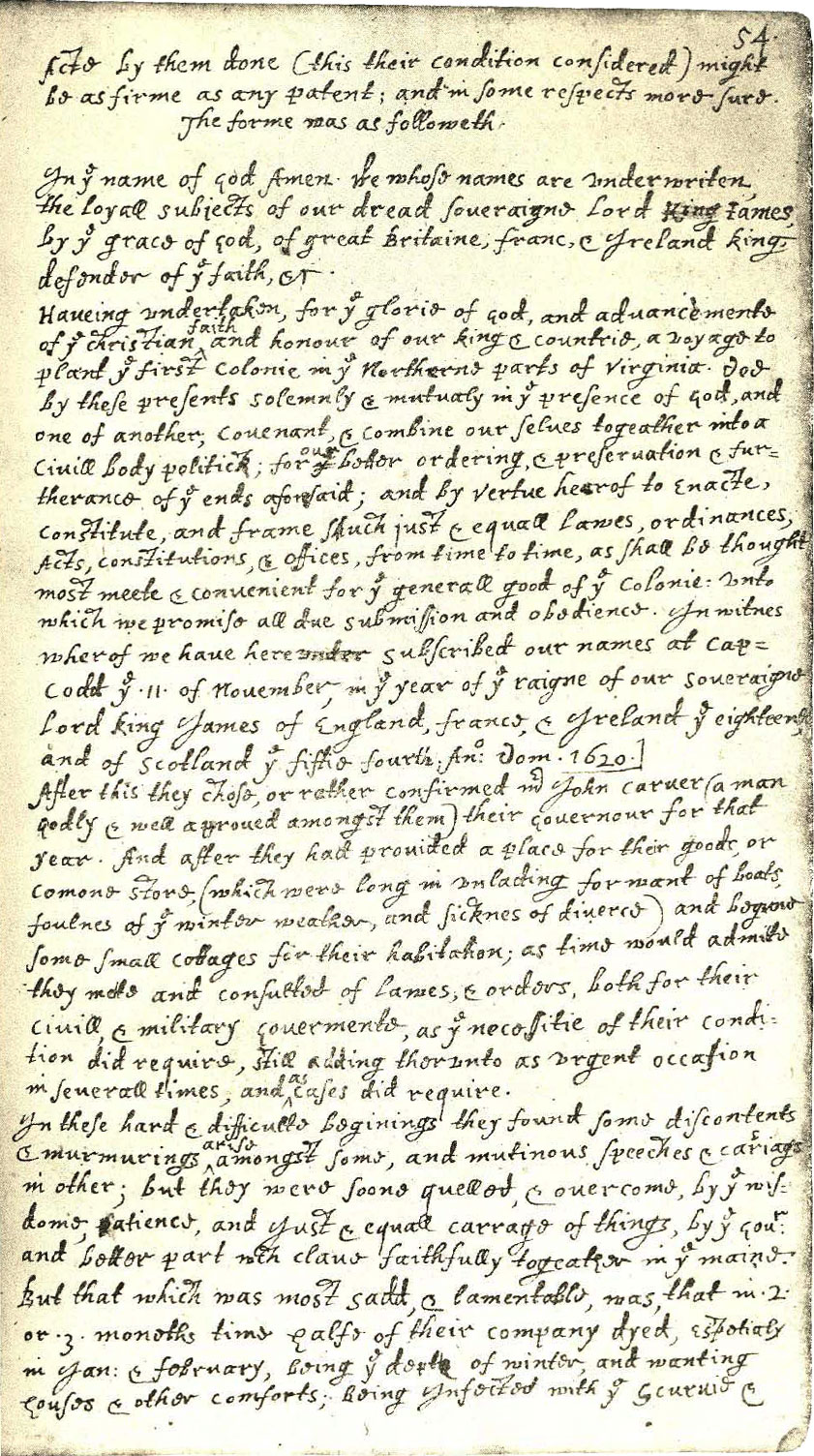
The Mayflower Compact is often treated as if it were a miniature constitution waiting for the United States to catch up. That memory gives the document too much modern polish and not enough danger. Read closely, the agreement made off Cape Cod in November 1620 was not a full blueprint for democracy. It was an emergency instrument written by people who had crossed the Atlantic, missed the geographic frame of their patent, and needed a way to keep a mixed company from splintering before anyone had built a settlement.[2][3][4]
The General Society of Mayflower Descendants gives the clean institutional problem: the ship had meant to reach the Hudson River, but contrary winds and dangerous shoals forced it back to modern Provincetown Harbor, leaving the Virginia patent no longer valid in New England.[2] Plimoth Patuxet Museums makes the textual problem just as important: the original Compact does not survive, and the text first appeared in Mourt's Relation, the 1622 account of the settlement's early year.[3] So the document reaches us through copies, memory, print, and later commemoration. That should make us read it with care, not reverence.
The strongest sentence is the one that says the signers "covenant and combine" themselves into a "civil Body Politick."[2][4] Those words do not sound like a broad declaration of individual rights. They sound like people manufacturing a temporary public authority from mutual promise. The Compact's force lies there: it turns consent into a practical bridge between a failed landing plan and a hoped-for legal settlement.
The Document Begins With Loyalty, Not Rebellion
The opening matters because it complicates the usual origin myth. The signers identify themselves as loyal subjects of King James, not as founders rejecting monarchy.[2][4] They name king, country, God, and Christian mission before they name local self-government. A modern reader looking for independence will find the wrong document.
That loyalty language was not empty decoration. The Library of Congress law blog notes that the Compact's immediate purpose was narrower than later democratic symbolism: the passengers needed to overcome an unexpected legal circumstance after weather and navigation left them far north of their intended destination.[5] The Compact therefore works inside imperial assumptions even as it improvises outside the patent's geography. It says, in effect: we remain loyal subjects, but in this place and for this moment we need a local rule-making body before royal or company authority catches up.
That is why the document is historically sharper as a stopgap than as a proto-Constitution. A constitution claims durability. The Compact claims order. It promises obedience to laws, ordinances, acts, constitutions, and offices that would be judged suitable for the colony's general good.[2][4] The phrase is broad, but it is not a theory of popular sovereignty in the later revolutionary sense. It is a survival clause.
"Civil Body Politic" Solves A Shipboard Problem
The most important context is social, not just legal. The Mayflower Society account, drawing on Bradford, explains that some passengers threatened to use their own liberty once ashore because the patent was for Virginia rather than New England.[2] The Mayflower carried religious Separatists, but also other passengers, servants, hired men, and investors' interests. A religious congregation alone could not automatically govern everyone aboard.
That is the pressure behind "civil body politic." The phrase creates a public body broader than church membership and narrower than a sovereign nation. It allows men who may not share the same religious discipline to promise submission to a shared civil order. It is a small sentence with a large boundary: civil authority is being assembled because the settlement will need rules for land, labor, defense, food, punishment, and offices before the colony has a settled charter.
The word "combine" is just as revealing. It does not merely mean cooperate. It suggests joining separate persons into one operative body. The Compact is trying to prevent liberty from becoming dispersion. The Mayflower Society page says the Compact's legal role was superseded when the colonists obtained a Council for New England patent in 1621.[2] That sequence is crucial. The document is provisional by design.
Consent Is Mutual, But Not Universal
The Compact's famous mutuality also has limits. It says the signers act solemnly and mutually in the presence of God and one another.[2][4] That horizontal promise is real. The authority of the future colony is not simply descending from a distant official. It is being accepted by the signers themselves.
But the political community named by the text is not the whole ship and not the whole land. Plimoth Patuxet notes that according to Nathaniel Morton's later account, 41 male passengers signed, including most freemen, some hired men, and two servants.[3] Women, children, many servants, and Native peoples were outside the act of subscription. The Compact therefore should not be made cleaner than it was. It is a landmark in self-ordering among English settlers, not an inclusive democratic covenant.
That boundary does not make the document unimportant. It makes it legible. The Compact shows how early English colonial self-government could be both consent-based and exclusionary, both improvised and loyalist, both practical and myth-ready. Its later fame comes partly from the way Americans turned one emergency association into a national origin story. The source itself resists that smoothing.
The Lost Original Changes How We Read
The survival chain matters because it keeps the document from becoming too solid in memory. The original Compact is gone. Plimoth Patuxet identifies Mourt's Relation as the first appearance of the text and adds that the agreement later appeared in Nathaniel Morton's New England's Memorial in 1669, with a possible list of signers not included in the earlier copies.[3] The image used with this article shows Bradford's later manuscript copy in Of Plimoth Plantation, created decades after the landing and preserved as a crucial textual witness rather than as the original signed paper.[1][6]
That does not mean the Compact is fake or useless. It means its authority is partly archival. We know it through a cluster of early witnesses: print, manuscript, retrospective history, and institutional custody. The document has always been both an act and a memory of an act.
This helps explain why later commemorations could inflate it. A lost original invites symbolic reconstruction. Paintings, monuments, schoolbooks, and anniversary speeches can fill the absence with scenes of solemn beginning. But the closer textual record points to something more disciplined: a short agreement made under pressure, written to hold a company together, and preserved because later generations needed a usable origin.
Its Achievement Is Smaller And Stronger
If the Compact is not a modern constitution, what did it achieve? It created a language in which stranded colonists could obey rules that had not yet been written because they had already consented to the body that would write them. That is a real political invention. It separates the question "who has authority here?" from the immediate availability of a valid charter, then answers through mutual submission to future civil acts.[2][4]
The wording is careful about time. The signers do not list a finished code. They authorize laws and offices over time rather than as a closed system.[2][4] That phrasing gives the new body room to adapt. A settlement beginning in winter 1620, still facing disease, scarcity, unfamiliar terrain, and uncertain external authority, needed flexible governance more than elegant political theory. The Compact's genius is that it is short enough to act before conditions settle.
The best close reading therefore resists both dismissal and worship. Dismissal misses the document's genuine innovation: consent made local civil authority possible before formal legal repair arrived. Worship misses its limits: loyalty to King James remained explicit, participation was restricted, and Native sovereignty was not consulted. Between those poles, the Compact becomes more interesting. It was a provisional bargain that later Americans made monumental because it solved a problem they kept wanting to remember as a beginning.
That is why "civil body politic" still carries pressure. The phrase does not announce democracy fully formed. It records a more fragile moment: a ship's company, legally out of place, deciding that order would have to begin with a promise made among themselves.
Sources
- Wikimedia Commons, "File: Mayflower Compact Bradford.jpg" - manuscript page from William Bradford's Of Plimoth Plantation containing the Compact text, sourced to the Commonwealth of Massachusetts.
- General Society of Mayflower Descendants, "The Mayflower Compact" - institutional history page on the invalid Virginia patent, Cape Cod anchoring, compact text, later patent, and symbolic afterlife.
- Plimoth Patuxet Museums, "Mayflower and Mayflower Compact" - museum account of the lost original, early textual appearances, and later list of 41 male signers.
- John R. Vile, "Mayflower Compact," The First Amendment Encyclopedia, updated July 2, 2024 - constitutional-history framing and compact text excerpt.
- Nathan Dorn, "The 400th Anniversary of the Mayflower Compact," Library of Congress In Custodia Legis, November 25, 2020 - legal-history context for the Compact's immediate purpose and later symbolism.
- Commonwealth of Massachusetts, "Bradford's Manuscript 'Of Plimoth Plantation'" - state collection page on Bradford's manuscript and the Compact's survival through the manuscript tradition.