The Treaty of Kanagawa is often remembered as the moment Japan "opened" to the United States. That memory is true only if "opened" is read very carefully. The treaty signed on March 31, 1854 did not create a normal commercial relationship. It opened Shimoda immediately, promised Hakodate the following Japanese year, protected shipwrecked Americans, allowed limited movement near the ports, arranged supplies through Japanese officials, and made room for a U.S. consul after eighteen months.[2][3]
That narrowness is the point. Commodore Matthew Perry's expedition had arrived with steamships, naval power, and U.S. ambitions for Pacific access. The Office of the Historian describes the mission as seeking protection for stranded Americans and ports for supplies and refueling, backed by a visible willingness to use force.[3] The National Archives Prologue account is blunter about the sequence: Perry came in 1853, returned in March 1854 with a larger force, and the resulting treaty contained no trade provision; full commercial treaty-making came later.[4]
So the close-reading question is not simply "how did Japan open?" It is: how did one short treaty let both sides claim agreement while postponing the most explosive issue?
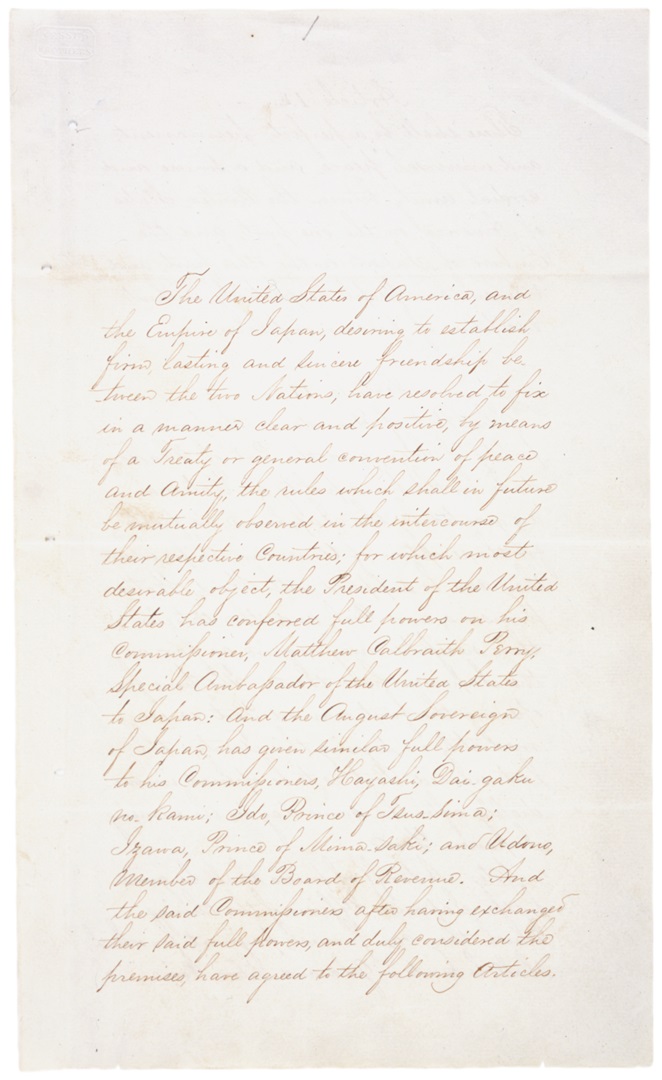
Image context: the cover uses the National Archives' archival scan of the first page of the English-language treaty. It belongs here because the document's physical form matters. A polished phrase about peace sits on a page produced by unequal pressure, translation problems, and practical bargaining over ports, movement, supplies, and official presence.[1]
The First Article Makes Pressure Sound Like Peace
Article I promises "perfect, permanent and universal peace" and "sincere and cordial amity" between the United States and Japan.[2] The language is ceremonially expansive. It does not sound like a gunboat compromise. That is exactly why it should be read slowly.
The peace formula did real work. Perry had entered Edo Bay in July 1853, delivered President Millard Fillmore's letter, and promised to return for an answer.[3][4] The Library of Congress describes Japanese observers recording the "black ships" as an imposing and curious presence, while its 2024 Pacific Encounters post notes that Perry's ships fired blank shots and ignored demands from Japanese guard boats to stay put.[5] The treaty's opening language converts that coercive encounter into a diplomatic relation. It makes a naval demonstration legible as amity.
That conversion helped both parties. The United States could claim a treaty rather than a raid. The Tokugawa authorities could present the outcome as a controlled agreement rather than unconditional submission. But the phrasing also conceals a structural inequality. One side arrived with steam power and a return deadline; the other was trying to prevent military escalation while preserving as much control over contact as possible.[3][5]
Article II Opens Ports As Service Points
The second article is the treaty's practical core. It grants American ships access to Shimoda and Hakodate for "wood, water, provisions and coal" and other necessities, as far as the Japanese could furnish them.[2] This is not a free-trade clause. It is a logistics clause.
That distinction changes the treaty's meaning. The United States was a Pacific and China-trade power that needed coaling and provisioning stations, especially as steamships made fuel access strategically important.[1][3] American whaling and merchant activity also created recurring shipwreck and rescue problems in Japanese waters.[1][3] The treaty therefore opened Japan first as a support system for ships, not as an open market for merchants.
The wording keeps Japanese control visible. A note to Article II says prices would be given by Japanese officers, and Article VIII later says wood, water, provisions, coal, and required goods could be procured only through Japanese officials.[2] Access was granted, but ordinary market exchange was not. American ships could receive necessary goods; they could not simply turn Shimoda into a private trading floor.
The Office of the Historian makes the same boundary explicit: the Treaty of Kanagawa was not a commercial treaty and did not guarantee a right to trade with Japan.[3] That is why the usual shorthand of "opening Japan" can mislead. The first opening was narrower, bureaucratic, and port-specific.
Shipwreck Relief Became Diplomatic Infrastructure
Articles III and IV address wrecked ships and stranded people. If U.S. ships were thrown or wrecked on Japan's coast, Japanese vessels would assist the crews, carry them to Shimoda or Hakodate, and hand them over to Americans appointed to receive them.[2] Shipwrecked Americans and other U.S. citizens would not be confined as the Dutch and Chinese had been at Nagasaki; they would be free within limits and subject to "just laws."[2]
This was not a humanitarian footnote. It was one of the treaty's strongest practical claims. Before a merchant system existed, the treaty created a rescue-and-transfer channel. A stranded sailor ceased to be only a local incident and became a person moving through a treaty procedure: rescue, transport to a designated port, transfer to countrymen, limited freedom of movement, and legal accountability.[2]
The Japanese side also gained something from that structure. By naming ports and procedures, the treaty reduced the risk that every wreck or landing would become an improvised confrontation. Foreign bodies could be moved to known places. American officials could eventually receive them. Local authorities could keep contact bounded rather than letting it spill anywhere along the coast.
That is the treaty's hidden administrative intelligence. It did not need to settle every question of international status. It needed to turn recurring emergencies into a small number of repeatable routines.
Article VII Hints At Trade While Refusing To Become Trade
Article VII is easy to overread. It says American ships at the open ports could exchange gold and silver coin and goods for other goods under temporary regulations established by the Japanese government.[2] At first glance, that sounds like commerce. Read with Article VIII and the later historical sequence, it is better understood as a controlled exchange provision attached to provisioning.
The key phrase is "under such regulations as shall be temporarily established by the Japanese government."[2] The treaty allows exchange, but it gives the Japanese government the regulatory frame. The ships can carry away items they do not wish to exchange, yet the mechanism remains temporary, official, and narrow.[2] It is not a tariff schedule. It is not extraterritorial commercial law. It is not the broader market access that Townsend Harris would pursue in the 1858 commercial treaty.[3][4]
That ambiguity was useful. The United States could treat Article VII as a wedge toward future commerce. Tokugawa negotiators could treat it as a managed incident of port support. The text kept both readings alive long enough for the agreement to hold.
Article IX made the wedge sharper. If Japan later granted another nation privileges not included in the treaty, the same privileges would come to the United States without consultation or delay.[2] That most-favored-nation clause made the narrow treaty expandable. Even without opening trade in 1854, it positioned the United States to benefit from future concessions Japan might make under pressure from other powers.[3]
The Consul Clause Put A Person Where Trade Was Not Yet Allowed
Article XI allowed the United States to appoint consuls or agents to reside in Shimoda after eighteen months, if either government deemed it necessary.[2] A consul is not a market, but a consul changes the meaning of a port. Once an official representative can live there, the relationship becomes more than occasional ship visits.
The Office of the Historian notes that Townsend Harris arrived in Shimoda in 1856 as the first U.S. consul assigned to a Japanese port, then took much longer to secure the more extended 1858 commercial treaty.[3] That sequence shows why Article XI mattered. It inserted a diplomatic foothold before commercial opening was settled.
In practical terms, the treaty built a ladder: ship access, rescue procedure, limited movement, provisioning, possible goods exchange, most-favored-nation leverage, and consular residence. None of those steps alone equals full trade. Together, they made full trade harder to avoid.
The Missing Signature Shows Compromise And Constraint
The National Archives points to one striking feature of the English-language version: the omission of a Japanese signature.[1] Perry later explained to the Navy Secretary that Japanese law forbade subjects of the empire from putting their names to a document written in a foreign language.[1] The absence is not a trivial archival oddity. It reveals the treaty as a document crossing administrative worlds that did not share the same diplomatic habits.
That missing signature complicates the story of simple coercion. Perry had enough pressure to secure an agreement, but he also accepted a formal workaround when Japanese custom made the ordinary signature practice impossible.[1] The treaty therefore records both force and accommodation. American naval leverage made refusal dangerous. Japanese institutional rules still shaped the document's form.
This is why the treaty should not be flattened into either triumph or humiliation alone. It was an unequal bargain, but it was still a bargain worked through language, timing, port names, official channels, and textual compromise.
The Opening Was Narrow Enough To Be Durable
The Treaty of Kanagawa mattered because it made a first official U.S.-Japan relationship possible without immediately writing the whole future into one document. It did not abolish Tokugawa control over contact. It did not create ordinary trade. It did not make Japan a passive open market in a single afternoon. It made a narrower opening: two ports, supplies, rescue, controlled exchange, most-favored-nation leverage, and a future consul.[2][3][4]
That narrow opening still had large consequences. The Library of Congress notes that the Treaty of Peace and Amity marked the beginning of official relations between the United States and Japan, and that the Perry Expedition appears across Japanese and American visual and manuscript records because contemporaries understood the encounter as a threshold.[5] The Office of the Historian carries the sequence forward: the 1858 Harris Treaty expanded commercial relations, Japan sent a mission to the United States in 1860, and the process weakened the Tokugawa Shogunate before the Meiji Restoration of 1868.[3]
The close-reading judgment is therefore precise: Kanagawa opened Japan by refusing to say too much. Its articles made contact administratively workable before they made commerce legally normal. The treaty's power lay in that half-step. It converted a confrontation at the edge of Edo Bay into a set of routines that ships, officials, castaways, consuls, and later negotiators could use. The door did not swing open. A port procedure became a hinge.
Sources
- U.S. National Archives, "The Treaty of Kanagawa" - featured-documents page with the archival treaty image, overview of the 1854 agreement, and note on the missing Japanese signature in the English-language version.
- Yale Law School Avalon Project, "Japanese-American Diplomacy - Treaty of Kanagawa; March, 31, 1854" - full English text of the treaty articles.
- U.S. Department of State, Office of the Historian, "The United States and the Opening to Japan, 1853" - diplomatic context for Perry's mission, the treaty terms, Townsend Harris, and the later 1858 commercial treaty.
- U.S. National Archives, Prologue Magazine, "Treaty of Kanagawa" - historical narrative on Perry's 1853-54 mission, the nine-ship return, the absence of a trade provision, and the treaty's later significance.
- Library of Congress, "Now Online: Pacific Encounters in Nineteenth-Century Japan" - collection introduction covering the Perry Expedition, Japanese visual records of the black ships, and contemporary documentary materials.