The Martens Clause is easy to admire and hard to read well. In modern legal memory, it often appears as a noble sentence about humanity and public conscience. In the July 29, 1899 Hague Convention with Respect to the Laws and Customs of War on Land, however, it is doing a more exacting job. It sits in the preamble at the moment where the treaty admits that written rules cannot cover every circumstance of war.[1]
That placement matters. The clause is not a decoration hung over the treaty after the real work is done. It is a pressure valve inside the treaty's machinery. The convention tries to codify conduct: who counts as a belligerent, how prisoners should be treated, what means of injury are prohibited, how sieges and bombardments should be handled, and what protections attach to certain people and places.[1] Then, before the operative articles begin, the preamble confronts the obvious weakness of any such list. War will produce cases the negotiators did not name.
The close-reading question is therefore narrow: what does the text do with legal silence?
Its answer is not that commanders may improvise freely. It says the opposite. Where the written regulations do not reach, populations and belligerents remain under the protection of international law principles, the "laws of humanity," and the "requirements of the public conscience."[1] The clause's historical force lies in that turn. It makes the gap itself accountable.
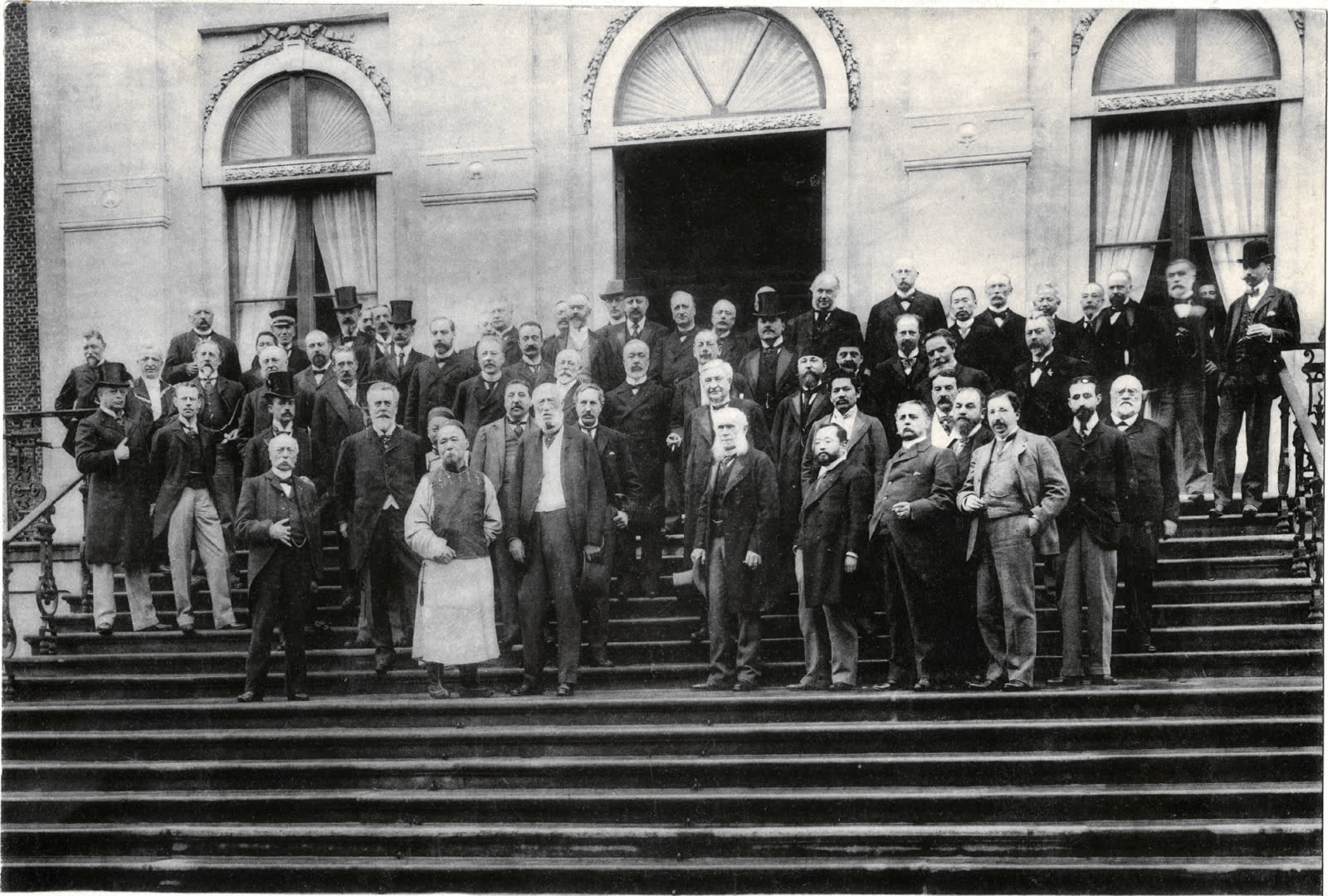
Image context: the cover uses a real archival photograph of delegates to the First Hague Peace Conference on the steps of Huis ten Bosch Palace, dated circa May 18, 1899 on Wikimedia Commons. The image is useful because the clause was born in a crowded diplomatic setting, not in a later textbook. Its language came out of states posing together for a peace photograph while struggling over how much restraint they could accept in war.[6]
The Conference Began With A Larger Failure
The First Hague Peace Conference was convened in a world that wanted legal restraint but did not know how far states would let restraint go. UNIDIR's historical survey notes that the motives behind the 1899 conference remain disputed: some accounts emphasize Nicholas II and fears about the social burden of modern armaments, while skeptical accounts see a Russian effort to narrow relative military disadvantage.[2] The difference matters less than the result. States came to The Hague with peace language, military anxieties, and unequal bargaining power in the same room.
The conference did produce institutions and instruments. The 1899 Convention for the Pacific Settlement of International Disputes created non-obligatory techniques such as mediation, inquiry commissions, and arbitration, and it established the Permanent Court of Arbitration to facilitate arbitration.[2] But UNIDIR's account also stresses the limit: attempts to make arbitration obligatory and create a true standing court failed in both 1899 and 1907.[2] The Hague project could organize channels for peace, but it could not abolish the state's retained resort to war.
That is the background against which the land-war convention should be read. The preamble begins by saying that states seek to preserve peace, yet must also consider cases where arms are used despite that solicitude.[1] This is not pacifist rhetoric alone. It is an admission of failure built into a legal instrument. If war remains possible, then its conduct must be made less arbitrary.
The preamble also reaches backward. It invokes the 1874 Brussels Conference and the effort to revise the laws and customs of war.[1][2] That earlier reference keeps the 1899 text from sounding like a sudden moral awakening. The Hague delegates were inheriting an unfinished codification project. The Martens Clause appears at the point where that inherited project confesses that it is still unfinished.
The Preamble Names The Danger Before The Rule
The preamble's structure is disciplined. First, it says the parties want to serve "the interest of humanity" even in the extreme case of war.[1] Next, it says the purpose is to define existing laws and customs more precisely, or to lay down limits that modify war's severity as far as possible.[1] Then it says the adopted provisions are general rules of conduct for belligerents in relation to one another and to populations.[1]
Only after that does the treaty reveal the problem: it has not been possible to agree immediately on rules covering every practical circumstance.[1] That sentence is the hinge. A codification treaty has to say what it covers. A mature codification treaty also has to say what happens when coverage runs out.
The following sentence is sharper still. The parties say that cases not provided for should not be left, merely for want of a written rule, to the arbitrary judgment of military commanders.[1] The key word is not "humanity." It is "arbitrary." The clause is trying to prevent a particular legal inference: if the treaty does not prohibit or regulate an act by name, the commander is free to decide by convenience, anger, or operational appetite.
Read this way, the Martens Clause is not soft language. It is anti-arbitrariness language. It tells military power that silence in a code is not the same as permission.
Articles 1 And 2 Explain The Immediate Pressure
The preamble says the clause especially explains Articles 1 and 2 of the annexed regulations.[1] That internal cross-reference matters because it keeps the clause tied to an immediate battlefield problem.
Article 1 defines when militia and volunteer corps are covered by the laws, rights, and duties of war. They must have responsible command, a fixed distinctive emblem recognizable at a distance, openly carried arms, and conduct operations according to the laws and customs of war.[1] Article 2 adds a more urgent case: the population of a territory not yet occupied may spontaneously take up arms on the enemy's approach, without time to organize under Article 1, and still be regarded as belligerent if it carries arms openly and respects the laws and customs of war.[1]
That is a precise problem, not an abstract humanitarian slogan. War creates organized armies, but also irregular resistance, local defense, and civilians caught between occupation and combat. ICRC's casebook summary identifies the Martens Clause as a compromise in discussions about fighters not accorded prisoner-of-war status.[4] Rupert Ticehurst's International Review of the Red Cross article likewise places the clause with Fyodor Fyodorovich Martens, the Russian delegate at the Hague Peace Conference, and explains that Martens introduced the declaration after delegates could not agree on the treatment of such resistance fighters.[3]
The wording therefore does two jobs at once. It keeps the treaty's formal criteria for belligerency, because states were not ready to make every irregular fighter automatically lawful. But it also refuses to let people outside clean categories fall into a zone of pure discretion. That refusal is the clause's first historical meaning.
The Clause Is A Bridge, Not A Substitute Code
The famous sentence has three anchors: established usage among civilized nations, the laws of humanity, and public conscience.[1] Each anchor does a different kind of work.
Usage points backward to practice. It says that custom and settled behavior still matter even where the treaty does not spell out a rule. Humanity points to a moral limit that military convenience cannot fully absorb. Public conscience points outward to judgment beyond the commander's immediate chain of command. The phrase is broad, but it is not empty. It tells the reader that the battlefield is not the only audience for battlefield conduct.
Still, the clause is not a hidden codebook. It does not list new offenses. It does not say every hard case has an immediate answer. It does not abolish military necessity; the same preamble says the rules aim to diminish war's evils as far as military necessities permit.[1] That tension is the clause's strength and weakness. It does not solve legal uncertainty by pretending uncertainty is gone. It changes the burden of uncertainty.
Without the clause, a commander might argue that an unregulated case is a free case. With the clause, the better question becomes: what do custom, humanity, and public conscience require when the written rule is incomplete?
That is why the phrase has lasted. ICRC's casebook frames the clause as meaning that people affected by armed conflict are not wholly deprived of protection simply because a treaty gap appears.[4] The Lieber Institute's recent discussion is careful about the same point. It notes that interpretations differ: narrow readings treat the clause as a reminder that custom remains relevant beside treaty law, while broader readings use it as a tool for humanitarian interpretation or as evidence of principles that influence legal development.[5]
The debate is real, and the article should not flatten it. The clause is powerful partly because it is not perfectly determinate. Its words can steady legal interpretation, but they can also tempt writers into making "public conscience" carry more precision than the phrase can bear on its own.
Martens Gave A Deadlock A Form
Fyodor Martens matters because the clause is named after a diplomat who turned a deadlock into language. The ICRC and Lieber summaries both identify him as the Russian delegate associated with drafting or introducing the clause at the 1899 conference.[3][5] That origin is worth keeping visible. The clause did not descend as a timeless maxim. It was crafted to help a treaty survive disagreement.
That craft shows in its grammar. The clause does not say: here is the final rule for every irregular fighter. It says: until a more complete code exists, unregulated cases remain under legal and moral protection.[1] The phrase "until" is doing quiet historical work. It admits that codification is temporary and incomplete. It also refuses to wait for perfection before imposing a boundary.
The convention entered into force on September 4, 1900.[1] Later instruments would return to Martens-style language, including in the 1949 Geneva Conventions and later Additional Protocol framing identified by ICRC and Lieber sources.[4][5] But the close reading should begin in 1899, because that is where the clause is least ceremonial. It is a tool for holding together a treaty that knew it could not be complete.
Why This Still Reads As Modern
The modern relevance of the clause does not depend on treating it as magic. It matters because new forms of violence keep arriving faster than agreed rules. The Lieber Institute piece explicitly discusses the clause as a tool rather than a simple codification subject, especially where customary law, treaty gaps, and newer technologies raise methodological questions.[5] That is a modern legal debate, but the structure is old: a code exists, the facts outrun the code, and someone claims the gap is freedom.
The Martens Clause answers that claim with legal humility. It does not pretend that public conscience writes regulations as clearly as treaty articles do. It does not let human feeling replace proof, process, or state practice. But it also does not let the absence of a named article become a permission slip.
That is the lasting close-reading judgment. The clause made the incompleteness of war law visible inside war law itself. It told states, soldiers, jurists, and later courts that a written code is not the whole moral and legal universe. In 1874, the Brussels effort had already imagined war regulated to reduce suffering.[2] In 1899, the Hague delegates gave that hope a fallback sentence. In 1900, the convention entered legal force with its own limits acknowledged.[1] The lesson is not that law had conquered war. It is that even law's silences had to answer to something.
Sources
- Yale Law School Avalon Project, "Laws and Customs of War on Land (Hague II); July 29, 1899" - full translated text of the convention, preamble, Articles 1-2, entry-into-force note, and annexed regulations.
- United Nations Institute for Disarmament Research, The Role and Importance of the Hague Conferences: A Historical Perspective - conference context, arbitration limits, Permanent Court of Arbitration, Brussels precedent, and codification background.
- Rupert Ticehurst, "The Martens Clause and the Laws of Armed Conflict," International Review of the Red Cross - first appearance in the 1899 Hague preamble, Martens's role, the irregular-fighter disagreement, and later interpretive debates.
- International Committee of the Red Cross Casebook, "Martens Clause" - source summary of the clause's text, origin, compromise function, later adoption, and protective interpretation.
- Lieber Institute, West Point, "Revisiting Customary IHL Series - Study 2.0 Featuring the Martens Clause: Tool Rather Than Subject" - modern interpretation debate over the clause as custom reminder, interpretive tool, and secondary norm.
- Wikimedia Commons, "Delegates of the First International Peace Conference at The Hague, 1899" - archival group photograph source, dated circa May 18, 1899, from Haags Gemeentearchief.