The 1968 Democratic National Convention is often remembered through one phrase: "The whole world is watching." That memory is powerful because it catches the televised shock of police violence on Michigan Avenue. It is also too short. Chicago did not suddenly become a national crisis in one chant. It became one through a chain of decisions about permits, parks, curfews, police deployment, television coverage, and party procedure that converted a nominating convention into a test of public authority.
The week ran from August 26 to 29, 1968, but the pressure had been building all year. The Tet Offensive intensified public anger over Vietnam; Lyndon Johnson withdrew from the presidential race on March 31; Robert Kennedy was assassinated after the California primary in June; and Hubert Humphrey reached Chicago as the establishment favorite despite having skipped the primaries then available.[3] The party was arriving to choose a nominee while a large antiwar movement was arriving to make that choice look morally compromised.
That is why the sharper historical question is not whether protesters or police were capable of violence. Both the later federal court history and the Walker Report summary acknowledge provocation, rocks, threats, and clashes.[1] The sharper question is how a city with an already fragile political week built conditions in which crowd control became confrontation, confrontation became television, and television became national evidence.
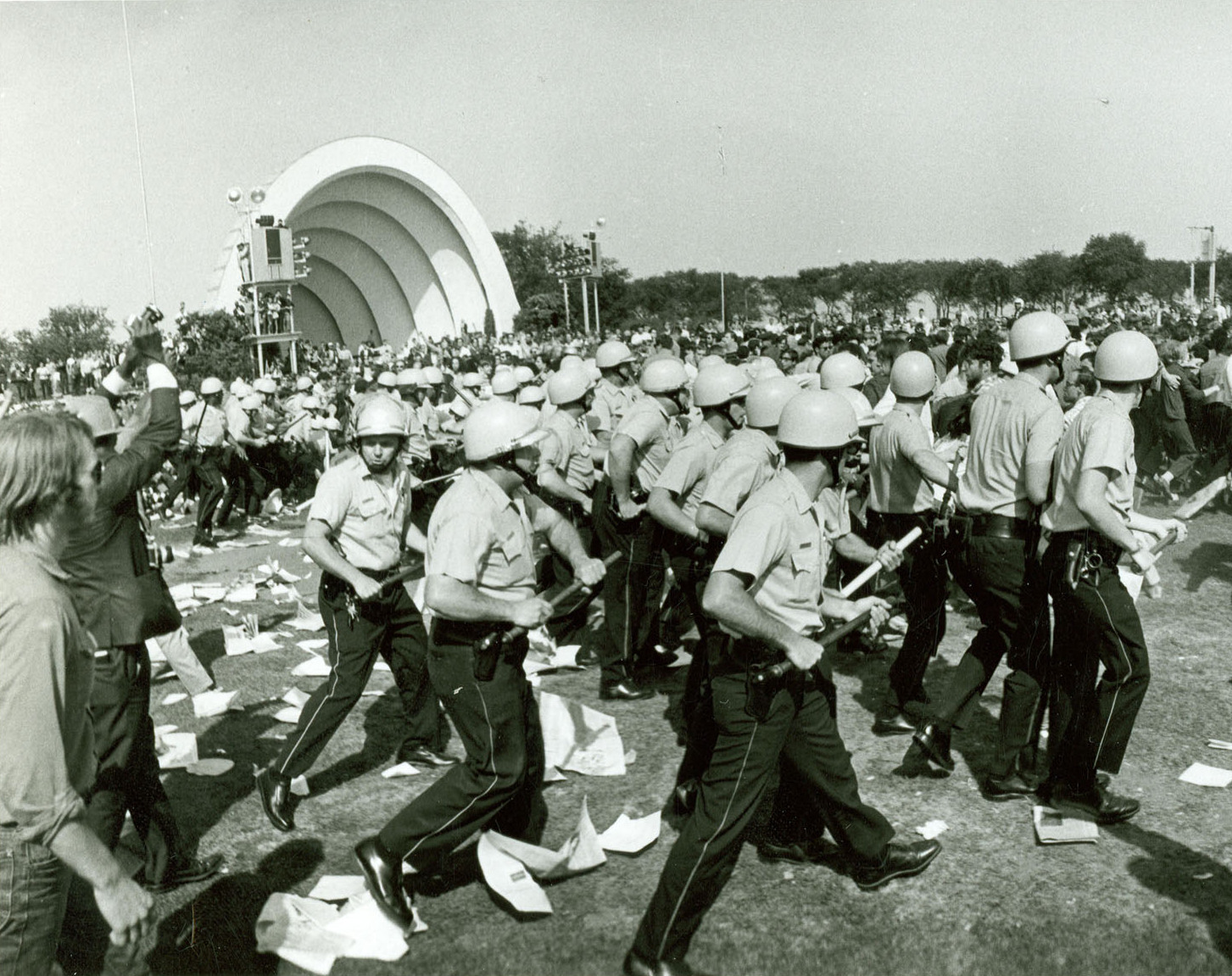
Image context: the cover uses a real archival photograph from the National Archives at Chicago, contributed via DPLA and preserved on Wikimedia Commons. It shows protesters and Chicago police in Grant Park on August 28, 1968, as an exhibit from the later federal criminal case United States v. Dellinger. The image is useful because it fixes the story at ground level: helmets, batons, paper litter, police movement, and demonstrators in the same park space that the article reconstructs.[5]
Before the convention: permits became the first conflict
Planning for Chicago exposed the basic mismatch. Antiwar organizers from the National Mobilization Committee to End the War in Vietnam proposed demonstrations tied to the convention, while Yippie leaders pursued more theatrical countercultural actions. The Federal Judicial Center's history of the Chicago Seven trial notes that organizers sought permits for marches and for sleeping in city parks, but that negotiations continued into convention week as the Daley administration refused almost all requests.[1]
That administrative fact matters more than it may seem. A permit can be read as a narrow legal form, but in this case it decided whether dissent would have a controlled route, a recognized sleeping area, and a negotiated spatial grammar. Without those things, the city made parks and sidewalks do work they were not designed to do. Protesters still came. Police still had to manage them. The absence of agreed space turned every gathering into a test of who could define order on the spot.[1]
The city also prepared for force. On the eve of the convention, Mayor Richard J. Daley put Chicago's roughly 12,000 police officers on twelve-hour shifts, asked for the National Guard, and faced the presence of 6,000 U.S. Army troops positioned to protect the city.[1] The estimated number of demonstrators who came was about 10,000, much smaller than some advance expectations, but the police posture was built for a larger threat and for strict enforcement of the 11 p.m. park curfew.[1]
That imbalance is the first step in the reconstruction. Chicago was not simply invaded by disorder. It was administratively organized for confrontation: denied permits, enforced curfew, concentrated police capacity, and a political leadership determined to show command.
August 25-27: the park curfew turned sleeping into a fight
The first major pattern unfolded before the most famous night. Beginning on Sunday, August 25, police and demonstrators clashed in city parks, especially where visitors hoped to sleep.[1] For three nights, according to the Federal Judicial Center's summary, aggressive police sweeps through Lincoln Park met taunts and occasional rocks; tear gas and clubbing forced demonstrators out of the park and into commercial areas where windows were smashed.[1]
The mechanism is important. A park curfew is ordinary municipal law in normal times. During convention week it became a trigger. If protesters could not legally sleep in the parks, but had no accepted alternative, enforcement necessarily happened at night, under fatigue, in poor visibility, and with crowds already interpreting police movement as political suppression. Once police cleared the park, the crowd did not vanish. It moved into nearby streets, where the problem became harder to contain and easier to broadcast as urban disorder.[1]
The violence also affected the recorders of the event. The Federal Judicial Center account says police repeatedly targeted journalists and destroyed cameras during these sweeps.[1] That detail belongs inside the event, not after it. Chicago 1968 became a media event partly because the media were not safely outside the conflict. Reporters and photographers were witnesses, targets, and later critics. The fight over public order became a fight over who could document public order.
August 28: Grant Park made the sequences collide
The decisive day was Wednesday, August 28. The Federal Judicial Center account identifies the afternoon as the week's largest rally and locates one escalation in Grant Park, where police charged through the crowd to stop a man from lowering a U.S. flag.[1] Protesters answered with rocks and improvised missiles. David Dellinger then tried to negotiate a permit to march to the convention hall; the city denied it.[1]
That denial linked the park to the convention. A rally could still be treated as a contained park event. A denied march toward the convention hall turned movement itself into the next disputed act. When demonstrators regrouped near hotels used by delegates, police attempted to clear the street intersection and lost control of proportional response.[1] Television cameras recorded the violence while demonstrators chanted the line that would become the week sentence: "The whole world is watching."[1]
Inside the convention, the party was trying to finish the work of nomination. Miller Center's account notes that Humphrey won the nomination on the first ballot, with 1,759 votes against 601 for Eugene McCarthy and 146 for George McGovern.[3] Humphrey's own acceptance speech tried to frame the convention as difficult but legitimate democracy: debate, decision, majority rule, and preserved minority rights.[4] The speech also acknowledged serious differences over Vietnam and promised effort toward a durable peace.[4]
The dissonance was the point. Humphrey's text asked the country to see a party deciding by ballot rather than force.[4] The live television record outside showed police force clearing dissent near the party's convention headquarters.[1][3] The two scenes did not cancel each other. They created the historical meaning of the night. Chicago 1968 became unforgettable because the machinery of nomination and the machinery of street control were visible at the same time.
Why "police riot" was a finding, not a slogan
The later argument over responsibility split into two strong readings. The Daley administration's immediate explanation blamed outside agitators and revolutionaries who had come for hostile confrontation.[1] That reading had evidence it could point to: threats, obscene taunts, rocks, sticks, and some demonstrators who did answer police with violence.[1] A reconstruction that ignores that evidence turns the event into a morality play.
The Walker Report's reading was stronger because it did not need to deny provocation. Daniel Walker's team, working for the National Commission on the Causes and Prevention of Violence, interviewed more than 1,400 witnesses and studied film and FBI materials before the report appeared on December 1, 1968.[1] Its conclusion was more precise than a protest slogan. It characterized the convention violence as a "police riot," while also saying most police behaved responsibly and most demonstrators were intent on peaceful dissent.[1]
That balance is what gives the report its force. It did not claim every officer was brutal or every demonstrator passive. It found that unrestrained and indiscriminate police violence occurred on many occasions, often against people who had broken no law, including peaceful demonstrators, onlookers, residents, and news workers.[1] It also faulted the failure to discipline officers who violated procedure and public trust.[1]
The finding would weaken if the best evidence showed that permits had been reasonably granted, that violence flowed mainly from planned assaults by protesters, or that police force was narrowly directed only at immediate attackers. The surviving summary points the other way. It shows provocation, but it also shows administrative choices and police actions that widened the zone of harm beyond the people actively throwing objects.[1]
The trial moved the street into court
The afterlife completed the transformation. On March 20, 1969, a federal grand jury indicted eight demonstrators and eight police officers.[1] The demonstrators, soon known as the Chicago Eight and later the Chicago Seven after Bobby Seale's case was severed, were charged under the anti-riot provisions of the 1968 Civil Rights Act. The Federal Judicial Center notes that these were the first prosecutions under those provisions.[1]
That legal turn matters because it shows how the state tried to name what had happened. Was Chicago a riot caused by conspirators crossing state lines to incite disorder? Was it a police riot, as Walker's investigation concluded? Was it a broken political convention whose inside and outside failures reinforced each other? The trial did not simply follow the event. It became the arena where the event's meaning was fought again, this time through conspiracy law, judicial authority, media attention, and contempt battles.[1]
Chicago History Museum's exhibit page captures the broader frame succinctly: delegates fought inside the convention arena, protesters and police fought on the streets, and the news media depicted division and violence.[2] That three-part structure is the durable lesson. Chicago 1968 was not one riot in one place. It was a collision among party rules, protest logistics, municipal command, policing culture, and television.
The event's political consequences reached beyond the week. Miller Center notes that the convention helped demand reforms, and that the McGovern-Fraser process shifted more candidate selection power toward primaries and away from party elites.[3] Those reforms did not solve American political conflict. They did show that the convention's legitimacy problem could not be treated as a street problem alone. The streets had exposed something inside the party, too.
The best reconstruction, then, keeps the dates and places attached. March 31 changed the presidential race. June removed Kennedy. August 25 began the park sweeps. August 28 fused Grant Park, Michigan Avenue, television, and nomination. December 1 gave the phrase "police riot" investigative authority. March 20, 1969 carried the conflict into federal court. Chicago 1968 endures because each step narrowed the room for peaceful dissent and widened the audience for state violence.
Sources
- Federal Judicial Center, The Chicago Seven: 1960s Radicalism in the Federal Courts - official federal judicial history covering protest planning, permit disputes, police deployment, Grant Park/Michigan Avenue chronology, Walker Report findings, and later indictments.
- Chicago History Museum, "Chicago 1968: Law and Disorder" - institutional exhibition page framing the convention as simultaneous conflict inside the arena, on the streets, and in media representation.
- Miller Center, University of Virginia, "Divisions at the 1968 DNC" - presidential-history account of the party split, television exposure, Humphrey nomination vote, election aftermath, and McGovern-Fraser reforms.
- Hubert H. Humphrey, "Address Accepting the Presidential Nomination at the Democratic National Convention in Chicago," American Presidency Project - primary text of Humphrey's acceptance speech on debate, decision, Vietnam, and unity.
- Wikimedia Commons, "File:Protestors and Chicago Police Officers in Grant Park - DPLA - 2972723d78e7f60f542da94846a6f9a6 (1) (cropa).jpg" - National Archives at Chicago exhibit photograph from United States v. Dellinger, dated August 28, 1968, used as the article image.