The Marshall Plan is often remembered backwards. The phrase now evokes billions of dollars, Cold War strategy, and postwar American largesse. George C. Marshall's June 5, 1947 Harvard speech sounds much leaner than that memory. Read closely, it does not offer a fully worked institutional blueprint, and it does not sound like a triumphal announcement that Washington will simply command Europe's recovery. The speech is narrower, more technical, and in some ways more interesting: Marshall describes a continent whose exchange system has jammed, insists that assistance must be comprehensive rather than crisis by crisis, and places the burden of initial design on Europeans themselves.[1][3][4]
That difference matters because later shorthand flattens the document into slogan. America offered money, Europe recovered, the Cold War hardened. The text itself says something more precise. Marshall's key claim is that political stability rests on reviving a working economy, and that a working economy depends on restoring the ordinary circulation between farms, cities, fuel, machinery, currency, and trade.[1] The drama of the speech lies in how administrative that sounds. What later became one of the most famous aid programs of the twentieth century begins, in this document, as a diagnosis of broken incentives and broken coordination.
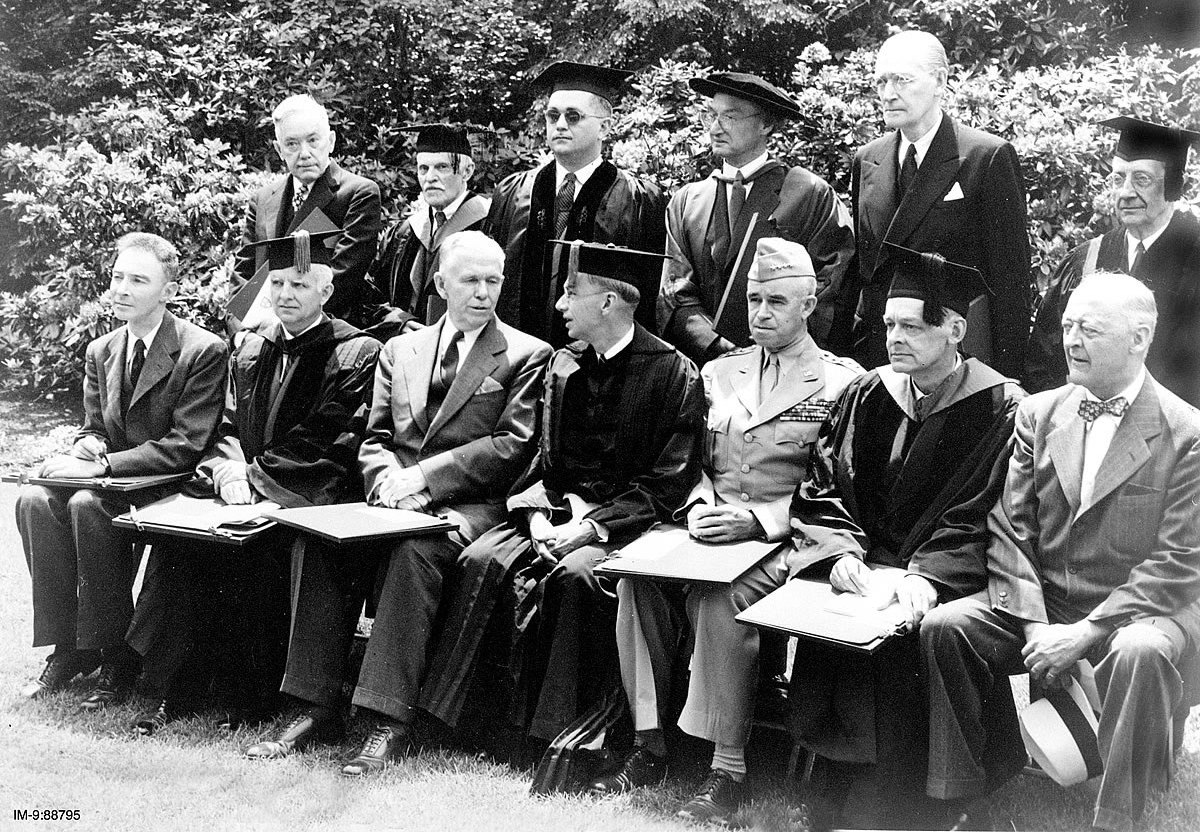
The archival photograph used here shows Marshall at Harvard on the day of the speech, standing among other honorary-degree recipients before the ceremony.[5] It suits the article because the speech's force came through understatement. Marshall did not unveil a banner, stage a grand ideological duel, or present a finished treaty architecture. He spoke as a statesman trying to make a large economic emergency legible to listeners who were physically distant from it and politically tempted to simplify it.[1][5]
Timeline anchors
- winter 1946-1947: European economic deterioration deepened, and U.S. officials increasingly treated recovery as urgent rather than optional.[3]
- 1947-06-05: Marshall delivered the Harvard commencement address that later gave its name to the Marshall Plan.[1]
- 1947-06-18: British and French officials, in a telegram recorded by Ambassador Jefferson Caffery, read Marshall's speech as a call for European governments to draft joint recovery programs of their own.[2]
- 1948-04-03: the Economic Cooperation Act became law, giving statutory form to what the speech had only sketched in principle.[4]
These markers help keep the sequence straight. The Harvard speech came before the plan had legal machinery, before the aid totals were fixed, and before the institutional name had hardened. That is exactly why the close reading matters. It lets us see what Marshall thought had to be established first.
1) Marshall begins by slowing the audience down, not by rallying it
The opening paragraph is a clue to the whole document. Marshall does not start with an enemy, an alliance, or a soaring doctrine. He starts with complexity. The public, he says, is being bombarded by such a mass of facts that "the man in the street" struggles to reach a clear appraisal of the situation, while Americans remain geographically distant from the places in distress.[1] The immediate task of the speech, then, is interpretive. Marshall wants to narrow the gap between the European crisis and the American imagination before he asks for any durable commitment.
That opening matters historically because it sets the tone for everything that follows. The speech is trying to produce comprehension before enthusiasm. It assumes that the greatest political risk is not only indifference but misreading: seeing Europe's problems as remote suffering or as a simple matter of ruined buildings, when in Marshall's view the deeper danger lies in economic dislocation that can keep feeding instability.[1][3]
This is also why the speech still feels unusually restrained. Marshall is not building his case out of emotional spectacle. He is building it out of diagnosis. In a text later remembered as the birth announcement of a major geopolitical program, the first move is to ask the audience to think more carefully about systems.
2) The speech's real object is a broken exchange system
The most revealing passage arrives when Marshall says the visible destruction of Europe had been correctly estimated, yet that destruction was "probably less serious than the dislocation of the entire fabric of European economy."[1] That sentence changes the scale of the problem. Rubble matters, but rubble is not the deepest issue. The deeper issue is that the ordinary mechanisms tying production to exchange are no longer functioning.
He makes that argument concrete through one of the speech's sharpest images: the broken relationship between the farmer and the city.[1] In Marshall's account, industry cannot produce enough goods for the food-producing farmer to buy. Raw materials are scarce, machinery is worn out, and money no longer carries convincing value. The farmer then has less reason to sell produce into the market, shifts land away from crop cultivation, and feeds more grain to livestock or keeps food for the household. Cities, in turn, run short of food and fuel; governments burn scarce foreign exchange to import essentials; reconstruction funds disappear into emergency consumption.[1]
This is the close reading's key payoff. Marshall is not treating recovery as a matter of handing out money to damaged states in the abstract. He is describing a blocked circulation problem. Production does not meet exchange, exchange does not restore confidence, and confidence does not return quickly enough to restart production. By the time he says Europe will need substantial help for the next three or four years, the argument has already been made in structural terms.[1]
That is why one of the speech's most important phrases is the call for the revival of a "working economy in the world."[1] The phrase is modest on the surface, yet it carries the whole design. Marshall does not promise instant prosperity. He defines the goal as workingness: a system that can move food, fuel, industrial goods, money, and expectations through ordinary channels again.
3) The famous depoliticizing line still carries a political program
The sentence most often excerpted from the speech is also one of its most carefully balanced: American policy, Marshall says, is directed "not against any country or doctrine" but against hunger, poverty, desperation, and chaos.[1] Read carelessly, the line can sound like a pure humanitarian abstraction detached from the emerging Cold War. Read closely, it does something subtler. It shifts the rhetorical surface away from open ideological combat while keeping the political destination in view.
Marshall makes that destination explicit in the very next movement. The purpose of assistance, he says, is to revive a working economy so that political and social conditions can emerge "in which free institutions can exist."[1] The speech therefore links economic repair and political order without presenting the entire argument in enemy-centered language. That is part of its craft. Marshall is trying to assemble a broad coalition for action by speaking about conditions rather than slogans, while still implying that prolonged breakdown will favor forces hostile to liberal democratic life.[1][3]
The Office of the Historian's later milestone summary makes the surrounding Cold War frame plain: European devastation and fear of Communist expansion formed the larger environment in which Congress later acted.[3] The speech itself, however, earns its durability by refusing to sound like a narrow propaganda tract. It frames recovery as a cure for a continent-wide systems failure and lets the political consequences follow from that diagnosis.
This is also where another famous phrase matters. Marshall says aid should not be "a piece-meal" response as crises arise; it should offer "a cure rather than a mere palliative."[1] The opposition here is not just literary. It marks the difference between episodic emergency relief and an organized recovery design. The future Marshall Plan is already present in that distinction.
4) The hinge sentence puts initiative in Europe and support in Washington
The most consequential passage in the speech may be the one most often compressed in memory. Before the United States can proceed much further, Marshall says, there must be agreement among European countries themselves about the requirements of the situation and the part they will take in meeting it.[1] Then comes the sentence that gives the whole design its sequence: "The initiative, I think, must come from Europe."[1]
That line is easy to misread as courtesy or diplomatic modesty. In context, it is governance architecture. Marshall is saying that the United States should not unilaterally draft a complete recovery program for Europe. The Americans may provide "friendly aid" in drafting and later support it in practice, but the program should be joint and European in origin.[1] Assistance is therefore conditional on coordination, not only on need.
The immediate diplomatic reaction recorded in June 18, 1947 telegrams shows that British and French officials heard the sentence exactly that way. In the Caffery telegram, their aide-memoire says Marshall had "clearly" suggested the drawing up of economic programs by the European nations themselves and that American help would support those programs in execution.[2] That matters because it demonstrates that contemporaries did not treat the speech merely as a moral signal. They treated it as a sequencing instruction.
The later statute reinforces the point. When Congress enacted the Economic Cooperation Act in April 1948, the law described a plan of European recovery built around production effort, trade expansion, financial stability, and economic cooperation.[4] The legal machinery came later, yet the logic is already visible in the Harvard speech: first a shared diagnosis, then a European program, then American backing substantial enough to keep the system from collapsing.[1][2][4]
Why the close reading still matters
The phrase "Marshall Plan" is now often used as a synonym for large-scale aid, as if the historical lesson were mainly about money and generosity. The speech suggests a more exact lesson. Marshall's design begins with a systems diagnosis of broken exchange, moves to the insistence that emergency patching will fail, and then places local or regional initiative ahead of American support.[1][2] In that sequence, aid is not the whole story. Coordination, production, confidence, and political legitimacy are equally central.
That is why the Harvard speech still repays careful reading. If it is reduced to anti-Soviet doctrine, the economic mechanism disappears. If it is remembered only as humanitarian benevolence, the political purpose and the demand for European initiative recede. The strongest interpretation keeps those layers together. Marshall was describing recovery as an economic repair job large enough to reshape political order, yet disciplined enough to require Europeans to draft the first coherent program themselves.[1][2][3][4]
The photograph from Harvard belongs with that reading.[5] It catches the speech before it became a slogan. On June 5, 1947, the future Marshall Plan still looked like a carefully worded public explanation of why reconstruction had to be comprehensive, coordinated, and built on a working economy rather than on scattered rescue.
Sources
- U.S. Department of State, Office of the Historian, Foreign Relations of the United States, 1947, Volume III, Document 140: "Remarks by the Honorable George C. Marshall, Secretary of State, at Harvard University on June 5, 1947."
- U.S. Department of State, Office of the Historian, Foreign Relations of the United States, 1947, Volume III, Document 153: "The Ambassador in France (Caffery) to the Secretary of State," June 18, 1947.
- U.S. Department of State, Office of the Historian, "Marshall Plan, 1948" in Milestones in the History of U.S. Foreign Relations.
- U.S. National Archives, "Marshall Plan (1948)" - transcript page for Marshall's speech and the Economic Cooperation Act / European Recovery Act.
- Wikimedia Commons, "File: Oppenheimer Marshall Conant Bradley and others at Harvard.jpg" - source page for the June 5, 1947 Harvard photograph used as this article's cover.