The March on Washington for Jobs and Freedom is usually remembered through one summit image and one summit voice: the crowd spread before the Lincoln Memorial, and Martin Luther King Jr. delivering "I Have a Dream." That memory is deserved, but it is incomplete. The day did not become historically durable only because one speech rose above the others. It became durable because, on August 28, 1963, the organizers turned a broad and potentially unstable coalition into a sequence that could hold: assembly at the Washington Monument, a managed route across the Mall, a tightly ordered memorial program, a contained internal argument over John Lewis's text, and finally a meeting with President John F. Kennedy at the White House.[2][3][4][6]
That sequence is the core of the event. If the march had simply been large, it might have remained a spectacular crowd scene. If it had only offered famous rhetoric, it might have become a commemorative clip severed from the harder politics of jobs, voting, school desegregation, and federal enforcement. What made the day work was the fact that A. Philip Randolph and Bayard Rustin helped build a public machine in which logistics, symbolism, and coalition management reinforced one another hour by hour.[2][3][5]
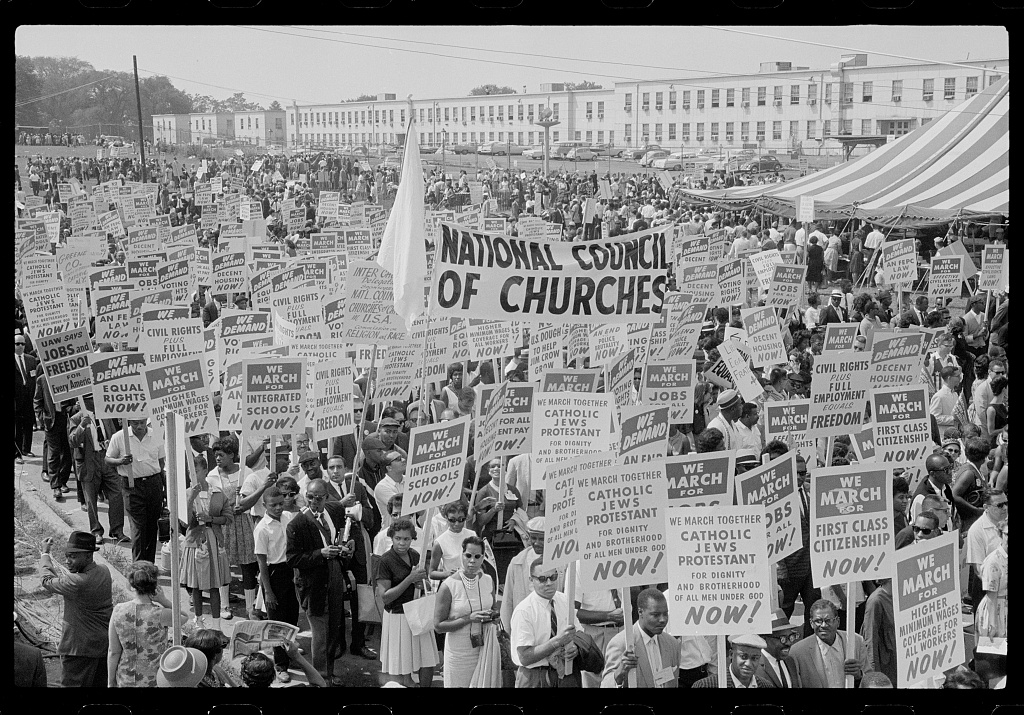
The lead image helps recover that reality. Rather than isolating a single celebrity or the memorial steps alone, it shows a denser civic field: marchers, signs, and event infrastructure inhabiting the same space. That is closer to what the march actually was. Before it became a canonized speech, it was a disciplined mass action that had to be organized, routed, heard, and kept politically intact.[1][3][5]
Timeline anchors
- Late 1962: Randolph revives the long-deferred idea of a mass march on the capital and begins building support for a national demonstration around jobs and freedom.[2][3]
- Summer 1963: the Council for United Civil Rights Leadership and allied groups raise funds for Rustin's day-to-day organizing crew, which included dozens of student workers and volunteers.[5]
- August 28, 1963, morning: demonstrators gather at the Washington Monument and then move along the National Mall toward the Lincoln Memorial.[2][3]
- August 28, 1963, around 1:00 p.m.: a last-minute dispute over John Lewis's speech forces movement leaders to renegotiate language before the main program begins.[4]
- August 28, 1963, 5:00 p.m.: the march leaders meet Kennedy at the White House after the Lincoln Memorial program concludes.[2][6]
Randolph's old idea became Rustin's operating problem
The march's first achievement was temporal. The idea itself was older than 1963. The National Park Service traces it back through Randolph's earlier threats of mass protest in the 1940s, when the possibility of a large Black-led march on Washington had already been used to pressure the federal government over discrimination.[3] By 1963, that inherited idea had to be adapted to a new political moment: the civil-rights movement had national momentum, the Kennedy administration was advancing civil-rights legislation, labor groups and religious organizations were involved, and multiple organizations wanted the event to succeed without surrendering their own agendas.[3]
That is why Randolph and Rustin mattered in different ways. Randolph gave the march moral lineage and public seniority. Rustin turned lineage into operations. The Park Service emphasizes that the event was organized in less than three months and that Rustin planned everything from nonviolent marshals to the sound system and portable toilets.[3] The Library of Congress adds a useful backstage detail: by the summer of 1963, an umbrella coalition had assembled funds for Rustin's day-to-day production effort, which was being carried by dozens of college students and other workers rather than by charisma alone.[5] The point is not that logistics somehow sit outside politics. The logistics were the politics in material form. A quarter-million-person demonstration only becomes legible if someone handles transportation, signage, route discipline, sanitation, sound, volunteers, and timing.
The same is true of the march's demands. The Park Service page preserves the event's full title and its wider platform. The march was not called simply a freedom rally. It was for Jobs and Freedom, and its agreed demands included civil-rights legislation, public accommodations, decent housing, integrated education, voting rights, stronger federal enforcement, and employment measures.[3] That matters because later memory often compresses the day into a moral pageant. The original march was sharper. It bound racial equality to economic claims and asked Washington for action rather than admiration.[3]
The route turned mass turnout into a readable public act
The march also depended on spatial discipline. The National Archives notes that the day began with a rally at the Washington Monument featuring musicians and public figures, after which participants moved the length of the Mall to the Lincoln Memorial.[2] The route sounds simple, but it solved a political problem. A dispersed capital crowd can look chaotic or threatening. A directed procession can look deliberate. The movement from monument to memorial therefore made the day readable to participants, press photographers, television cameras, and the federal government at once.[2][3]
This is one reason the march had so much afterlife. The visual field was inherently narrative. People arrived by buses, cars, trains, and planes; they entered a common route; and they converged on a ceremonial endpoint already saturated with constitutional symbolism.[3] The Lincoln Memorial was not a neutral stage. It pulled the language of emancipation, Union memory, and federal authority into the event before any speaker opened his mouth. By choosing that route and that finish, the organizers made the argument visible in advance: the nation's unfinished promises were being carried directly to one of its most charged civic sites.[2][3]
The image archive reinforces this reading. A still photograph from the day shows not only faces but coordination: signs clustered with bodies, a field tent, and the managed density of the gathering.[1] A march of this scale had to look peaceful without looking passive. It had to show numbers without dissolving into blur. The route helped do that work. It turned attendance into formation.
The official program was a device for coalition control
The National Archives program is especially revealing because it records not the later legend of the day but the order that the organizers wanted the public to experience.[2] That order was not accidental. The printed schedule interleaved clergy, movement leadership, labor, music, and formal civic ritual. Marian Anderson led the national anthem. Randolph gave opening remarks. Daisy Bates introduced the tribute to women fighters for freedom. John Lewis appeared relatively early in the sequence. Walter Reuther, Whitney Young, Roy Wilkins, Joachim Prinz, and King followed in a pattern that kept different constituencies visible inside one continuous public frame.[2]
The most striking detail is that the program does not end with King. In the archival order, King's speech is item sixteen, followed by "The Pledge" led by Randolph.[2] That matters because public memory now treats King's address as the definitive climax and natural endpoint. The program suggests a slightly different intention. The organizers wanted the most remembered speech to flow into a collective commitment rather than remain a solitary star turn. The day was built to conclude in pledged common purpose, not merely in applause.[2]
This is where event reconstruction changes the meaning of the march. It reminds us that program order is a political technology. Put Lewis too late and the day risks rupture. Put labor too low and the jobs frame weakens. Remove women's recognition and the coalition's gender hierarchy becomes even more glaring. Let King stand entirely alone as the culmination and the march can be misremembered as inspiration detached from organization. The printed order held those dangers in check. It staged breadth.[2][3]
John Lewis's revision shows that unity was made under pressure
The smoothness of the official program becomes even more significant when placed beside the backstage conflict described by the SNCC Digital Gateway. Around 1:00 p.m., just as the march was about to begin, organizers were still fighting over Lewis's speech.[4] His original text criticized the Kennedy administration's civil-rights bill as too weak and too late, accused the federal government of complicity with Southern white supremacy, and threatened a more militant course of nonviolent action.[4] According to SNCC's reconstruction, Archbishop Patrick O'Boyle refused to appear onstage with Lewis unless changes were made, and senior leaders including Randolph, Rustin, King, Ralph Abernathy, and Eugene Carson Blake pressed Lewis to revise.[4]
That episode is not a side anecdote. It is one of the march's central mechanisms. The day that later appears as perfect moral unity was, in real time, a negotiated settlement. The coalition did not begin harmonious and then express itself. It became harmonious enough by cutting, softening, and sequencing differences so that the public event could proceed.[4] Lewis still spoke. SNCC was not expelled from the platform. But the language that reached the memorial steps had been reworked to keep the coalition from breaking in front of the cameras.[2][4]
That helps explain why the march mattered politically. Moderation, here, was not an essence. It was a managed outcome. The march remained large, peaceful, and broadly legible precisely because some of its sharpest internal edges were processed before they hit the microphone. Event reconstruction restores that work. It shows that what the public saw as unity had to be built minute by minute under deadline pressure.[4][5]
The day ended as a petition to government, not only a national spectacle
The final stage of the sequence keeps the march from collapsing into symbolism alone. The National Archives notes that the day ended with a meeting between march leaders and Kennedy, and the JFK Library preserves the White House photograph folder for that meeting at 5:00 p.m. on August 28, 1963.[2][6] That is a crucial endpoint. It means the march did not understand itself merely as a morally expressive gathering. It ended by presenting organized leadership to executive power inside the White House itself.[6]
This matters for how the day should be remembered. The Lincoln Memorial program was not detached from legislation, administration, or federal decision-making. The public event created pressure, but it was also structured as a formal petition. The route, the program, the pledge, and the closing meeting all belong to the same chain. The march was addressed to the state.[2][3][6]
That is why the day remains larger than its most famous paragraph. King's speech has every reason to dominate memory. But the march worked because it was more than King. It was Randolph's long concept, Rustin's operating structure, a coalition broad enough to include labor and clergy, a program smart enough to stage multiple publics in one order, and a last-minute compromise strong enough to keep SNCC inside the tent without letting the day split apart.[2][3][4][5]
Reconstructed this way, the march looks less like spontaneous national revelation and more like disciplined democratic engineering. That reading does not diminish the event. It strengthens it. The achievement was not only that hundreds of thousands came. It was that they were made to signify together.[2][3][5][6]
Sources
- Wikimedia Commons, "Marchers, signs, and tent at the March on Washington, 1963" - source page for the archival photograph used as the article image, identified from the Library of Congress Marion S. Trikosko collection.
- National Archives, "Official Program for the March on Washington (1963)" - the printed Lincoln Memorial program, the rally-to-memorial sequence, the scale of the march, and the note that the day ended with a meeting with President Kennedy.
- National Park Service, "March History" - origins of Randolph's idea, the Big Six and expanded coalition, Rustin's logistical role, and the march's 10 demands.
- SNCC Digital Gateway, "March on Washington" - the backstage dispute over John Lewis's speech, the pressure to revise it, and what that conflict reveals about coalition politics on August 28, 1963.
- Library of Congress, "Inside the March on Washington: Bayard Rustin's 'Army'" - on the production crew, student labor, and the organizational apparatus behind the march.
- John F. Kennedy Presidential Library and Museum, "Meeting with the leaders of 'The March on Washington for Jobs and Freedom,' 5:00PM" - archival record for the White House meeting on August 28, 1963.
Editor’s Pick Review
This piece wins the 24-hour curation window because it turns a familiar civic icon back into an event with moving parts. The article does not stop at crowd size or King’s speech; it reconstructs the march as a timed sequence of route, logistics, program order, internal negotiation, and final petition to government. That structure gives the piece a stronger historical payoff than a standard anniversary-style summary, while the source chain stays compact and verifiable across archives, NPS context, SNCC reconstruction, Library of Congress production history, and the JFK Library record.
It also clears the stricter visual and translation gates. The lead image is an immersive, topic-grounded archival photograph of the march’s actual field infrastructure rather than an analytical chart or decorative abstraction, and the caption uses the image to reinforce the article’s central thesis. The Chinese version preserves the sequence logic, terminology, and historical pressure points in fluent long-form prose, so the pick holds up in both language tracks.