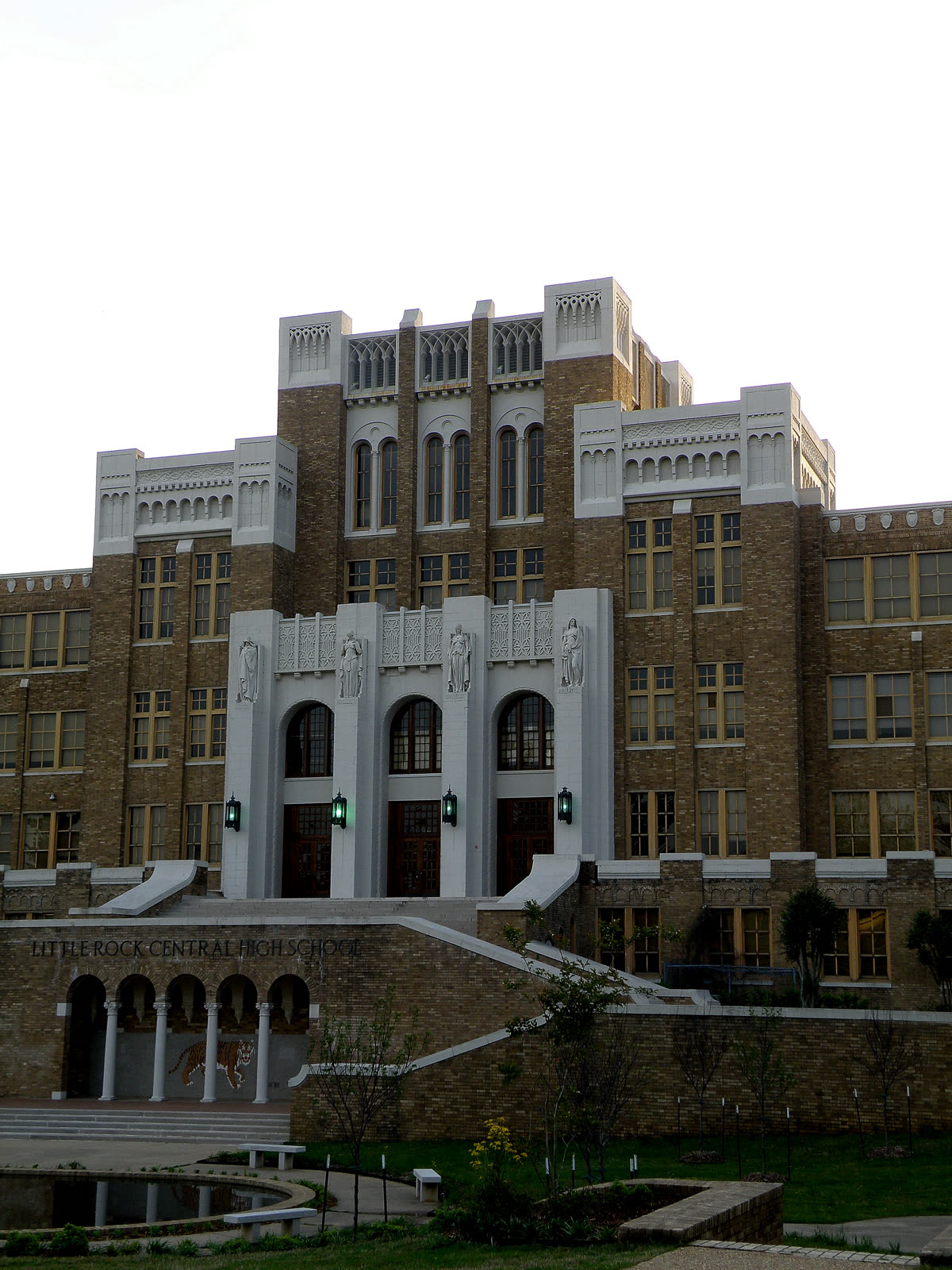
Many historic sites become legible by stopping. A battlefield is fenced, a house becomes a museum, a prison cell is preserved behind glass. Little Rock Central High School matters because it never followed that script. The front steps, sidewalks, and street that became globally recognizable in September 1957 still belong to a functioning public high school. That decision changed the kind of memory the place could hold. Instead of treating desegregation as a completed drama with a fixed ending, Central High kept the argument inside civic routine: students still arrive, tours still have to work around school operations, and commemoration has to share space with ordinary education.[2][3][4]
That is why the site feels different from a memorial built afterward. In the standard story, the school enters history when the Little Rock Nine try to attend under federal court order, are blocked by Governor Orval Faubus and the Arkansas National Guard on September 4, 1957, then finally enter under federal troop escort on September 25, 1957.[5][6][7] All of that remains essential. But the longer afterlife matters just as much. The school was shut during the 1958-59 Lost Year rather than further integrated, became a National Historic Site in 1998, and gained a Commemorative Garden dedicated in 2001 that turns the surrounding streetscape into a place of reflection without ending the school's daily life.[3][4][8]
Image context: the cover image is a real photograph from Wikimedia Commons showing Central High's front facade. It belongs here because the article's argument depends on the building as a continuing civic object, not as a vanished scene reconstructed from a diagram or artist's rendering.[1][3][4]
The 1957 crisis made the front of the school into a national stage
The building already carried civic weight before desegregation. National Park Service materials note that when the school opened in 1927 it was celebrated for its size, academic standing, and symbolic importance inside white Little Rock; that prestige is part of why the fight over integration became so explosive.[3][4] Central High was not a marginal facility into which national conflict unexpectedly wandered. It was a prized civic centerpiece, and the meaning of the crisis depended on that fact. Desegregation did not test an empty abstraction called public education. It tested whether a city would allow one of its proudest institutions to obey federal law.
The NPS crisis brochure compresses the public sequence clearly. On September 2, 1957, Faubus announced that he would use the Arkansas National Guard to prevent violence and bar the nine Black students from entry. On September 4, the students attempted to enter and were turned away, while photographers and television crews transformed Park Street and the front stair into a national image field.[5] On September 23, local police lost control of the crowd after the Guard had been withdrawn, and the students had to be removed for their safety.[5] On September 24-25, Eisenhower federalized the Arkansas National Guard and sent in the 101st Airborne so the students could attend classes under armed protection.[5][6][7]
Eisenhower's radio and television address did more than justify troop deployment. It turned the site into a constitutional theater. In his speech of September 24, 1957, he insisted that the federal government had to ensure court orders were carried out and that law could not yield to the mob.[7] The school entrance thereby became more than a local threshold. It became the visible place where federal supremacy, civil rights, public schooling, and television-era spectatorship were forced into the same frame.[5][6][7]
The Lost Year proved that memory would not preserve itself
It is tempting to let the story end with the escorted entry and Ernest Green's graduation in May 1958. The site itself argues against that neatness. The NPS brochure notes the continuing abuse faced by the Little Rock Nine inside the school through the 1957-58 year, including Minnijean Brown's eventual expulsion after months of harassment.[5] The Encyclopedia of Arkansas then carries the chronology into the sharper civic wound: in September 1958, Faubus used newly passed state laws to close Little Rock's four public high schools rather than permit further desegregation, creating what became known as the Lost Year.[8]
That interruption matters for commemoration because it kept Central High from becoming a triumphalist symbol. The place could not be remembered simply as the site where justice arrived and then settled in. It also had to be remembered as a place where public authority, local resistance, and educational life remained unstable. Thousands of students, Black and white, lost a year of ordinary schooling because the city and state were still trying to evade the implications of Brown v. Board of Education and the events of 1957.[6][8]
In other words, the school was not memorialized because consensus formed. It was memorialized because conflict proved durable enough to alter how the city understood its own streets, institutions, and obligations. The memory of Central High stayed charged because the crisis kept leaking beyond the famous photographs into legislation, court orders, school administration, neighborhood change, and the later work of preservation.[4][6][8]
Federal designation drew a boundary around an institution still in use
The most unusual fact about Central High as a historic site is that the federal government designated a place that was still doing its original job. The park's own visitor materials say plainly that Central High is "still an operating high school" and that the public may visit only the grounds unless they join organized tours.[3] The NPS walking page goes further, describing it as the only operating high school designated as a national historic site.[2] That status is not a side note. It is the core of the site's commemorative form.
The 1998 enabling legislation, summarized in the park foundation document, established the site in order to preserve, protect, and interpret Central High School and its role in school integration and the Civil Rights Movement, while also making clear that the designation could not strip the Little Rock School District of its authority to administer the school.[4] That legal architecture matters. Congress did not convert the building into a static relic. It created a shared arrangement in which the National Park Service interprets the history while the district continues to run a living school.[4]
This is a more demanding kind of memory than a sealed museum room. It requires negotiated access, exterior preservation, ranger tours, visitor orientation, and continuing agreements between school authorities and federal interpreters.[3][4] It also keeps the building from becoming an emptied icon. Central High remains answerable to present-tense educational life, which means the history of 1957 is encountered at the same place where students still learn, move, wait, and graduate.
The Commemorative Garden externalized memory without freezing the campus
The site's commemorative landscape made that arrangement visible. The NPS foundation document says the Commemorative Garden was dedicated in 2001 and includes nine trees and nine benches symbolizing the Little Rock Nine, along with arches displaying historic photographs from 1927 to the early twenty-first century.[4] The NPS self-guided walk page adds a crucial detail about form: the garden sits between the visitor center and the school, using photographic panels, sculpture, and a circular poem space to invite reflection while remaining open to the movement of contemporary visitors.[2]
That placement is historically intelligent. The garden does not replace the school facade as the site of memory, and it does not pretend the school grounds can function like a silent cemetery. Instead it builds an interpretive threshold next to the operating institution. One crosses from visitor center to garden to street to school frontage, moving from explanation to contemplation to the actual urban scene where the crisis unfolded.[2][3][4]
The result is that memory at Central High becomes layered rather than singular. The building holds the authority of the original event. The street and sidewalks preserve the geometry of confrontation. The garden provides a civic pause. The visitor center gives documentary depth. Together they produce a site that commemorates struggle without claiming the struggle has been fully domesticated.
What Central High teaches about commemoration
The strongest reading of Central High is therefore not that the United States eventually honored a famous civil-rights episode. It is that the site remembers through managed coexistence. A working school, a federal historic site, a commemorative garden, and a tour landscape occupy the same block and keep rubbing against each other.[2][3][4] That friction is not a flaw in the memorial design. It is the design.
If the school had been emptied and converted into a pure shrine, the meaning of 1957 would be easier to package. It would also be less demanding. By staying open, Central High keeps asking a harder question: what does it mean to remember desegregation in a place where public education is still happening? The answer is neither purely archival nor purely ceremonial. It is civic. Memory here lives in access rules, preserved facades, ranger interpretation, school calendars, commemorative benches, and the fact that young people still pass through a building whose past once had to be defended by federal troops.[2][3][4][5]
That is why Little Rock Central High remains so historically sharp. It does not commemorate the civil-rights movement by withdrawing from everyday life. It commemorates by staying inside it.
Sources
- Wikimedia Commons, "File: Little Rock Central High.jpg" - source page for the real photograph used as the article image.
- National Park Service, "Walk the Footsteps of History" - official site walk description covering the operating school, the Commemorative Garden, and the memorial layout around the campus.
- National Park Service, "Park Archives: Little Rock Central High School National Historic Site" - brochure text on the school's 1927 status, visitor access, continuing school operations, and 1998 establishment date.
- National Park Service, Foundation Document: Little Rock Central High School National Historic Site (2017) - official park planning document covering the 1998 establishment, operating-school governance, park boundary, and 2001 Commemorative Garden.
- National Park Service, The 1957 Crisis at Central High - timeline brochure on September 1957, troop deployment, harassment inside the school, and Ernest Green's 1958 graduation.
- Eisenhower Presidential Library, "Civil Rights: The Little Rock School Integration Crisis" - official document hub with the key September 1957 telegrams, proclamations, and speech references.
- The American Presidency Project, "Radio and Television Address to the American People on the Situation in Little Rock" (September 24, 1957) - transcript of Eisenhower's national address on federal enforcement at Central High.
- Encyclopedia of Arkansas, "Lost Year" - summary of the 1958-59 closure of Little Rock's public high schools to resist desegregation.