The Homestead Act is still remembered in a compressed and flattering form: 160 free acres, a wagon headed west, and a republic supposedly turning empty land into independent farms.[1][2] The text itself is more disciplined than that memory. Read closely, the Act did not simply donate western land. It created a federal process for selecting settlers, measuring their conduct, and deciding whether occupancy had ripened into ownership.[1][2]
That is why a primary-source close reading helps. The key units in the Act are not only acreage and aspiration. They are the affidavit, the filing fee, the residence clock, the improvement requirement, the two-witness final proof, and the citizenship test.[1][2] Put differently, the law turned westward settlement into a claim-and-proof machine. Congress was not merely inviting people onto the land; it was asking them to perform a specific kind of smallholding life long enough for the federal government to recognize it as property.
The sharper interpretation therefore has two sides. The Act mattered because it widened formal access to public land for ordinary citizens and intended citizens at a scale older land policy had not.[1][3][4] But the same text also reveals the boundaries of that promise. The land was not empty, the process was not costless, and the "free land" story weakens as soon as one notices the price of tools, seed, transport, water, fraud, and the prior dispossession of Native peoples that made the entire system possible.[1][2][4]
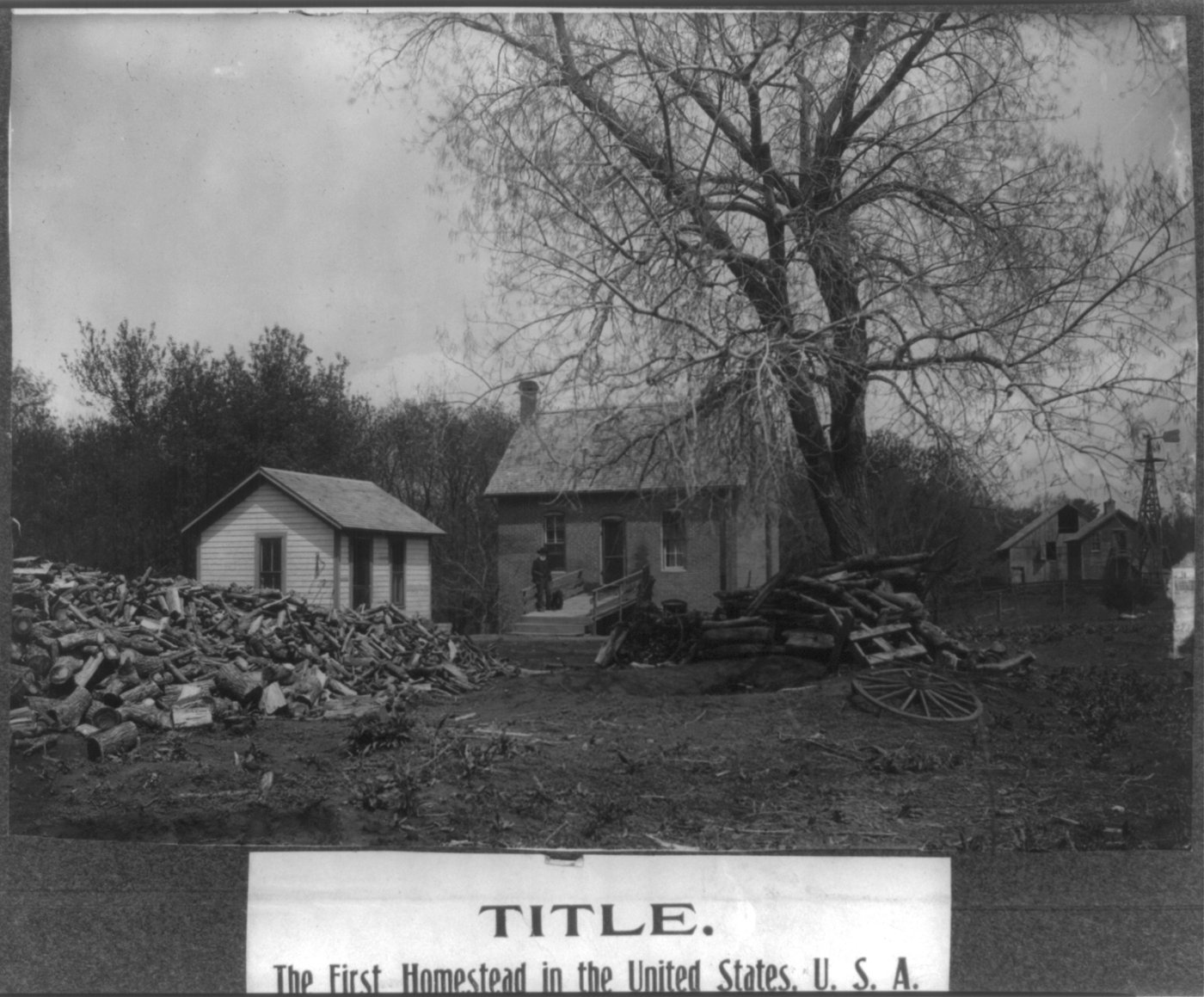
Image context: the cover uses the Library of Congress photograph of Daniel Freeman on his Nebraska homestead in 1904.[5] It belongs here because Freeman filed the first homestead claim on January 1, 1863, yet the image shows the law's real tempo. The Homestead Act did not operate as a single ceremonial grant. It worked through years of residence, cultivation, and proof before a claim became a settled fact.
Timeline anchors
- May 20, 1862: Abraham Lincoln signs the Homestead Act into law, after nearly two decades of earlier proposals and sectional conflict over whether western land should be reserved for smallholders or absorbed by larger interests.[1][4]
- January 1, 1863: Daniel Freeman files the first homestead claim under the new law in Nebraska.[2][5]
- 1862 to 1904: the claim system spreads across the Plains and beyond; by 1904, when the Library of Congress image of Freeman was made, the law had already been shaping settlement practice for more than forty years.[5]
- 1862 to 1986: while the statute remained in force, the federal government distributed more than 270 million acres, though the results were uneven and many acres never became stable family farms in the idealized sense.[1][2]
The law's opening promise was already narrower than the myth
The National Archives summary captures the basic terms cleanly. The Act offered up to 160 acres of surveyed public land to an adult citizen or intended citizen who would live on the tract, improve it, and pay a small registration fee.[1] That sounds sweeping, and for many people it was. The Act lowered the formal entry barrier compared with earlier land systems that favored cash purchase or larger-capital operators.[1][4]
Yet the opening promise is not the whole statute. The law did not say, in effect, "arrive and receive land." It said that a claimant had to file, swear eligibility, establish residence, and then hold the claim through performance over time.[1][2] The National Park Service's explanation of the law is especially useful here because it stresses that homesteading required applicants to be heads of household or at least 21 years old, to be citizens or have declared an intention to become citizens, and to affirm that they had never borne arms against the United States.[2] Even at the front door, then, access was political as well as economic. The state was distributing land only to people it judged fit for republican settlement and national loyalty.
That helps explain why the Homestead Act should be read as state-building rather than frontier folklore. It was a land law, but it was also a filter. The claimant did not simply receive acreage. The claimant entered a federally defined script of belonging.[1][2]
The core mechanism was proof by residence, cultivation, and witnesses
The most revealing clauses come after entry. As the National Park Service notes, homesteaders had to live on and improve the claim for five years before they could receive title, and at the end they had to submit final proof that these conditions had actually been met.[2] The law therefore treated ownership as the outcome of verified behavior, not merely intention.
This is the article's main point. The Act is often remembered as a transfer of land. Its deeper structure is closer to a probationary contract. A claimant was expected to build something, grow something, stay put, and then persuade the government, with witnesses, that the prescribed work of settlement had been done.[2] The famous acreage number matters less than that administrative rhythm. Congress built a machine for translating occupancy into title.
The National Archives milestone page adds a second important wrinkle.[1] Settlers did not always have to wait the full five years. After six months of residence, they could purchase the land outright for $1.25 per acre. That detail complicates the older free-land mythology. A homestead could end in full proof after years of residence, but it could also be converted more quickly through cash payment.[1] In other words, the Act promoted a smallholder ideal while still leaving room for money to accelerate the path.
That cash option mattered because it reveals what Congress feared and what it tolerated. Lawmakers wanted western land to support family settlement more than speculative monopoly, but they did not fully eliminate market shortcuts from the system.[1][4] The result was a statute that spoke the language of yeoman independence while preserving channels through which stronger-capital actors could still move faster.
Congress wanted settlers, immigrants, and loyalty tests, not an empty abstract frontier
The political context makes the wording easier to understand. The House history notes that homestead legislation had been delayed for years by sectional conflict and by fears that western settlement would reshape the balance of power.[4] Once southern secession cleared many of those obstacles, passage became possible in 1862.[4] That alone should warn against reading the law as neutral frontier benevolence. It was part of a wartime political order deciding what kind of West the Union should build.
The National Park Service's "America's Invitation to the World" page shows another purpose: immigration recruitment.[3] By extending eligibility to people who intended to become citizens, the law worked not only as a domestic agrarian measure but also as an advertisement for future Americans.[3] The homestead system was therefore demographic policy as much as land policy. It tied federal acreage to a vision of population growth, loyalty, and rural production.
This is why the affidavit language matters so much in close reading. The statute was not simply saying that land should be settled. It was saying who should do the settling and under what civic conditions.[1][2][3] Settlement was supposed to produce farms, households, and citizens in one motion.
The "free land" memory hides the two biggest costs: prior seizure and practical failure
The law's public language of opportunity rested on a prior act of removal. The National Park Service states the point plainly: what looked to many settlers like open western land was, to Native peoples, home.[2] The same page places the Homestead Act within a larger sequence that included removal, warfare, and the opening of Indigenous land to non-Native occupation.[2] A close reading of the Act itself cannot recover all that violence because the statute treats the land as available public domain. That silence is historically important. The law's administrative neatness depended on an earlier political decision to make Native occupancy disappear from the legal frame.
The other buried cost was material. Even where title was legally open, successful claiming required cash, tools, livestock, seed, transport, and luck with rainfall.[1][2] The National Archives and House history both emphasize the mixed results: huge acreages moved through the system, yet a large share of public land did not end up in the hands of the ideal independent homesteader at all.[1][4] Speculators, railroads, ranchers, poor soil, and distance from markets all weakened the promise.[1][4]
That is why Daniel Freeman's 1904 portrait is more useful than a romantic wagon scene.[5] It shows the law after time has passed. A homestead that survived into visible, settled possession had already made it through years of proving up. The image is quiet, but the system behind it was demanding.
The bounded conclusion
The Homestead Act changed the United States because it widened the formal right to claim land and tied that right to a republican performance of residence, cultivation, and allegiance.[1][2][3] But the text does not support the softer national myth that land was simply handed out to anyone willing to head west. The law asked claimants to file affidavits, pay fees, wait, improve, prove, and fit themselves into a federal definition of worthy settlement.[1][2]
Read that way, the Act looks less like a gift and more like an administrative wager. Congress wagered that property could be used to manufacture loyal citizens and productive households at scale.[1][3][4] It succeeded in opening a vast claim system. It failed if remembered as a costless democratic giveaway. The proof requirement itself tells the harder truth: even in the statute's own terms, land had to be earned, witnessed, and recognized, and the ground beneath that process had already been taken from somebody else.[2]
Sources
- U.S. National Archives, "Homestead Act (1862)" - milestone summary of the Act's terms, the six-month cash purchase option, the long legislative background, and the mixed land-distribution outcome.
- National Park Service, "About the Homestead Act" - requirements for eligibility, five-year residence and improvement, total acreage distributed, and the explicit note that western land for settlers was Native homeland for Indigenous peoples.
- National Park Service, "America's Invitation to the World" - on the Act as a recruitment signal to immigrants and intended citizens, not only to existing U.S. residents.
- U.S. House of Representatives, History, Art & Archives, "The Homestead Act" - on the long pre-1862 debate, the clearing effect of secession, and the law's uneven practical results.
- Library of Congress, "Daniel Freeman on his homestead near Beatrice, Nebraska" - source page for the 1904 photograph used as this article's image and for the connection to the first homestead claim.