Manzanar is often remembered as one of the camps created under Executive Order 9066 after Pearl Harbor.[1][2][3] That description is true, but it leaves the harder historical question untouched. The sharper question is what happened after the camp closed. Most of the structures did not remain as a complete frozen tableau. The federal government sold much of the camp as surplus, buried many physical traces, and left behind a landscape that could easily have become empty desert plus bad memory.[2] Manzanar became durable public history anyway.
The reason was not simple survival of buildings. It was the creation of a memory system. A cemetery monument remained visible; ministers and former incarcerees returned to it; a younger generation turned return into organized pilgrimage; and preservation law eventually converted moral urgency into administrative durability.[4][5] Manzanar endured because people kept making the site readable.
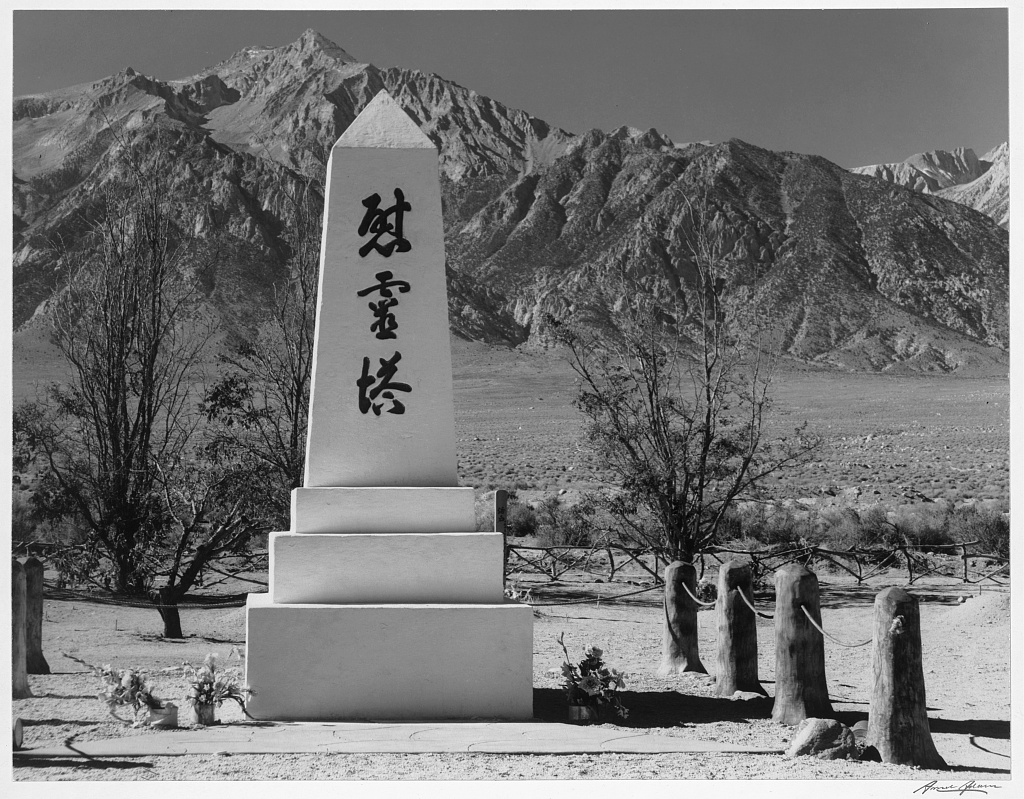
The cover image shows the cemetery monument at Manzanar in 1943, photographed by Ansel Adams while the camp was still in operation.[6] It is the right image for this article because the obelisk later became more than one wartime object among many. After the barracks were dismantled and the camp shut down, the cemetery became the place where absence could still gather into form.[2][4][6]
Timeline anchors: the site stayed alive because return became structure
- February 19, 1942: Franklin D. Roosevelt signed Executive Order 9066, creating the legal frame for exclusion from the West Coast.[1][3]
- March 21, 1942: the first group of Japanese Americans arrived at Manzanar; over time 11,070 people were incarcerated there between March 21, 1942 and November 21, 1945.[2]
- November 21, 1945: Manzanar closed; much of the camp was sold off or buried, leaving a damaged and thinned landscape rather than an intact museum piece.[2]
- Memorial Day 1946: Buddhist minister Sentoku Mayeda and Christian minister Shoichi Wakahiro returned to the cemetery monument and began the postwar pilgrimage tradition.[4]
- December 1969: about 150 people joined the first organized Manzanar Pilgrimage, turning private return into a public annual event.[4]
- January 1972 to March 3, 1992: the site moved through a preservation chain: California Registered Historical Landmark, National Register of Historic Places, National Historic Landmark, and finally Manzanar National Historic Site established by Congress.[5]
This sequence matters because it shows that Manzanar did not survive in public memory through passive reverence. The site had to be revisited, argued over, and legally fixed in place across several different decades.
First layer: after 1945, the camp thinned out faster than the memory problem did
The wartime story is clear enough in the official record. Executive Order 9066 authorized military exclusion, and in practice the order was applied to people of Japanese ancestry on the West Coast on a mass basis rather than as individualized suspicion.[1][3] The National Archives explains that fear after December 7, 1941 quickly became incarceration policy in February 1942.[1] The National Park Service adds the local scale: Manzanar was the first camp the government built, more than 10,000 people lived there behind barbed wire and under guard, and the site compressed families into barracks, communal mess halls, and almost no privacy.[2][3]
But the memory history starts where the wartime camp ends. When Manzanar closed in November 1945, the physical fabric that might have made later remembrance easy did not remain whole.[2] Barracks and equipment were sold as surplus. Many gardens, basements, and concrete features were buried.[2] In other words, the place that future generations needed in order to understand incarceration was being physically thinned out at the moment it ceased operating.
That loss is crucial to the article's argument. Manzanar did not become a major memory site because the camp conveniently stayed intact. It became a memory site because one part of the landscape, especially the cemetery monument, could still anchor return after the rest of the grid had been reduced.[2][4][6]
Second layer: the cemetery turned grief into a repeatable route back
The National Park Service's cemetery interpretation is unusually direct about this. Sentoku Mayeda and Shoichi Wakahiro came back on Memorial Day 1946, and for the next three decades they made pilgrimages to honor the dead.[4] That detail matters because it shifts Manzanar out of a purely federal story and into a ritual one. The site did not wait for Washington to decide what it meant. Former incarcerees and community leaders began marking it themselves.
The cemetery was the right place for that work. A cemetery can hold grief, prayer, accusation, and return without requiring that the entire camp remain architecturally complete. At Manzanar, the white obelisk offered a fixed visual point in a landscape whose other coordinates had been eroded.[4][6] It gathered memory without resolving it. People could come there to mourn the dead, to remember confinement, or to protest the state that had created the camp in the first place.[4]
That is why the article's image matters. Adams's 1943 photograph shows the monument before it became the center of later pilgrimage culture.[6] Read backward from the postwar record, the picture captures the object that would eventually carry more memory weight than many of the camp's larger surviving traces.
Third layer: the pilgrimage converted silence into public civil-rights language
The cemetery page also identifies the next turn. In the 1960s, amid wider civil-rights struggles, younger Japanese Americans began to challenge the silence and shame that had surrounded the camps.[4] On a cold day in December 1969, roughly 150 people made the first organized pilgrimage to Manzanar, and the event has continued annually since then.[4]
This was a structural change, not just a larger reunion. A private return can preserve family memory. An organized pilgrimage creates a civic calendar. Once people gathered every year at the cemetery for speeches, memorial service, and ondo dance, Manzanar stopped functioning only as a buried wound and started functioning as a teachable public site.[4] Visitors could now enter the history through repetition. Each annual return reasserted that the camp belonged inside the American civil-rights narrative rather than outside it as an embarrassing wartime exception.
Sue Kunitomi Embrey's role shows how much labor that transition required. The National Park Service describes her as the driving force behind the Manzanar Committee, organizer of the pilgrimage for 37 years, and a central figure in preserving the site so its stories could protect the human and civil rights of future generations.[4] This is the hinge between mourning and commemoration. Memory became durable because organizers built institutions and rituals around it.
Fourth layer: preservation law made remembrance harder to erase
Ritual alone does not secure a place against neglect, redevelopment, or administrative amnesia. Manzanar's next transformation came through designation. The National Park Service statistics page gives the sequence plainly: California Registered Historical Landmark in 1972, National Register of Historic Places in 1976, National Historic Landmark in 1985, and Manzanar National Historic Site established by Congress on March 3, 1992.[5]
That chain matters because it changed the operating conditions of memory. Once Manzanar moved inside landmark and park frameworks, remembrance no longer depended only on community persistence. The site acquired formal protection, interpretation duties, and a federal mandate to preserve and explain what had happened there.[2][5]
The interpretive frame also changed. The National Park Service's "Site of Conscience" page cites the Commission on the Wartime Relocation and Internment of Civilians, which concluded nearly forty years after the war that Executive Order 9066 had not been justified by military necessity and instead reflected race prejudice, war hysteria, and failure of political leadership.[3] That judgment did not create the memory of Manzanar from scratch. It did something different: it gave federal interpretation language closer to what community activists had already been insisting on.
Two ways to read what Manzanar now is
Reading 1: Manzanar is primarily a wartime ruin
Under this reading, the site matters because it preserves evidence of what the federal government did between 1942 and 1945.[1][2][3]
Reading 2: Manzanar is primarily a return-based civic memory system
Under this reading, the site matters because the cemetery monument, the annual pilgrimage, and the designation chain kept the site active after closure, turning a dismantled camp into a recurring lesson about citizenship, rights, and state power.[4][5][6]
The second reading fits the evidence better. The wartime camp explains why the place matters. The postwar ritual and preservation history explain why the place remained publicly legible long enough to teach later generations anything at all.
What would change the assessment?
This interpretation would weaken if stronger evidence showed that the cemetery played only a minor role in postwar return and that annual pilgrimage activity quickly moved away from Manzanar itself. It would also weaken if the designation chain from 1972 to 1992 had no real effect on preservation or interpretation. The official record points the other way. It shows a site repeatedly reactivated through pilgrimage, organizing, preservation status, and federal interpretation.[2][3][4][5]
The larger historical lesson is practical. A place of injustice does not remain visible just because history says it should. It remains visible when people keep giving it a route of return, a calendar, and a legal form. At Manzanar, the cemetery monument did that work first. The pilgrimage and the preservation chain made it last.
Sources
- U.S. National Archives, "Japanese-American Incarceration During World War II" - Executive Order 9066, exclusion context, and primary-source teaching record.
- National Park Service, "Manzanar National Historic Site" - camp population, dates of operation, closure, and postwar loss of structures.
- National Park Service, "Manzanar - A Site of Conscience" - wartime exclusion context and the later CWRIC judgment on race prejudice, war hysteria, and political failure.
- National Park Service, "Legacy of the Manzanar Cemetery" - 1946 returns, the 1969 organized pilgrimage, annual commemoration, and Sue Kunitomi Embrey's role.
- National Park Service, "Park Statistics" - the site's preservation and designation chain from 1972 to 1997.
- Library of Congress, "Monument in cemetery, Manzanar Relocation Center, California" - Ansel Adams photograph used as this article's image.