The first Earth Day is often remembered as a spontaneous awakening, as if environmental concern had been quietly accumulating and then suddenly burst into view on April 22, 1970. That memory misses the real historical accomplishment. The harder question is how a topic that had been scattered across oil spills, dirty air, pesticides, sewage, campus activism, and local nuisance fights became a single national event in less than a year. The strongest answer is organizational. Earth Day worked because Gaylord Nelson and the organizers around him did not try to build one giant centralized spectacle. They built a decentralized teach-in with a common date, a simple name, and a structure loose enough for local groups to fill with their own grievances and tactics.[1][2][3]
That design choice matters because it explains both the scale and the tone of the day. The first Earth Day could look national without forcing everyone into the same script. In one place it looked like a campus teach-in, in another a march, in another a cleanup, a street closure, a rally, or an exhibit. What united those forms was timing and political purpose: show that environmental protection had a mass constituency broad enough to push the issue onto the national agenda.[1][2][3]
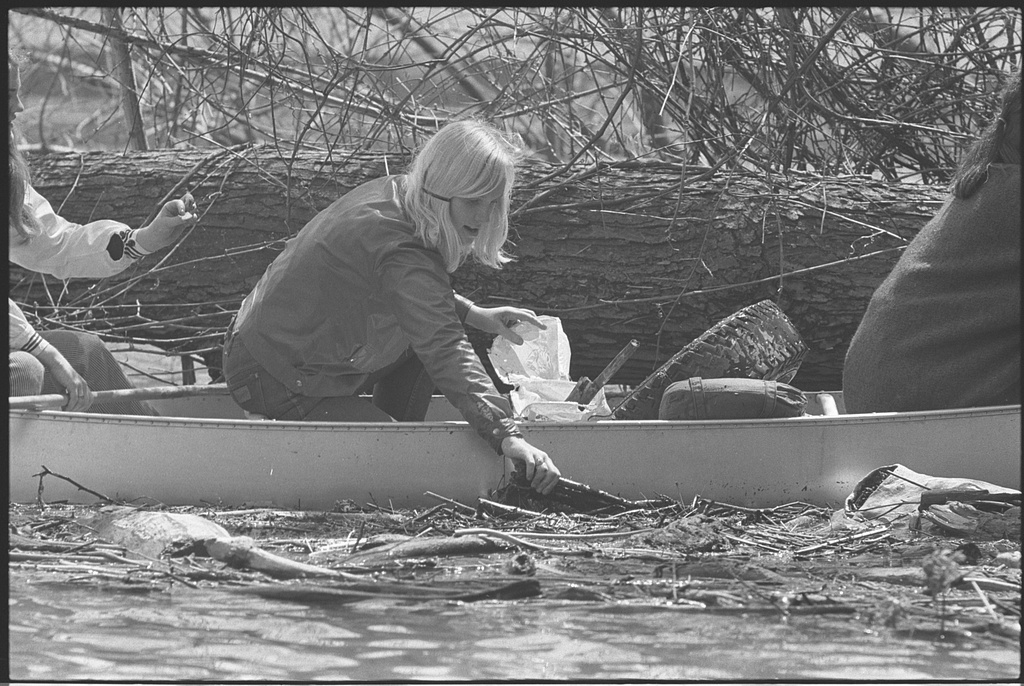
Image context: the cover image is Thomas J. O'Halloran's photograph of a Girl Scout cleaning the Potomac during Earth Week on April 22, 1970. It is a useful historical image because it captures the first Earth Day in its most legible register: not as one podium and one speech, but as a distributed day of civic action that ordinary people could perform, photograph, and recognize immediately.[5][6]
Timeline anchors
- January 1969: the Santa Barbara oil spill becomes one of the shocks that helps convince Senator Gaylord Nelson that environmental deterioration can be made into a national political issue.[1]
- September 1969: Nelson announces the idea of a nationwide environmental teach-in and explicitly borrows energy from the student anti-war movement.[1]
- Late 1969 to early 1970: Denis Hayes is recruited to organize the effort, April 22 is selected because it falls between spring break and final exams, and a national staff of 85 begins promoting local participation.[1]
- April 22, 1970: first Earth Day events draw about 20 million people nationwide across campuses, schools, parks, streets, and community sites.[1][3][5]
- December 1970: Congress authorizes the creation of the Environmental Protection Agency, one of the clearest federal consequences claimed by the movement's first year.[2]
Those dates show why the first Earth Day deserves reconstruction as an event, not just celebration as a symbol. Its success depended on compression: a short runway, a broad frame, and a form of coordination that could travel fast.
Before Earth Day had a crowd, it had a format
Nelson's original contribution was not merely concern about pollution. Many Americans already worried about smoke, pesticides, oil spills, and poisoned water. His move was to give those concerns a portable political form. Earthday.org's institutional history and EPA's historical pages agree on the sequence: after January 1969 and the Santa Barbara spill, Nelson moved to connect environmental concern with the teach-in energy that anti-war students had already made familiar.[1][2] That matters because a teach-in was scalable in a way a single Washington demonstration was not. It could happen on campus lawns, in churches, in city squares, in union halls, and in school auditoriums all on the same day.
This was a strategic choice about coalition-building. Environmental issues in the late 1960s still lived in separate boxes. Air pollution did not automatically bring in people fighting highway construction; wildlife advocates did not automatically share an organizational lane with urban residents angry about dirty streets or contaminated food. Earth Day's teach-in format let those groups keep their own language while joining a shared national date.[1] In historical terms, the novelty was less "people cared about the environment" than "people were given a common frame under which many different complaints could appear together."
Gaylord Nelson later described his aim with unusual clarity: show the political leadership of the country that environmental concern ran broad and deep.[3] That retrospective matters because it clarifies the event's true audience. Earth Day was addressed not only to participants, but to elected officials, editors, and bureaucrats who needed visible proof that environmentalism was no longer a boutique cause.
April 22 was a scheduling solution before it was a ritual date
The most revealing decision may have been the date. Earthday.org's history notes that Hayes and Nelson chose Wednesday, April 22, 1970, because it sat between spring break and final exams, maximizing student participation.[1] That sounds like a logistical footnote. It was actually the hinge between idea and scale.
If Earth Day had been placed in summer, campuses would have emptied out. If it had fallen during exams, the teach-in logic would have collapsed. By choosing a weekday in the academic term, the organizers ensured that universities and schools could function as ready-made assembly systems. Nelson's own 1980 EPA essay later counted roughly 2,000 colleges and universities, 10,000 high schools and grade schools, and several thousand communities in the first Earth Day orbit.[3] Those numbers make sense only if the date was chosen with the academic calendar in mind.
This is where the event starts to look less like a sentimental anniversary and more like a piece of tactical scheduling. The organizers did not wait for a naturally sacred date. They manufactured one by placing environmental politics inside an existing social rhythm that already moved students, teachers, local press, and civic institutions onto common timetables.[1][3][5]
Central message, local execution
The first Earth Day became national because it combined message discipline with local autonomy. Earthday.org's history emphasizes that Hayes built a national staff of 85, but the same source makes clear that the effort broadened precisely because it invited many kinds of organizations to adapt the day for their own constituencies.[1] That division of labor mattered. A small national team could define the frame, push the date, and attract media attention; local groups could do the labor-intensive work of turning the day into something concrete where they lived.
National Geographic's Earth Day overview captures the result at the national scale: inaugural events appeared at tens of thousands of sites, including schools, universities, and community venues, with an estimated 20 million participants overall.[5] That number is so large that it can flatten the story unless one pauses over the mechanism. Twenty million people did not gather in one place. They gathered in many places under one name.
That is why the Potomac cleanup photograph used here is more than decorative.[6] It documents the event's real grammar. The first Earth Day could be a cleanup, a classroom, a rally, a leaflet table, or a march. The point was not uniformity. The point was visibility plus simultaneity. Once those local forms happened on the same day, the press and political class could read them as a national verdict rather than as isolated grievances.[1][5][6]
New York shows how the day translated into city politics
The New York Public Library's account of the Environmental Action Coalition is especially valuable because it shows the first Earth Day at street level rather than only in national retrospect.[4] In New York City, Fifth Avenue and Union Square became primary stages. The mayor's office closed Fifth Avenue from 59th Street to 14th Street from 12 p.m. to 2 p.m., and 14th Street from 7th Avenue to 2nd Avenue from 12 p.m. to 12 a.m. Union Square hosted nearly 100 educational booths, while observers reported that carbon monoxide levels there dropped from 13 parts per million to 2 during the street closure.[4]
Those details matter because they show Earth Day as an event that could translate environmental argument into something people could physically experience. A closed avenue, a cleaner pocket of air, a square filled with issue booths, public speakers, and visible crowds all made pollution feel less like an abstract scientific warning and more like a condition embedded in everyday urban life.[4] That is exactly what a successful teach-in was supposed to do: convert a distant subject into a felt public fact.
New York also shows the political balancing act inside the day. NYPL's archival account describes a movement pulled between moderate civic pedagogy and more radical activist energies.[4] That tension did not weaken the event; it was part of what made the day broad enough to matter. Nelson wanted something nonpartisan and respectable enough to attract wide participation. Many younger organizers wanted something sharper and more political. Earth Day held because it allowed both impulses to coexist inside a shared calendar.
Why Washington had to pay attention
The first Earth Day was not important simply because it was large. It mattered because its scale was legible to institutions that count. The NYPL account notes that Congress recessed for the day so members could appear in local events with constituents.[4] Nelson's later EPA essay frames the same point from the other side: the event demonstrated that environmental politics had enough public support, energy, and commitment to force national leaders to reckon with it.[3]
That combination of local participation and national legibility is what turned Earth Day from pageant into leverage. The event did not need every rally to be radical or every speech to be profound. It needed enough distributed activity, on one day, to make political indifference look riskier than response. EPA's own historical summary draws the institutional line forward to December 1970, when Congress authorized the Environmental Protection Agency.[2] No single one-day demonstration can explain all later federal action. The legislation and administrative changes had their own histories. But the evidence supports a narrower and stronger claim: Earth Day compressed public attention so effectively that environmental protection could no longer be treated as marginal.[2][3]
What the first Earth Day actually was
The cleanest way to understand April 22, 1970 is to treat it as a successful act of national synchronization. It was not one march, one campus, or one ideology. It was a deliberately decentralized teach-in whose organizers solved three problems at once: they found a date that could mobilize students, invented a name simple enough for national media, and let local groups fill the day with actions suited to their own terrain.[1][3][4][5]
That is why the first Earth Day still matters historically. It showed that environmental politics could become mass politics without waiting for one party, one profession, or one city to carry the whole burden. The day created a common clock. Once that clock started, polluted rivers, dirty air, littered streets, pesticides, and urban nuisance complaints could appear not as separate annoyances, but as pieces of one national argument. Earth Day did not discover environmental crisis. It discovered a way to stage public consensus around it.
Sources
- EARTHDAY.ORG, "The History of Earth Day" - origins after the 1969 Santa Barbara spill, the April 22 date choice, the 85-person staff, and the broad coalition logic of the first Earth Day.
- U.S. Environmental Protection Agency, "EPA History: Earth Day" - the first Earth Day as a national agenda-setting event and the December 1970 creation of EPA.
- Gaylord Nelson, "Earth Day '70: What It Meant" (EPA archive, April 1980) - Nelson's retrospective on the political aim of Earth Day and the scale of participation across colleges, schools, and communities.
- New York Public Library, "Informed Archives: The Environmental Action Coalition and the Birth of Earth Day" - local logistics in New York City, street closures, Union Square programming, and Congress recessing for the day.
- National Geographic Education, "Earth Day" - overview of the first Earth Day's nationwide reach across schools, campuses, and community sites.
- Library of Congress Prints and Photographs Division, "Girl Scout in canoe, picking trash out of the Potomac River during Earth Week" (Thomas J. O'Halloran, April 22, 1970) - archival photograph used as the article image.