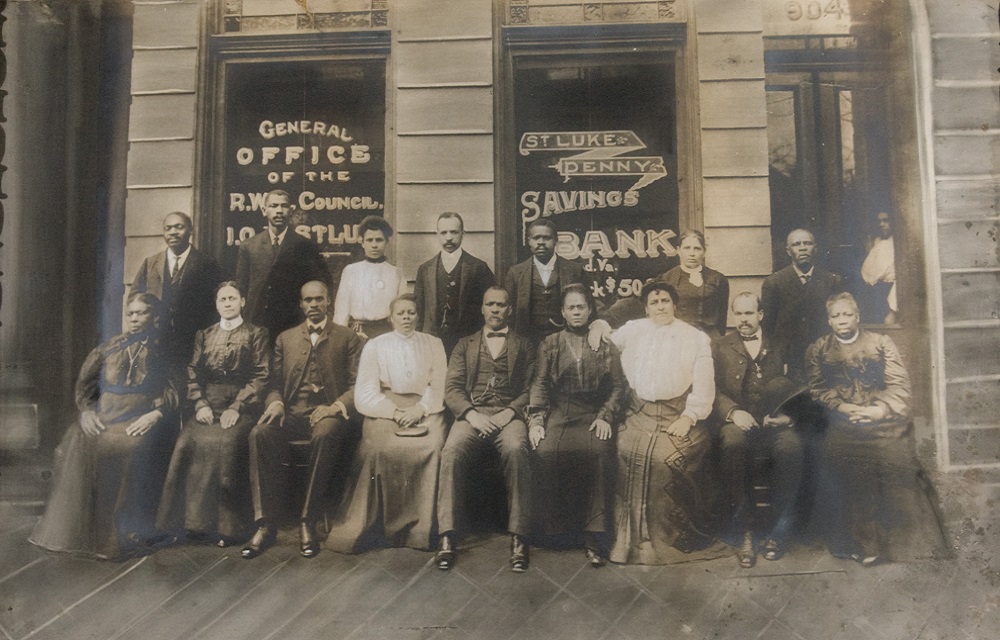
Most short summaries of Maggie Lena Walker stop at one superlative: she was the first Black woman in the United States to charter and lead a bank.[1][4][6] The fact is true, but it flattens the harder historical achievement. The sharper question is how, in segregated Richmond, Walker built a bank that could gather working-class deposits, make very small loans, outlast the failure of peer institutions, and still be strong enough to merge forward during the early Depression.[1][2][4][5][6]
The answer sits in sequence. Between 1899 and 1931, Walker did not treat banking as a one-building miracle. She rescued the Independent Order of St. Luke, used that fraternal order as a trust network, added a newspaper to keep the network in constant conversation, staffed the enterprise with Black women, and taught members to see even pennies as the beginning of usable capital.[1][2][3][4][5][6] The bank was one part of a larger machine for converting mutual aid into credit.
That sequence matters because it changes how Walker should be read. Her real innovation was not simply legal firstness. It was organizational design. She built an institution that could make Black savings legible to banking law without severing those savings from community discipline, local knowledge, and the everyday habits of people living under Jim Crow.[2][3][4][5]
Timeline anchors
- 1899: Walker becomes Right Worthy Grand Secretary of the Independent Order of St. Luke, taking over an organization in financial distress.[1][4][6]
- August 20, 1901: at the Order's annual convention, she announces a program built around a newspaper, a bank, and an emporium.[2][6]
- 1902: The St. Luke Herald begins publication, giving the Order a house organ for recruitment, instruction, and promotion.[1][4][6]
- November 2, 1903: the St. Luke Penny Savings Bank opens with 280 deposits, more than $8,000 on day one, and accounts ranging from 31 cents upward.[2]
- 1910-1911: the bank passes new state examination requirements and opens a new building at First and Marshall while peer Black banks falter.[2][4]
- 1929-1931: Walker engineers the mergers that create Consolidated Bank and Trust, protecting depositors in a harsher banking climate.[2][4]
1. The order gave Walker a financial public before she had a bank
Walker did not begin with a vault. She began with an organization that already knew how to collect dues, bury the dead, care for the sick, and hold people to obligations. The Independent Order of St. Luke was a Black fraternal order, and in the late nineteenth century that mattered for more than ceremony.[3] Segregation pushed Black communities to construct their own institutions of welfare, insurance, fellowship, and economic self-help. The Order was one of the places where that work became durable form.[1][3]
Walker joined St. Luke as a teenager and moved more deeply into it after her teaching career ended upon her 1886 marriage, the point at which married women were forced out of classroom work.[1][4] By then she had already acquired useful skills beyond moral commitment: classroom management, sales work, and enough accounting fluency to think institutionally rather than rhetorically.[4] That background helps explain why her later banking project never floated free from administration. She understood membership lists, collections, communications, and routine.
When Walker took the Order's top office in 1899, the organization was in bad shape. The Richmond Fed article describes a body with only 1,080 members in 57 councils, $31.61 in its treasury, and $400 in debt.[4] NPS summarizes the turnaround more broadly: under her leadership, membership expanded across the country and the Order's finances achieved solvency.[1] Those two facts belong together. Before Walker could ask people to trust a bank, she had to prove that a Black-led institution could survive bookkeeping, scale, and scrutiny.
This is the first reason the later bank opened with unusual strength. Walker already had a trained public. The members of St. Luke were not anonymous strangers encountering finance for the first time. They were people accustomed to dues, officers, conventions, discipline, and reciprocal obligation. The fraternal order functioned as a social technology for trust long before a chartered bank existed.[1][3][4]
2. The 1901 speech proposed a loop, not a single bank
Walker's famous August 20, 1901 appeal for "a bank that will take the nickels and turn them into dollars" is easy to read as a slogan about thrift.[2][4][6] Read in context, it was a systems plan. At the same convention, she also called for a newspaper, an emporium, and other enterprises.[2][4][6] The bank sat inside a loop of communication, retail, employment, and fraternal legitimacy.
That design was historically specific to Black Richmond. NPS notes that Walker saw banks as symbols of high achievement, but also as instruments against the humiliations built into white-controlled economic life.[2] Black customers were often denied fair treatment in white businesses; Black workers were restricted in employment; Black entrepreneurs encountered discriminatory credit conditions. A stand-alone bank could help with one part of that problem. A bank joined to a newspaper and a membership order could do much more. It could recruit, persuade, educate, and hold attention between transactions.[2][3]
The launch of The St. Luke Herald in 1902 shows how deliberate this was.[1][4][6] The newspaper promoted the Order and helped make the bank intelligible before the bank opened.[4] Walker was not waiting for depositors to materialize from an abstract public. She was building the public in advance, with repeated messaging inside an institution her members already recognized as theirs.[1][4][5]
The same logic shaped labor. Smithsonian's account stresses that Walker's enterprises created higher-status Black employment in stenography, accounting, journalism, and secretarial work, especially for women.[5] Richmond Fed makes the point even more sharply: Walker believed the expansion of women's economic roles was essential to Black advancement, and she deliberately drew women around her in the construction of the institution.[4] That choice was not ornamental. A bank built from small deposits required meticulous clerical order. Walker solved part of that problem by building a disciplined female white-collar workforce where the segregated economy offered few such openings.[4][5]
3. Small deposits became real credit because St. Luke knew its borrowers
Opening day in 1903 is often cited because the numbers are vivid. They are vivid for a reason. On November 2, the St. Luke Penny Savings Bank opened at 900 St. James Street and ended the day with 280 deposits totaling more than $8,000, while one customer opened an account with just 31 cents.[2] Those figures are not charming trivia. They show that Walker's base had already been organized well enough to turn symbolic enthusiasm into measurable liquidity.
The term "penny savings bank" was not branding fluff. It named Walker's theory of who finance should be built for. She distributed children's penny banks and taught families that 100 pennies could become the $1 needed to open an account.[2][4] The Smithsonian article captures the larger principle: combined nickels and pennies from ordinary Black workers accumulated into substantial capital, reaching about half a million dollars by the mid-1920s.[5] Walker was teaching scale through repetition. The smallness of any one deposit mattered less than the regularity and social reach of the depositing public.
Richmond Fed's reconstruction is especially useful here because it shows that Walker did not stop at deposit collection. She made the bank lend in ways that matched her depositors' circumstances.[4] Loans could be as small as $5. Home loans could begin with down payments as low as 10 percent, far below the era's more punitive norms, and the bank often allowed refinancing rather than forcing ruinous balloon-style repayments after a few years.[4] By the early 1920s, at least 600 community members had paid off their home mortgages in full through the bank.[4]
This was not generosity in the loose sense. It was underwriting with local knowledge. The bank used ad hoc credit committees from the community, required co-signers or guarantors, and pursued collections aggressively when loans went delinquent.[4] That combination of social trust and formal discipline is the key to Walker's success. She did not romanticize neighborhood solidarity as a substitute for banking standards. She turned neighborhood knowledge into banking standards.
Seen from that angle, the St. Luke bank was a translation device. It converted reputational knowledge, fraternal membership, savings habits, and women's clerical labor into something examiners, borrowers, and depositors could all recognize as a bank. That is a much more demanding achievement than simply opening a Black-owned institution in 1903.[2][4][5]
4. Walker's real test was survival, then merger
Walker's historical weight also depends on what happened after the first burst of success. In 1904, the Order bought a Broad Street building to house both the bank and the St. Luke Emporium, and the bank moved there in 1905.[2] The emporium never matched the bank's durability, but the paired move still reveals Walker's intent. She wanted a Black institutional space in which customers could shop, deposit, withdraw, invest, and circulate money under one roof.[2][4]
The state-level challenge arrived soon after. In 1910, Virginia imposed annual examinations on state banks.[2] The St. Luke Penny Savings Bank passed. Other Black banks did not. NPS points to the closure of the True Reformers Bank after weak operations and embezzlement, while Richmond Fed notes that both the True Reformers Bank and later the Mechanics Savings Bank were forced out of business.[2][4] This is where Walker's strictness starts to look less like personality and more like strategy. A bank built for small depositors could not afford loose records, vague collections, or sentimental lending.
The numbers underline the point. Richmond Fed reports asset growth from $37,870 in 1904 to $120,813 in 1910, then to $529,883 in 1920.[4] Those figures do not mark a fantasy of unlimited ascent. They mark institutional competence across a period in which segregated Black banks faced political exclusion, thin customer margins, and fragile confidence.[4][5]
Walker's last major financial move was also her most revealing. She saw trouble coming before the crash fully hardened the banking landscape. In 1929, she began merger talks with the other Black-owned banks in Richmond; Consolidated Bank and Trust opened on January 2, 1930; and another bank joined in 1931.[2][4] The historical value of that sequence is easy to miss if one expects heroic autonomy as the only noble ending. Walker's genius included knowing when independence had to be preserved through combination. She protected depositors by merging forward.
That is why her biography should be read through infrastructure rather than through inspiration alone. Walker made a fraternal order bankable. She moved from dues books to newspapers, from children's penny banks to mortgages, from female clerical labor to audited balance sheets, and from local optimism to Depression-era consolidation.[1][2][3][4][5][6] The result was a Black financial institution strong enough to outlive its founder and, in altered form, much of the world that had first made it necessary.
Sources
- Maggie L Walker National Historic Site, "Maggie Lena Walker" - on Walker's 1899 leadership of the Independent Order of St. Luke, the launch of The St. Luke Herald, the bank's founding significance, and her 1934 death.
- Maggie L Walker National Historic Site, "The St. Luke Penny Savings Bank" - on the August 20, 1901 convention speech, the November 2, 1903 opening-day deposits, the children's penny-bank campaign, the 1905 move, the 1910-1911 banking tests, and the 1929-1931 merger sequence.
- National Park Service, "Independent Order of St. Luke" - on the fraternal order as the institutional body through which Walker's Black economic self-help program operated.
- John Mullin, "Maggie Lena Walker." Econ Focus, Federal Reserve Bank of Richmond (Fourth Quarter 2022) - on the Order's 1899 finances, Walker's 1901 program, lending practices, mortgage terms, asset growth, and the logic of the later merger.
- Crystal Moten, "Pennies and nickels add up to success: Maggie Lena Walker." National Museum of American History (February 27, 2020) - on membership growth, Black women's clerical labor, the accumulation of small deposits, and the 1931 consolidation.
- Encyclopedia Virginia, "Maggie Lena Walker (1864-1934)" - on the dated timeline of Walker's 1899 election, the August 20, 1901 speech, the July 28, 1903 charter, and later milestones in Richmond.