The Boston Tea Party is often reduced to a patriotic shorthand: colonists hated taxes, a shipment of tea arrived, and angry men dumped it into the harbor.[1][3] The shorthand keeps the energy of the event, but it distorts the argument that made the destruction of the tea thinkable in the first place. The Tea Act of May 10, 1773 did not create a new tea tax. It made East India Company tea cheaper in legal terms while preserving the old Townshend duty and giving the company a privileged route into colonial markets.[1][3][4] What Bostonians resisted in December 1773 was therefore not price alone. They were resisting a package: cheaper tea, imperial favoritism, and a constitutional principle that still said Parliament could tax them without their consent.[3][4][5]
That distinction matters because it changes what sort of event the Tea Party was. If the story is only about consumers lashing out at an expensive everyday good, the destruction looks impulsive or theatrical. If the story is about whether colonists could accept a lower price that quietly ratified Parliament's taxing claim and the East India Company's privileged access, the event becomes a sovereignty fight conducted through merchandise.[1][4][5][6] The tea was cargo, but it was also a test case.
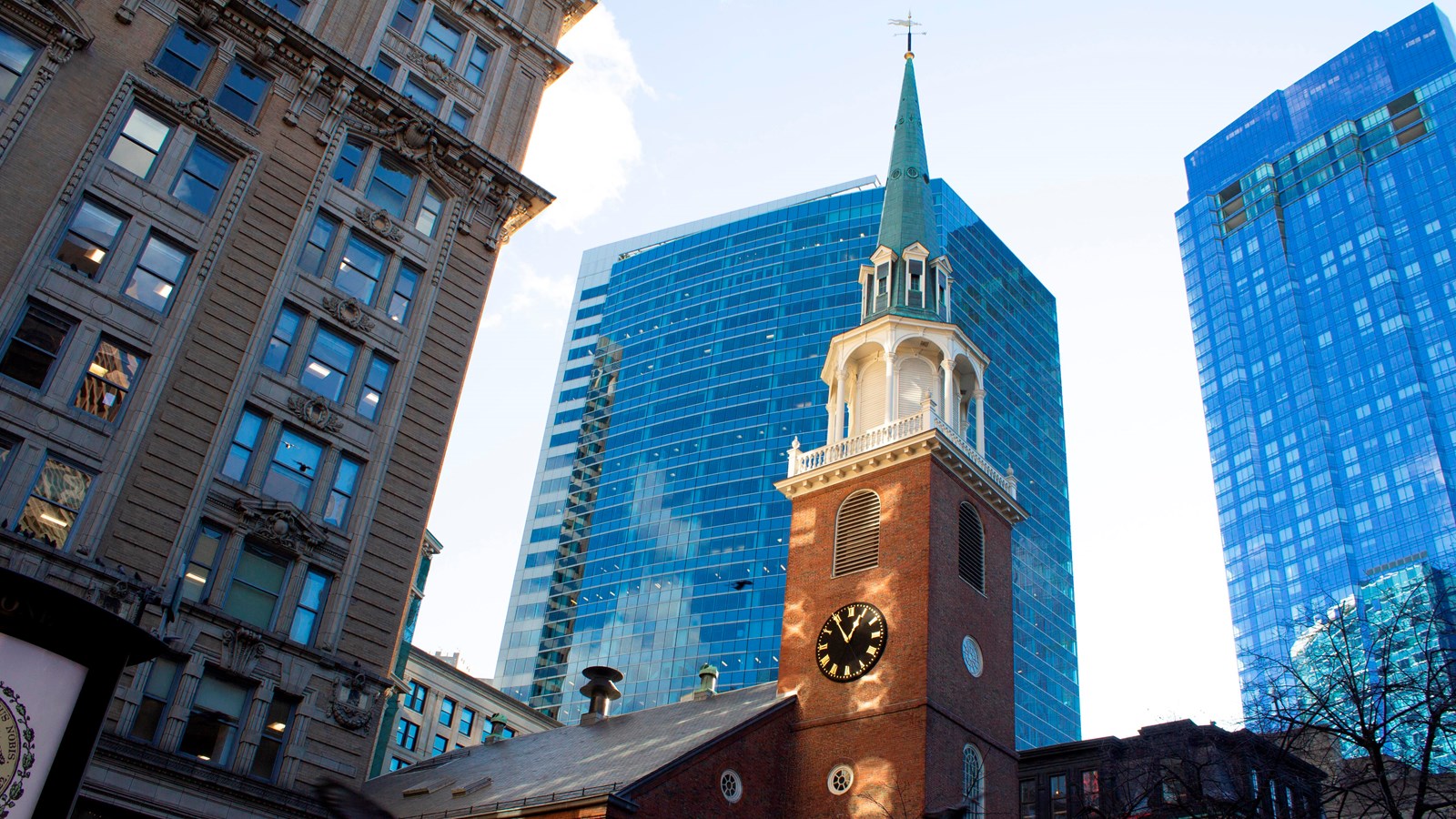
Image context: the cover uses a real National Park Service photograph of Old South Meeting House rather than a later patriotic painting of men in disguise on the ships. That choice fits the article because the decisive hinge came in Boston's meeting culture: thousands gathering, voting, hearing that the tea would not be sent back, and then accepting direct action as the remaining instrument.[2][4]
Timeline anchors
- April 1770: Parliament repeals most Townshend duties but leaves the duty on tea in place.[4]
- May 10, 1773: Parliament passes the Tea Act to aid the East India Company and reshape colonial tea sales.[4]
- November 28, 1773: the Dartmouth arrives in Boston Harbor carrying 114 chests of tea; mass meetings begin the next day.[4]
- December 10 to 16, 1773: the Eleanor and Beaver join the standoff while Governor Thomas Hutchinson refuses to let the tea ships leave without unloading.[3][4][5]
- December 16, 1773: the final overflow meeting at Old South Meeting House is followed by the destruction of 342 chests of tea in Boston Harbor.[1][2][3]
- Spring 1774: Parliament punishes Boston through the Coercive or Intolerable Acts, helping turn a port dispute into an intercolonial political crisis.[1][4]
Myth 1: the Tea Party happened because tea was too expensive
The most common simplification turns the Tea Party into a price revolt. The evidence points somewhere sharper. The National Archives summary is explicit that the Tea Act imposed no new tax on tea; the National Park Service timeline likewise notes that Parliament used the act to make East India Company tea cheaper than smuggled Dutch tea while still helping the government collect the existing tax.[1][3] In narrow consumer terms, legal tea was supposed to become easier to buy.
That is precisely why the act was dangerous to its opponents. A cheaper price could tempt consumers back into the imperial market while leaving the constitutional principle intact. The Massachusetts Historical Society's summary explains that Parliament hoped lower-cost company tea would undercut smugglers and revive consumption.[4] If colonists resumed buying that tea, they would not merely be purchasing a beverage. They would be participating in a system that treated Parliament's tea duty as normal, collectible, and survivable.[3][4][5]
In other words, the issue was not that the colonists failed to notice a bargain. The issue was that the bargain came tied to a political claim. A lower shelf price could function as a constitutional trap.
What contemporaries said the problem was
The cleanest evidence comes from the crisis itself. Writing to Benjamin Franklin on December 10, 1773, Thomas Cushing described the Tea Act as a measure that confirmed the tax, introduced monopoly, and threatened the colonists' claim to tax themselves.[5] That triad matters. Cushing did not separate economics from constitutional power. He treated them as one problem because that is how the act arrived in practice: the East India Company received privileged access, the existing tea duty remained, and acceptance of the cargo would imply submission to Parliament's authority in a domain the colonists believed should require their own consent.[5]
This is where later memory often drifts. Modern retellings sometimes choose between two stories, one economic and one ideological, as though the participants had to pick only one language. The surviving record suggests the opposite. Economic privilege and political subordination reinforced each other. The monopoly feature made the tax harder to dismiss as trivial, and the tax feature made the monopoly harder to accept as ordinary commerce.[3][4][5][6]
That is also why the phrase "taxation without representation" remains relevant but incomplete. It captures the constitutional grievance, yet by itself it can make the event sound abstract. The Tea Act worked through distribution channels, consignees, cargo deadlines, and the rescue of a struggling corporation.[3][4] The slogan becomes more historically accurate once it is placed back inside those market arrangements.
Why Boston went further than other ports
The Tea Party also becomes clearer when Boston is placed inside the wider colonial pattern. Boston was not alone in resisting the tea. The National Archives notes that ports along the eastern seaboard blocked East India Company tea from landing, and the National Park Service timeline records that in New York and Philadelphia the tea ships were turned away, while in Charleston the tea was left to rot on the wharf.[1][3] Boston, then, was part of a shared resistance rather than an isolated fit.
What made Boston different was the institutional deadlock. The Massachusetts Historical Society traces a precise sequence: the Dartmouth arrived on November 28; mass meetings expanded from Faneuil Hall to Old South Meeting House; a rotating watch guarded Griffin's Wharf; and the clock ticked toward the customs deadline after which the cargo could be seized if the duty remained unpaid.[4] At the same time, Hutchinson and the tea consignees refused to send the tea back to England.[4][5] The city therefore reached a position in which public meetings had mobilized thousands, alternative ports had already shown that resistance was possible, yet local authority would not permit the clean exit that might have defused the confrontation.[3][4]
That sequence helps explain why the final act was destruction of tea rather than a generalized riot. The crisis had narrowed to one material question: would the cargo be landed under imperial terms or prevented from entering local commerce at all. Once the governor refused clearance and the deadline closed in, the tea itself became the object through which the political argument had to be answered.[4][5]
What the destruction actually accomplished
The destruction of 342 chests on the night of December 16, 1773 mattered because it refused a very specific settlement.[1][3] It refused the idea that colonists should accept imperial governance so long as the commodity was cheap enough. It also refused the idea that the East India Company could solve its own crisis by using the colonies as a protected market.[3][4][6]
This helps explain why Parliament's reaction was so severe. The Massachusetts Historical Society notes that Boston was singled out in the aftermath through the Coercive Acts, including the closing of the port and a heavier military presence.[4] The punishment was not simply repayment for ruined property. It was an imperial answer to a direct challenge over who had the authority to organize trade, collect duties, and discipline resistance.[1][4]
The Tea Party therefore belongs in myth-vs-evidence history because the popular myth makes the event smaller than it was. The evidence does not show a crowd irrationally rejecting cheaper tea. It shows colonists recognizing that cheap tea could be the delivery system for a larger defeat. Price, monopoly, taxation, and consent arrived together. Once they arrived together, the tea itself became the easiest thing to throw overboard and the hardest thing to accept.
Sources
- National Archives Museum, "250th Anniversary of the Boston Tea Party" - no-new-tax framing, East India Company monopoly, 342 chests, disguise rationale, and Parliament's punishment.
- National Park Service, "Old South Meeting House" - official site page identifying the building as the overflow meeting place where the Boston Tea Party began; also the source page for the lead photograph.
- National Park Service, "Boston Tea Party Timeline" - Tea Act market effects, East India Company bailout and monopoly framing, and the contrasting outcomes in Boston, New York, Philadelphia, and Charleston.
- Massachusetts Historical Society, "Explore MHS Collections Relating to the Boston Tea Party" - timeline of arrivals, town meetings, Tea Act background, and the sequence from Old South to the harbor.
- Founders Online, "Thomas Cushing to Benjamin Franklin, 10 December 1773" - contemporaneous statement linking monopoly, the tea duty, and the colonists' claim to tax themselves.
- Benjamin L. Carp, Defiance of the Patriots: The Boston Tea Party and the Making of America. Yale University Press - publisher page for a major scholarly synthesis of the Tea Party's wider political and commercial setting.