Executive Order 9066 is often remembered as though it already contained the entire incarceration system inside its own language.[1][2] That memory is understandable because the order became the legal hinge for one of the most sweeping deprivations of liberty in modern U.S. history. But a close reading starts with a harder question: what did the document itself actually authorize on February 19, 1942, and what had to be added afterward to turn that authorization into mass removal?[1][2][3]
The answer is that the order mattered through delegation. It did not name Japanese Americans. It did not list camps. It did not openly announce a West Coast roundup. What it did was authorize the Secretary of War and designated commanders to create military areas, exclude people from them, manage the movement and care of the excluded, and call on the rest of the federal state to help.[1][2] In other words, the document wrote a geography first and a population second. That structure is what made it so powerful.
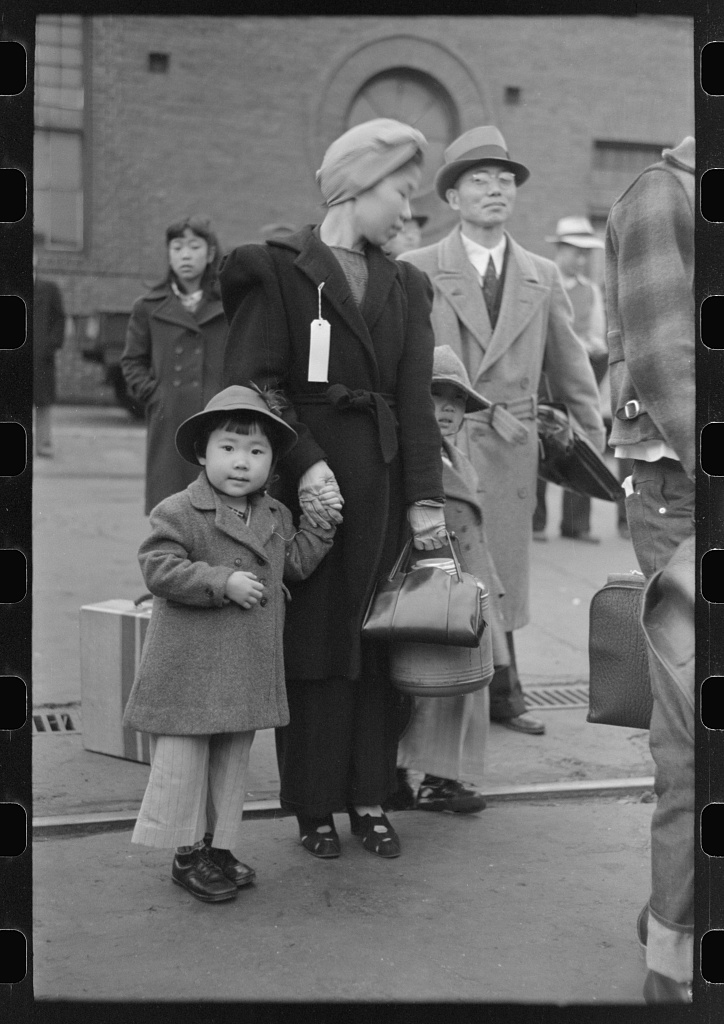
The cover photograph shows a Japanese American family waiting for a train to Owens Valley in April 1942, with luggage in hand and identification tags already attached.[5] It belongs with this article because it captures the order's real historical work. The text itself stays abstract. The image shows what abstraction looked like once military zoning, exclusion notices, and transport arrangements moved from Washington language into local routine.[1][3][5]
Timeline anchors
- 1942-02-19: Franklin D. Roosevelt signs Executive Order 9066, authorizing the Secretary of War and military commanders to prescribe military areas and exclude persons from them.[1]
- 1942-03-02: General John L. DeWitt issues Public Proclamation No. 1, designating Military Areas No. 1 and 2; Japanese Americans would be excluded from the first area.[3]
- 1942-03-21: Congress passes Public Law 503, making violations of military orders under the new regime punishable by fine or imprisonment.[1][2]
- 1942-03-24: Civilian Exclusion Order No. 1 targets Bainbridge Island, beginning the neighborhood-by-neighborhood removal process.[3]
- 1942-03-29: Public Proclamation No. 4 ends so-called voluntary movement and pushes the process toward forced removal on short notice.[1]
- 1942-08-18: after 108 exclusion orders, Japanese Americans had been forcibly removed from the West Coast outside confinement sites.[3]
- 1988: Congress acknowledges that the incarceration was driven by "race prejudice, war hysteria, and a failure of political leadership" rather than valid military necessity.[4]
1. The order named space before it named people
The official transcript is strikingly spare at the point where its power becomes most visible. Roosevelt authorizes the Secretary of War and designated commanders to prescribe military areas "in such places and of such extent" as they determine, "from which any or all persons may be excluded."[1] Read literally, that is a geographic and administrative grant before it is a race-specific command. The order does not yet say who the excluded will be. It says who gets to draw the map, define the zone, and control entry, exit, and presence inside it.[1][2]
That distinction matters because it explains why the order could present itself as neutral while still enabling racially targeted action. Densho's summary puts the point plainly: the order did not mention Japanese Americans by name.[2] The National Archives page says the same thing in institutional language, noting that the text itself did not specify any ethnic group even though DeWitt quickly used it to announce curfews and later removals that applied only to Japanese Americans.[1]
This is the first thing a close reading has to recover. The order's danger did not come from blunt descriptive honesty. It came from open-ended form. A document that directly announced the expulsion of a named racial minority would have displayed its constitutional problem in one sentence. Executive Order 9066 did something more durable. It delegated a security rationale, a territorial mechanism, and discretionary power to commanders who could later decide what population would be made to fit the map.[1][2][3]
2. The logistics clause mattered as much as the exclusion clause
Readers often stop at the phrase "any or all persons," because that is the order's most chilling line.[1] But the next paragraph is just as important historically. The Secretary of War is authorized to provide excluded residents with "transportation, food, shelter, and other accommodations" judged necessary to carry out the order.[1] That sentence turns exclusion into a whole-of-government operation. The state is not merely empowered to bar people from a space. It is empowered to move them, house them, feed them, and maintain the coercive process that follows from exclusion.[1]
This is why the family in the lead photograph matters.[5] The historical system did not begin with barbed wire in a remote camp. It began with tagged luggage, train stations, civil control stations, temporary assembly points, and the routinized handling of civilian movement.[3][5] The order's logistics clause helps explain how a short presidential directive could scale into a mass administrative program so quickly. Once exclusion was paired with transport and provisioning authority, the machinery of removal no longer looked like an improvised police action. It could be run as managed displacement.[1][3]
The enforcement language deepens the point. Roosevelt further authorizes military commanders to take "such other steps" as they deem advisable, including the use of federal troops and federal agencies, while also directing executive departments to furnish medical aid, clothing, land, equipment, facilities, and services.[1] That is a broad implementation bridge. It tells us the order was never just about declaring danger. It was about making the federal government interoperable around the consequences of exclusion.
3. The later orders supplied the racial content and the timetable
If Executive Order 9066 was the enabling shell, later proclamations and exclusion orders filled it in. Densho's account of the exclusion orders is valuable here because it shows the mechanism in sequence.[3] After Public Proclamation No. 1 divided the coast into Military Areas No. 1 and 2 on March 2, 1942, the Western Defense Command shifted from broad territorial designation to neighborhood-scale notices.[3] Civilian Exclusion Order No. 1, issued on March 24 for Bainbridge Island, became the template. Notices were posted publicly. Families were told when to register. They were instructed to bring only what they could carry. Their bags were tagged, and they were transported to assembly centers under criminal penalty if they failed to comply.[3]
That is the crucial documentary chain. The executive order gave the state a discretionary territorial frame. The exclusion orders converted that frame into explicit racial direction by ordering out "all persons of Japanese ancestry, including aliens and non-aliens" from designated zones.[3] The order and the exclusion notices are therefore not interchangeable texts. The first creates the legal-administrative field. The second names the people, the place, and the deadline.
Public Law 503 tightened the system even further. As both the National Archives and Densho note, Congress passed it on March 21, 1942, allowing federal courts to punish violations of military orders flowing from Executive Order 9066.[1][2] A document that began in executive discretion thus gained legislative teeth before the first exclusion order had even finished its week's notice cycle.[1][2][3]
4. Why the "blank check" reading explains more than the "military necessity" reading
There is a narrow reading of Executive Order 9066 that treats it mainly as a wartime security instrument drafted in generic language because war planners wanted flexibility.[1][2] That reading captures one real feature of the document. The order is written in military-administrative prose, not in overtly racial invective. It speaks in the language of sabotage, defense premises, commanders, restricted areas, and enforcement.[1]
But that reading explains too little if taken on its own. It cannot account for why the discretionary powers were then used against Japanese Americans on the West Coast rather than against every ancestry group the war had rendered suspect. The stronger reading is the one preserved in the postwar reckoning quoted by the National Park Service: the incarceration system was driven by "race prejudice, war hysteria, and a failure of political leadership."[4] On that reading, the order's generality was not evidence of fairness. It was the form that allowed racialized policy to travel under the cover of military discretion.
That is why the document still matters as a text. Executive Order 9066 shows how a state can avoid naming its target at the moment it authorizes extraordinary power. It can write authority in general terms, distribute that authority downward, and let later notices, commanders, and routines specify who will bear the burden.[1][2][3] The document's historical force lies in that sequence.
What February 19, 1942 actually changed
Executive Order 9066 did not by itself post the notices, tag the baggage, schedule the trains, or build the camps.[1][3][5] Those steps came through subsequent proclamations, exclusion orders, local registration stations, and a large bureaucratic apparatus. But February 19 changed the constitutional weather. It normalized the idea that a military geography could override ordinary residence, movement, and due process for civilians living within the chosen zones.[1][2]
Read in that light, the order's brevity becomes part of the story. It is short because the document was not trying to narrate the whole program. It was trying to unlock one. Once the War Department and Western Defense Command had the authority to define areas, exclude persons, arrange logistics, demand federal assistance, and enforce compliance, the road from presidential text to railway platform became frighteningly short.[1][3][5]
Sources
- National Archives, "Executive Order 9066: Resulting in Japanese-American Incarceration (1942)" - official transcript and context on the order's language, Public Law 503, the six-month removal sequence, and camp transfer system.
- Densho Encyclopedia, "Executive Order 9066" - summary of the order's delegated authority, the fact that it did not name Japanese Americans, the role of Public Law 503, and the later coram nobis revelations.
- Densho Encyclopedia, "Civilian exclusion orders" - sequence from Public Proclamation No. 1 to the 108 exclusion orders, one-week notices, tagged baggage, assembly centers, and the August 18 completion of removal.
- National Park Service, "Remembering Executive Order 9066" - Presidio enforcement context, the 108 exclusion orders, and the federal government's later acknowledgment of "race prejudice, war hysteria, and a failure of political leadership."
- Library of Congress, Russell Lee photograph, "Los Angeles, California. The evacuation of Japanese-Americans from West Coast areas under U.S. Army war emergency order. Japanese-American family waiting for train to take them to Owens Valley" (April 1942) - cover image source page.