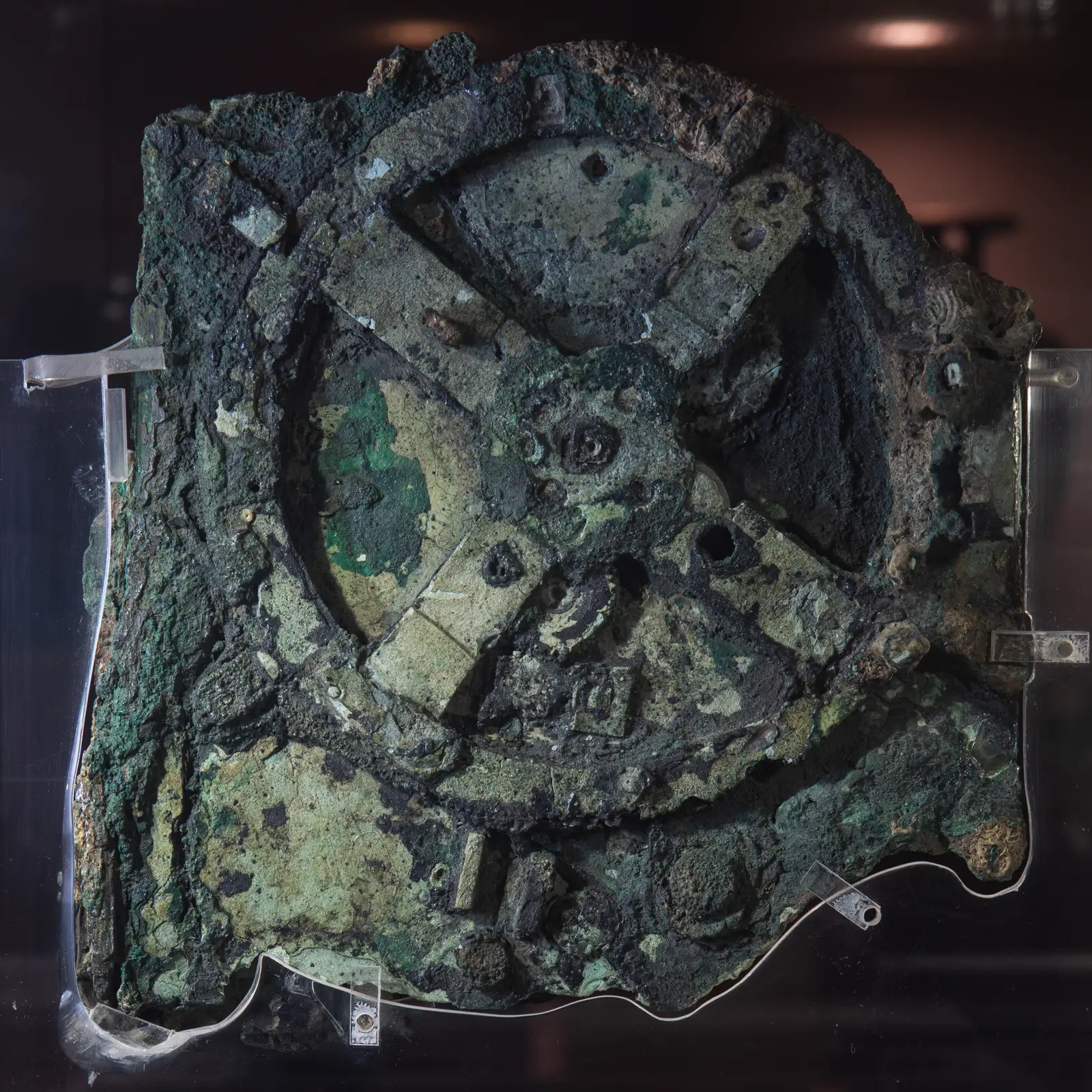
The Antikythera Mechanism is often introduced with a modern shortcut: the first analog computer. The phrase is useful because it warns readers not to underestimate the object. It is also too clean. Fragment A, the largest surviving piece, does not look like a computer. It looks like marine damage interrupted by intelligence: bronze plate, compact gearwork, toothed wheels, broken boundaries, and traces of a vanished case.[2][5]
That physical contradiction is the best starting point. The object was recovered from the Antikythera shipwreck, a major underwater find first explored by Greek sponge divers and the Greek Royal Navy in 1900-1901; objects from the wreck now sit inside the National Archaeological Museum's account of Hellenistic metalwork and Roman-era movement of Greek art and luxury goods.[1] Research dates the mechanism itself to the late second century BC or nearby Hellenistic horizon, while NYU's archival record for early photographs identifies the museum object as Athens National Archaeological Museum X 15087 and places the depicted object between 200 and 50 BC.[2][4]
The historical question, then, is not simply "how advanced was it?" The sharper question is what kind of time this machine tried to make usable. Read through Fragment A and the research record, the answer is layered: civic calendars, lunar phases, eclipse cycles, astronomical theory, and festival timing were not separate abstractions. The mechanism compressed them into a portable, geared interface.[2][3]
Fragment A makes astronomy tactile
Fragment A matters because it preserves much of the mechanism's most visible gear evidence. The 2006 Nature study describes the device as a unique Greek geared construction, damaged and fragmentary, whose surviving material includes bronze gear wheels and astronomical inscriptions.[2] Its authors used surface imaging and high-resolution X-ray tomography to read beyond what the naked eye could settle, reconstructing functions from gears, inscriptions, and hidden structure rather than from a complete machine.[2]
That distinction is important. The Antikythera Mechanism is not a text that happens to have gears attached. It is a material argument in which gear teeth are part of the reading surface. A calendar written in a book can tell the user what day it is. A geared calendar can make cycles turn against one another. It lets a user move time by hand and watch several kinds of regularity stay related: solar year, lunar month, eclipse interval, and festival count.[2][3]
This is why "computer" helps only if it remains physical. The machine did not compute by hiding calculation inside invisible electronics. It computed by making ratios durable. Bronze teeth embodied numerical relationships. A crank or input motion could advance indicators because the mechanism translated astronomical cycles into mechanical proportion.[2] Fragment A is therefore a primary source for a particular historical skill: the ability to turn mathematical astronomy into workmanship.
The calendar was not just sky time
The 2006 research established that the mechanism calculated and displayed celestial information, especially lunar phases and a lunisolar calendar, and that it predicted lunar and solar eclipses using Babylonian cycle arithmetic.[2] That alone would make the object extraordinary. But the later 2008 Nature paper changed the social meaning of the back dials. It identified the upper back dial as a 19-year Metonic calendar arranged in a five-turn spiral, the lower back dial as a 223-lunar-month Saros eclipse-prediction dial, and a subsidiary display tied not to abstract astronomy but to the four-year cycle of the Olympiad and associated Panhellenic games.[3]
That last point changes the reading. The mechanism did not merely tell a learned owner where the Moon stood. It linked celestial order to civic and ritual scheduling. In the 2008 authors' formulation, the mechanism's cycles joined human institutions to gearwork.[3] A city calendar, a festival cycle, and eclipse expectation could all belong to the same box.
The identified Corinthian month names deepen the point.[3] They suggest that the calendar was not a generic Greek calendar stripped of locality. It carried regional language into a technical instrument. In other words, the mechanism was cosmopolitan in knowledge but not placeless in use. A device capable of modeling broad astronomical cycles still needed month names that made sense to a community.
Prediction did not mean certainty without interpretation
The eclipse dial is especially revealing because it shows prediction as a managed approximation rather than magic. The 2008 paper describes the Saros dial as a four-turn spiral with glyphs indicating eclipse predictions, then explains that index letters, glyph distribution, and the Exeligmos correction shaped how eclipse times were handled.[3] The machine did not abolish the interpretive work of astronomy. It organized that work into a repeatable interface.
That is historically important because eclipses carried more than observational interest in the ancient Mediterranean. The 2006 paper notes that eclipses and planetary motions were often interpreted as omens, while astronomical cycles also had philosophical appeal.[2] The Antikythera Mechanism sat at that boundary. It belonged to a world where the heavens could be calculated, watched, feared, celebrated, and folded into public time.
The object therefore resists a simple opposition between science and culture. Its technical achievement is real: compact gears, lunar anomaly modeling, inscriptions, and cycle displays. Its cultural setting is real too: calendars for agriculture and festivals, games, local month names, omen-sensitive eclipses, and elite Hellenistic craftsmanship.[2][3] The machine's force comes from not separating those domains.
Damage is part of the source
The earliest photographic record matters because it reminds us that the modern object has always been mediated by breakage. NYU's record for Ioannis Svoronos's 1902-1903 photographs gives a public-domain source for early images of Fragments A, B, C, and D, tied to publications from 1903 and 1908.[4] Those photographs are not mere illustrations. They belong to the history of decipherment, because the mechanism became knowable through successive acts of looking: cleaning, photographing, X-raying, scanning, modeling, and comparing inscriptions.
This is the historian's caution. The mechanism did not come down as a complete instruction manual. It came down as fragments. The 2006 study emphasizes that controversy persisted because gears and inscriptions were fragmentary.[2] The 2008 study likewise proceeds from partial dials, recovered names, and revised reconstructions.[3] Confidence here is cumulative, not instant. Each claim depends on the fit between bronze remains, inscriptions, imaging, ancient astronomical cycles, and mechanical plausibility.
Fragment A's visual power comes from that condition. The exposed gears are damaged evidence rather than a clean visual shorthand for ancient genius. Their survival asks a harder question than admiration does: how much can a broken object still disclose when the right tools and comparisons are brought to it?
Why this object still unsettles the timeline
The Antikythera Mechanism is not important because it proves that antiquity was secretly modern. That framing makes the past interesting only when it resembles us. Its deeper value is the opposite. It shows a Hellenistic world in which mathematical astronomy, metalworking, inscription, and calendar practice could converge in a form that later evidence does not make routine.[1][2][3]
The 2006 Nature article states the problem bluntly: the mechanism was more technically complex than any known device for at least a millennium afterward.[2] That does not mean every Greek workshop was producing such machines. It means this one survival forces a broader range of possibility into the historical record. The object is singular, but not inexplicable. It belongs to traditions of astronomy, instrument-making, and elite display, even if the surviving archive gives us only one damaged machine of this sophistication.
Read closely, Fragment A is not a curiosity at the edge of history. It is a dense source for how knowledge can become an object. It turns time into gear teeth, festivals into dial positions, eclipses into glyphs, and theory into bronze. Its brokenness is not an obstacle to interpretation; it is the reason interpretation has to be so disciplined.
Sources
- National Archaeological Museum, "Hellenistic Period" - museum context for Antikythera shipwreck bronzes, Hellenistic metalwork, and the Roman-era movement of Greek works.
- Tony Freeth et al., "Decoding the ancient Greek astronomical calculator known as the Antikythera Mechanism," Nature 444, 587-591 (2006).
- Tony Freeth, Alexander Jones, John M. Steele, and Yanis Bitsakis, "Calendars with Olympiad display and eclipse prediction on the Antikythera Mechanism," Nature 454, 614-617 (2008).
- NYU Faculty Digital Archive, "Antikythera Mechanism, photographs of Fragments A, B, C, and D, 1902-1903" - public-domain early photographic record and object metadata.
- Wikimedia Commons, "Antikythera Fragment A (Front).webp" - source page for the photographed Fragment A image used as this article's cover.
Editor’s Pick Review
This article wins today’s merged Editor’s Pick because it has the strongest full-stack editorial case in the eligible 24-hour pool: the image is an exact, immersive photograph of the object rather than an analytical support graphic; the essay turns a familiar “ancient computer” subject into a disciplined close reading of Fragment A; and the evidence chain stays unusually tight across museum context, Nature reconstructions, early photographs, and the Wikimedia source page for the visual.
Its Chinese edition also clears the curation bar. The translation preserves the article’s historical caution without flattening the prose into technical summary: damaged bronze, civic calendars, eclipse cycles, regional month names, and reconstruction work remain readable as one connected argument. That combination of source rigor, object-specific visual grounding, and bilingual textual polish makes it the best candidate for the standard and add-on editor-pick slots under the updated image policy.